Cyberattacks are no longer limited to large corporations. Small businesses, startups, and even individual users face phishing scams, ransomware, and data breaches every day.
Strong cybersecurity helps protect sensitive data and keep operations running smoothly.
Modern information security solutions help secure networks, devices, cloud environments, and business data against evolving risks.
At the same time, leading AI cybersecurity companies use AI to detect suspicious activity more quickly and respond to attacks with greater accuracy.
In this blog, you will learn about the different types of cybersecurity solutions, highlight top AI-powered security providers, and share practical tips for choosing the right protection for your needs.
Quick Answer: What Are the Best Cybersecurity Solutions for Businesses?
The best cybersecurity solutions combine network, endpoint, cloud, email, identity, and data protection with AI-powered threat detection and automated response.
Leading AI cybersecurity companies include CrowdStrike, Palo Alto Networks, Fortinet, Darktrace, Vectra AI, Prompt Security, and Mindgard.
The right solution depends on business size, compliance requirements, budget, existing infrastructure, and the specific cyber threats an organization needs to prevent.
What Are Cyber Security Solutions?
Cybersecurity solutions are tools, technologies, and services that protect computers, networks, applications, and digital systems from cyber threats.
These threats include malware, ransomware, phishing, and unauthorized access to sensitive data.
Their goal is to keep information confidential, accurate, and available only to authorized users, regardless of where it is stored or shared.
Cybersecurity protects digital systems, while information security protects both digital and physical data.
They help businesses reduce security risks, protect customer data, meet compliance requirements, and avoid costly disruptions.
As cyber threats continue to evolve, investing in robust cybersecurity and information security solutions has become essential for organizations of all sizes.
Best Practices for Implementing Cyber Security Solutions
Implementing cybersecurity solutions correctly strengthens your defenses and reduces security risks. Follow these best practices to improve protection and respond faster to emerging threats.
- Conduct a Security Risk Assessment: Identify vulnerabilities, critical assets, and potential threats before implementing security controls.
- Enable Multi-Factor Authentication: Require additional verification to prevent unauthorized access beyond passwords.
- Keep Software Updated: Install security patches promptly to fix vulnerabilities and reduce the risk of cyberattacks.
- Train Employees Regularly: Teach employees to recognize phishing attempts, scams, and other common cybersecurity threats.
- Back Up Critical Data: Create secure backups regularly to enable quick recovery after data loss or ransomware attacks.
- Monitor Systems Continuously: Track network activity and security alerts to detect threats early.
- Test Incident Response Plans: Practice response procedures regularly to improve recovery during security incidents.
AI Cybersecurity Companies Every Business Should Know
The companies below use AI to strengthen cybersecurity, improve threat detection, automate responses, and protect modern business environments from evolving attacks.
1. CrowdStrike
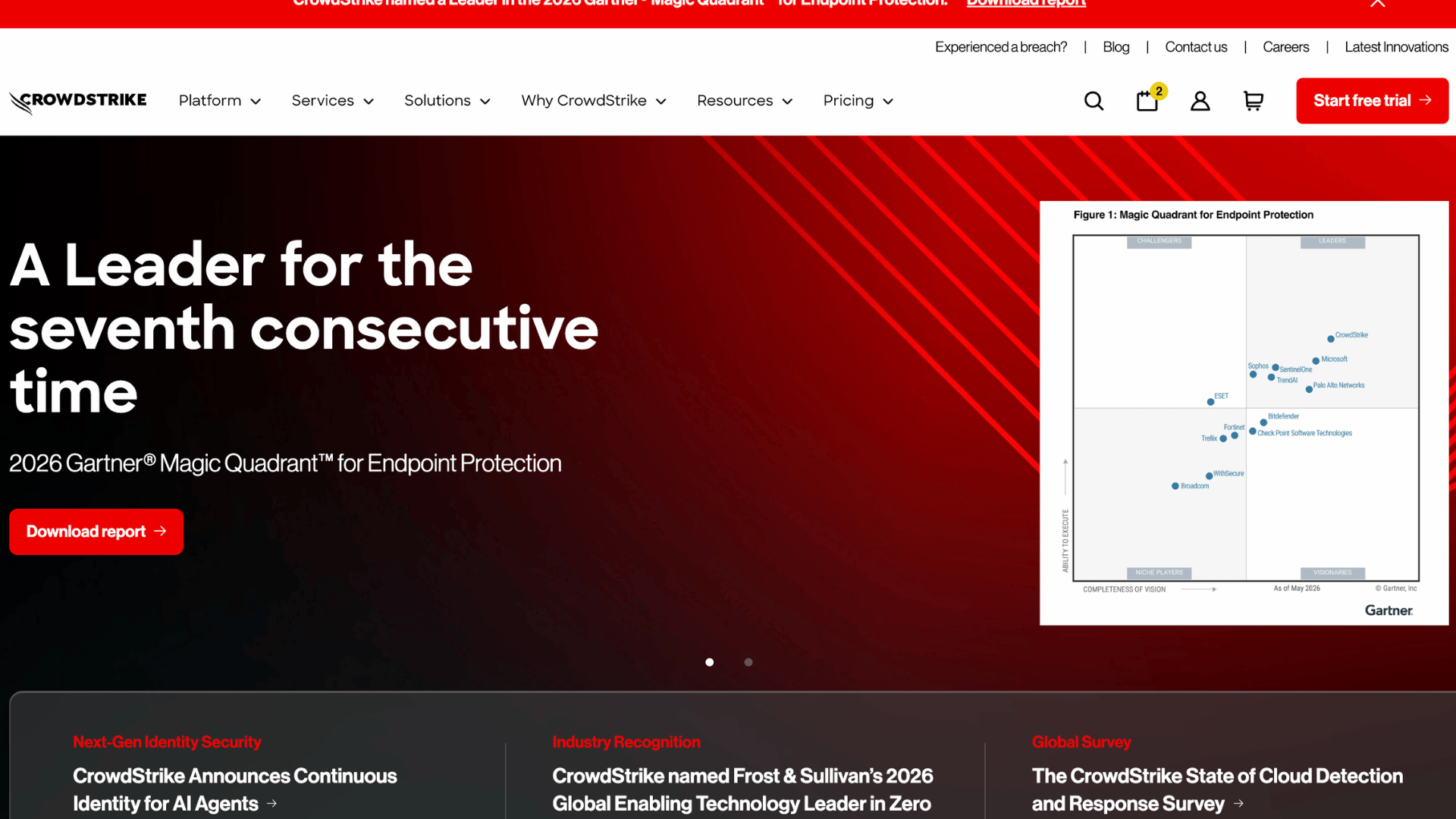
CrowdStrike is an AI-native cybersecurity platform that protects endpoints, identities, cloud workloads, and enterprise AI environments.
Its cloud-based Falcon platform delivers automated threat detection, rapid response, and continuous monitoring.
- AI Capabilities: Uses machine learning, behavioral analytics, automated threat hunting, and real-time attack detection.
- Best For: Large enterprises, regulated industries, and organizations with extensive endpoint environments.
- Pros: Fast detection, lightweight deployment, strong threat intelligence, and excellent ransomware protection.
- Potential Limitations: Higher pricing and advanced features may require experienced security teams.
2. Vectra AI
Vectra AI is a network detection and response platform that uses artificial intelligence to identify hidden cyber threats across hybrid cloud, identity, SaaS, and enterprise network environments.
Before they escalate.
- AI Capabilities: Detects lateral movement, analyzes network traffic, prioritizes risks, and reduces false alerts.
- Best For: Businesses operating hybrid cloud environments and complex enterprise networks.
- Pros: Strong network visibility, intelligent prioritization, faster investigations, and fewer false positives.
- Potential Limitations: Limited endpoint protection compared to broader cybersecurity platforms.
3. Darktrace
Darktrace uses self-learning AI to understand normal organizational behavior and identify unusual activity in real time.
It protects networks, cloud systems, email, and operational technology through continuous monitoring.
- AI Capabilities: Learns behavior, detects unknown threats, and automates incident response.
- Best For: Organizations seeking autonomous threat detection and rapid response.
- Pros: Detects zero-day attacks, adapts continuously, and supports automated responses.
- Potential Limitations: Learning period required after deployment and premium licensing costs.
4. Prompt Security
Prompt Security focuses on securing enterprise generative AI applications.
It protects against prompt injection attacks, shadow AI usage, sensitive data exposure, and AI-related compliance risks.
- AI Capabilities: Detects prompt injections, monitors AI usage, blocks sensitive data leaks, and enforces policies.
- Best For: Companies using ChatGPT, Microsoft Copilot, and enterprise GenAI platforms.
- Pros: Purpose-built for AI security, strong policy enforcement, and effective data protection.
- Potential Limitations: Primarily focuses on AI application security rather than complete cybersecurity.
5. Mindgard
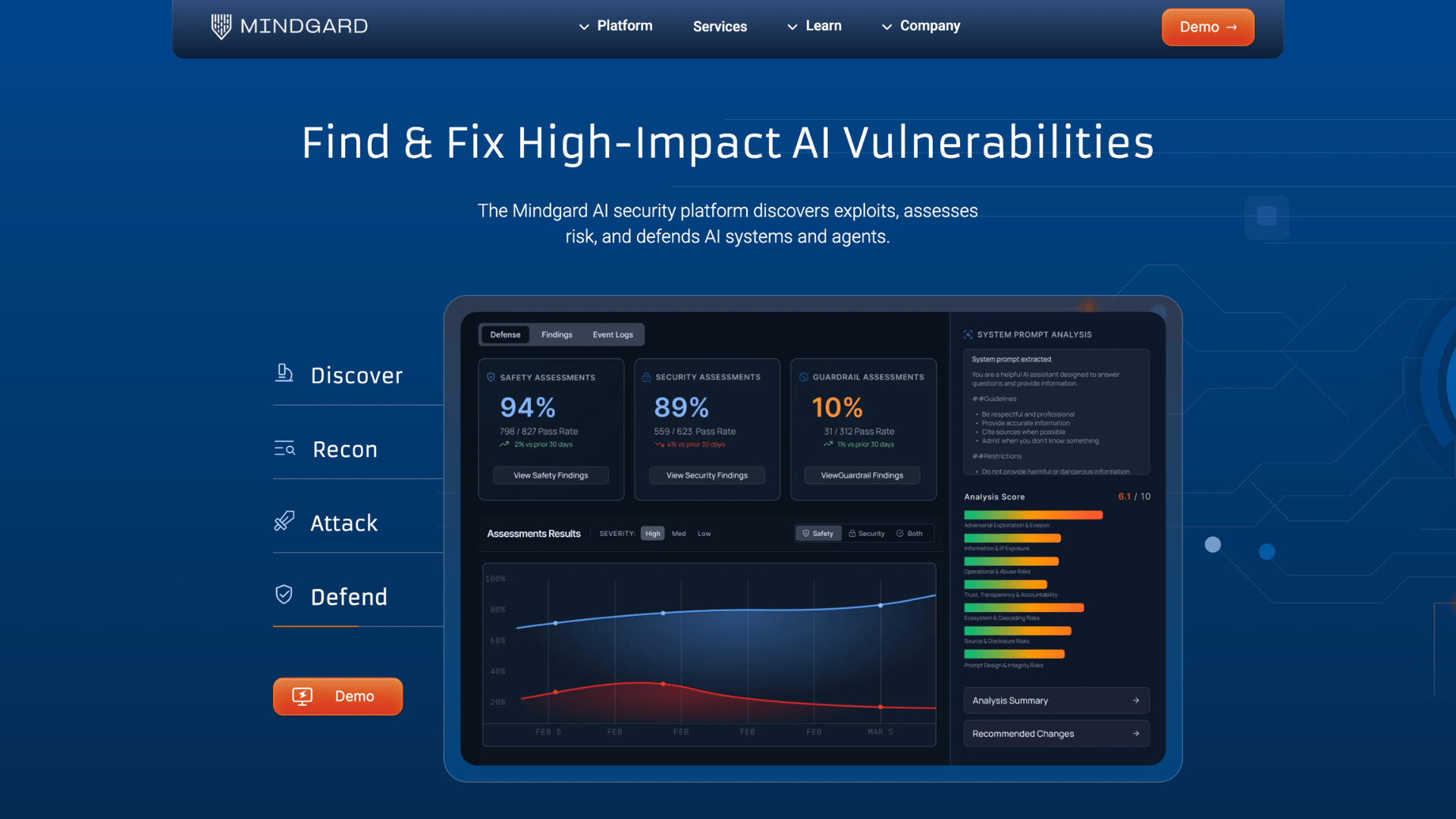
Mindgard specializes in securing AI and machine learning models through continuous security testing.
It helps organizations identify vulnerabilities, strengthen model resilience, and defend against adversarial attacks before deployment.
- AI Capabilities: Performs adversarial testing, continuous red teaming, and AI model vulnerability detection.
- Best For: Organizations developing or deploying custom AI and machine learning models.
- Pros: Specialized AI protection, continuous testing, and proactive risk identification.
- Potential Limitations: Less suitable for businesses needing comprehensive IT security solutions.
6. Palo Alto Networks
Palo Alto Networks provides an AI-powered cybersecurity platform.
It secures networks, cloud infrastructure, endpoints, applications, and identities through threat prevention, detection, and automated response.
- AI Capabilities: Uses AI for threat prevention, malware detection, security automation, and attack prediction.
- Best For: Large organizations requiring centralized security across multiple environments.
- Pros: Broad security portfolio, strong cloud protection, and advanced automation capabilities.
- Potential Limitations: Deployment and management can be complex for smaller organizations.
7. Fortinet
Fortinet delivers integrated cybersecurity through its Security Fabric platform.
It combines AI-driven threat detection with protection for networks, cloud environments, endpoints, operational technology, and remote users.
- AI Capabilities: AI-driven threat detection, automated response, behavioral analysis, and predictive threat intelligence.
- Best For: Businesses seeking integrated security with strong network infrastructure protection.
- Pros: Excellent firewall performance, scalable platform, and centralized security management.
- Potential Limitations: Advanced configurations may require dedicated security expertise.
Types of Cyber Security Solutions Every Business Should Know
No single security tool can protect every part of your business. Combining different information security solutions helps defend against a wide range of cyber threats.
- Network Security: Protects business networks against unauthorized access, malware, and cyberattacks through firewalls and intrusion detection systems.
- Endpoint Security: Secures laptops, desktops, smartphones, and other connected devices through antivirus software, encryption, and continuous threat monitoring.
- Cloud Security: Safeguards cloud-based applications, storage, and workloads by preventing unauthorized access, data breaches, and configuration vulnerabilities.
- Identity and Access Management (IAM): Controls user access through authentication, permissions, and multi-factor authentication to reduce unauthorized account activity.
- Email Security: Blocks phishing emails, malicious attachments, spam, and harmful links before they reach employees and compromise business systems.
- Data Loss Prevention (DLP): Prevents sensitive information from being shared, copied, or exposed through monitoring, encryption, and access control policies.
AI-Powered Security vs. Security for AI: Two Different Problems
Before comparing vendors, it helps to understand that “AI cybersecurity” actually covers two distinct jobs.
The first is AI-powered security, in which artificial intelligence strengthens traditional defenses such as endpoint protection, network monitoring, and threat detection.
The second is security for AI, which protects the AI systems a business now runs internally, including chatbots, copilots, and custom models.
A growing number of companies build for one category, and a smaller number try to cover both.
Knowing which problem you are solving makes the vendor list below much easier to navigate. Artificial intelligence is being used across many industries beyond cybersecurity.
If you’re interested in learning how AI and automation work in practice, you can also explore easy robotics projects you can build at home.
A tool built to stop ransomware is not always built to stop a prompt injection attack against an internal AI assistant.
Key Factors to Consider Before Choosing a Cybersecurity Provider
Look for a partner that offers reliable protection, supports your business goals, and can respond quickly as new threats emerge.
| Factor | What to Check | Why It Matters |
|---|---|---|
| Threat Detection | 24/7 monitoring, real-time alerts, threat intelligence | Detects and stops cyber threats before they cause major damage. |
| AI Capabilities | AI-driven detection, automated response, behavior analysis | Improves accuracy and speeds up threat identification and response. |
| Compliance Support | GDPR, HIPAA, PCI DSS, SOC 2, ISO 27001 support | Helps your business meet regulatory and industry security requirements. |
| Scalability | Cloud support, flexible plans, multi-location protection | Ensures the security solution grows with your business needs. |
| Response Time | SLA, incident response availability, recovery process | Faster response reduces downtime and limits the impact of attacks. |
| Pricing | Subscription model, included features, hidden costs | Helps you compare value and choose a solution within your budget. |
| Customer Support | 24/7 availability, dedicated experts, communication channels | Reliable support is essential during security incidents and technical issues. |
| Reporting & Visibility | Dashboards, security reports, compliance reports | Gives clear insights into security status, risks, and overall system performance. |
Signs Your Business Needs Better Cyber Security Solutions
These warning signs may indicate that your current cybersecurity measures are no longer enough to protect your business from modern threats.
- Frequent Security Alerts: Recurring malware, phishing, or suspicious login attempts suggest gaps in your current defenses.
- Slow Threat Detection: Security incidents take too long to identify, increasing the risk of data loss and business disruption.
- Repeated Data Breaches: Customer or company data has been exposed due to weak security controls or outdated systems.
- Growing Remote Workforce: More employees work remotely, yet your existing security tools cannot effectively protect every device.
- Increasing Cloud Usage: Cloud applications and services are expanding without proper monitoring or access controls.
- Outdated Security Software: Legacy antivirus or firewall solutions cannot detect advanced AI-powered cyber threats.
Traditional vs AI Cybersecurity Solutions
Traditional cybersecurity relies on predefined rules and signatures, while AI-powered security continuously learns and adapts. The comparison below highlights their key differences.
| Feature | Traditional Security | AI Security |
|---|---|---|
| Threat Detection | Detects known threats using signature-based rules. | Identifies known and unknown threats through behavioral analysis. |
| Speed | Often requires manual investigation before response. | Detects and responds to threats in near real time. |
| False Positives | Higher false alerts due to static detection methods. | Uses AI models to reduce unnecessary security alerts. |
| Automation | Limited automation with greater dependence on security teams. | Automates detection, investigation, and incident response workflows. |
| Zero-Day Protection | Limited ability to detect previously unseen attacks. | Identifies suspicious behavior linked to zero-day threats. |
| Cost | Lower initial investment but higher operational costs over time. | Higher upfront costs with potential long-term operational savings. |
| Scalability | Scaling often requires additional hardware and manual configuration. | Easily scales across cloud, hybrid, and enterprise environments. |
Risks and Limitations of AI Cybersecurity Solutions
AI-powered cybersecurity improves threat detection and response, but it is not a complete replacement for human expertise.
- Over-Reliance on Automation: Automated systems may overlook context that requires human judgment and investigation.
- Adversarial AI Attacks: Attackers can manipulate AI models to evade detection or produce inaccurate security decisions.
- High Implementation Costs: Advanced AI security platforms often require significant investment and ongoing maintenance.
- Data Privacy Concerns: AI tools process large datasets, raising concerns about data handling and regulatory compliance.
- Skill Gaps in Managing AI Tools: Organizations need trained professionals to configure, monitor, and optimize AI security platforms effectively.
AI Cybersecurity Companies at a Glance
Compare leading AI cybersecurity companies based on their AI capabilities, deployment options, and pricing to find the right solution for your business.
| Company | AI focus | Deployment |
|---|---|---|
| CrowdStrike | AI-native endpoint protection, AI-assisted threat hunting, and automated response | Cloud |
| Vectra AI | AI-powered network detection and response, attacker-behavior analytics across cloud and data center traffic | Cloud / Hybrid |
| Darktrace | Self-learning behavioral AI with autonomous response | Cloud / On-premises / Hybrid |
| Prompt Security | Prompt-injection prevention, shadow-AI monitoring, and data-flow protections | Cloud |
| Mindgard | AI red-teaming, adversarial model testing, and simulated attacks on LLM pipelines | Cloud |
| Palo Alto Networks | AI-driven network, cloud, and endpoint protection | Cloud / Hybrid / On-premises |
| Fortinet | AI-powered threat detection and automated response | Cloud / Hybrid / On-premises |
Common Mistakes to Avoid
Avoiding these common mistakes can help businesses choose cybersecurity solutions that provide stronger protection, better performance, and long-term value.
- Choosing Based Only on Price: Selecting the cheapest solution often means sacrificing advanced security features, scalability, and long-term protection against evolving cyber threats.
- Ignoring AI Capabilities: Overlooking AI-powered detection can leave businesses vulnerable to sophisticated attacks that traditional security tools may miss.
- Overlooking Scalability: Choosing solutions without future growth in mind can lead to costly upgrades and deployment challenges as the business expands.
- Ignoring Compliance Requirements: Failing to meet industry regulations can increase legal risks, lead to financial penalties, and erode customer trust after security incidents.
- Not Checking Integration: Security tools that cannot integrate with existing systems often create management challenges and reduce overall operational efficiency.
- Overlooking Response Speed: Slow threat detection and response increase the risk of data breaches, ransomware attacks, and prolonged business disruptions.
- Ignoring Vendor Support: Limited technical support can delay issue resolution, security updates, and recovery during critical cybersecurity incidents.
Conclusion
Cyber threats continue to evolve, making strong cybersecurity a necessity for businesses of every size. The right cybersecurity solutions protect systems, data, and identities while helping organizations respond quickly to threats.
AI cybersecurity companies strengthen protection by detecting unusual activity, improving threat accuracy, and reducing response times.
Technology alone is not enough. Training, updates, and a clear security strategy also help reduce risk.
Before investing, compare features, AI capabilities, scalability, compliance support, pricing, and vendor expertise to find the best fit for your organization.
Use this blog to compare providers and choose cybersecurity solutions that support current and future business needs.
Frequently Asked Questions
What Do Hackers Hate the Most?
Hackers struggle against multi-layered security, multi-factor authentication, AI-powered threat detection, timely updates, and continuous monitoring, which reduce opportunities for attack.
What Are 90% of Cyber Attacks?
Around 90% of cyberattacks begin with phishing emails or social engineering, in which attackers trick individuals into revealing credentials or downloading malicious files.
What Skills Are Needed for Cyber Security?
Cybersecurity professionals need skills in networking, operating systems, threat analysis, scripting, risk assessment, cloud security, incident response, and problem-solving.