Many companies say they have moved to the cloud, but their teams still fight slow systems, rising bills, security gaps, and scattered data.
That is where the real problem starts. Using cloud tools is not the same as becoming a cloud-ready business.
A company can shift servers, apps, or files online and still carry the same old bottlenecks into a newer environment.
Cloud transformation solutions are built to close that gap. They help businesses rethink infrastructure, applications, data, security, and daily operations so the cloud actually supports growth.
But the right path depends on the current setup, business goals, and provider choice. This guide breaks down what matters before making that move.
What are Cloud Transformation Solutions?
Cloud transformation solutions are services and frameworks that help businesses move from traditional IT environments to modern, cloud-native architectures.
The scope goes well beyond migrating servers or databases to a hosted platform.
A complete cloud transformation solution can include infrastructure modernization, application refactoring, data platform redesign, DevOps implementation, security and compliance automation, and workforce training.
Every component gets evaluated against a cloud-first operating model, not just relocated to a new address.
Cloud Migration vs. Cloud Transformation
| Cloud migration | Cloud transformation |
|---|---|
| Moves workloads from on-premises to the cloud | Redesigns how the business runs on the cloud |
| Focused on lift-and-shift | Focused on modernization and re-architecture |
| Primarily a technical project | A strategic and operational change |
| One-time event | Ongoing optimization and maturity |
Many organizations that have “moved to the cloud” still struggle with the same problems they had on-premises, because they migrated workloads without transforming the systems around them.
The distinction matters before signing any contract.
Key Services Offered by Cloud Transformation Companies
Cloud transformation companies do more than move workloads to the cloud.
The right provider integrates strategy, migration, modernization, security, cost control, and ongoing support so that cloud adoption creates real business value rather than another complex IT setup.
- Readiness and roadmap: Reviews current systems, risks, costs, and maturity, then builds a phased cloud plan tied to business goals and workload priorities.
- Migration and modernization: Moves workloads to public, private, hybrid, or multi-cloud environments while updating legacy apps through refactoring, containers, APIs, or serverless architecture.
- Security, data, and automation: Strengthen identity, encryption, monitoring, compliance, data pipelines, analytics platforms, CI CD workflows, and infrastructure as code for safer cloud operations.
- FinOps and managed support: Track cloud spending, prevent waste, manage incidents, patch systems, optimize performance, and support the environment after launch.
Understanding how cloud integration fits into this picture helps too. The top cloud integration platforms are tools that cloud transformation companies use to connect systems during and after migration.
Benefits of Cloud Transformation for Modern Businesses
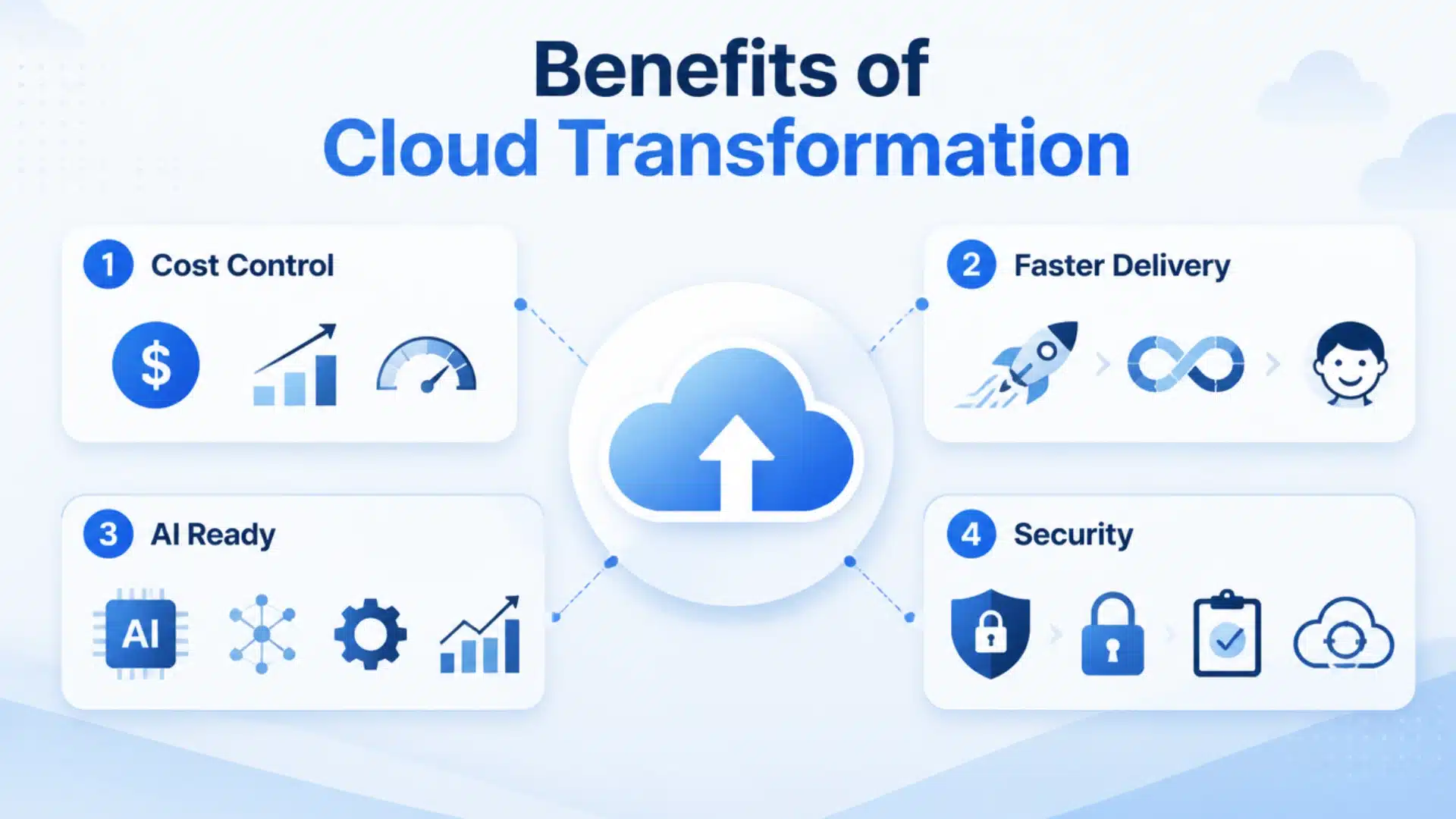
Cloud transformation solutions give businesses more than a modern IT setup. They help reduce waste, speed up delivery, improve security, support AI, and make systems easier to scale.
1. Cost Control and Scalability
Cloud environments replace large hardware spending with consumption-based pricing, which helps businesses pay for the resources they actually use.
According to a 2025 cloud computing report by Softjourn, cloud is expected to account for over 45% of enterprise IT spending by 2026.
Auto scaling also reduces overprovisioning by matching capacity with real demand instead of fixed peak estimates.
2. Faster Delivery and Better Customer Experience
Legacy systems often slow product releases because every update needs long testing across tightly connected environments.
Cloud native systems, DevOps pipelines, and automated testing help teams release updates faster and respond to customer needs with less delay.
For businesses where speed affects revenue, cloud transformation solutions create visible value by improving delivery cycles, service quality, and the overall customer experience.
3. AI, Data, and Automation Readiness
Modern AI and automation depend on flexible infrastructure, clean data access, and scalable computing power.
Gartner projects that by 2029, 50% of cloud compute resources will support AI and machine learning workloads, compared to under 10% today.
Businesses without a cloud native base may struggle to run AI tools, automate workflows, or use data at the speed competitors already can.
4. Security, Compliance, and Resilience
Modern cloud platforms include security controls that many in-house systems cannot match at the same cost.
Strong cloud transformation solutions build identity management, encryption, monitoring, compliance support, and disaster recovery into the environment from the beginning.
When security is part of the design, businesses can reduce risk, improve recovery, protect data, and maintain stronger operations during outages or unexpected disruptions.
When evaluating how well a provider handles data security across cloud environments, it also helps to understand how cloud environments handle encrypted communication for business-critical data.
Encryption in transit and at rest should be non-negotiable requirements when evaluating any provider.
What a Cloud Transformation Roadmap Looks Like in Practice
A practical cloud transformation roadmap starts with understanding the current IT environment before making any major move.
Teams first review applications, data flows, dependencies, costs, security risks, and business priorities to see what is ready for the cloud and what needs improvement.
After that, the company defines its target architecture, selects the appropriate cloud platform, establishes governance rules, and develops a phased plan.
A low-risk workload is usually moved first so the team can test the process and fix issues early.
Then applications are modernized in stages through replatforming, refactoring, containers, or serverless methods.
Data platforms are also redesigned to support reporting, automation, and future AI needs. DevOps practices, CI CD pipelines, and infrastructure as code help speed up daily work.
The future of cloud computing also demands that roadmaps account for AI infrastructure and sovereign data requirements from the start.
Sovereign cloud planning, which governs where data physically lives to meet regional compliance rules, is no longer an afterthought for global businesses.
Top Companies That Provide Cloud Transformation
Knowing what cloud transformation involves is useful. Knowing which companies actually deliver it is what moves the decision forward.
Here is a breakdown by scale so you can match the right type of provider to your situation.
1. Accenture

Accenture is one of the most recognized companies for cloud transformation solutions, especially for large organizations with complex systems.
Its services include cloud strategy, large-scale migration, change management, security transformation, and managed cloud support.
Accenture is a strong fit for enterprises that need long-term planning, strict compliance handling, and support across multiple departments, vendors, and cloud environments.
2. Deloitte Consulting

Deloitte Consulting combines business strategy with technical cloud expertise, making it a strong option for companies modernizing both operations and infrastructure.
Its cloud services focus on AI, automation, cloud engineering, hybrid cloud, and multi-cloud environments.
Deloitte works well for organizations that still rely on legacy systems but want to move toward faster, more flexible, and more modern cloud workloads
3. KPMG
KPMG is a practical choice for businesses that want cloud transformation with strong governance and compliance planning.
Its cloud services help companies reduce operational costs, improve scalability, and build secure digital systems.
KPMG is especially useful for mid-to-large companies that need a cloud strategy connected with business goals, risk management, financial planning, and long-term operational improvements.
4. Devoteam
Devoteam is known for its work in Google Cloud transformations and modern data platforms.
Its approach focuses on collaboration, practical implementation, and knowledge transfer, which helps client teams manage cloud platforms with more confidence.
Devoteam is a good fit for companies that want hands-on cloud support while also building internal skills instead of depending fully on outside consultants.
5. Wipro

Wipro provides cloud transformation support through its FullStride Cloud Services framework, which gives businesses a structured path from assessment to execution.
Its services include cloud consulting, migration, application modernization, DevSecOps, SRE practices, and legacy system re-architecture.
Wipro is helpful for growing businesses that need clear direction, technical support, and a step-by-step approach to early cloud decisions.
How to Choose a Cloud Transformation Partner?
Choosing the right cloud transformation partner is not only about technical skills.
A strong provider should understand your industry, reduce migration risk, and support security from the start. The goal is to find a partner that connects cloud strategy with real business outcomes.
- Check industry and platform experience: Look for sector-specific case studies, AWS, Azure, or Google Cloud certifications, and proof of handling similar compliance needs.
- Review full-service coverage: Choose a partner that manages strategy, migration, modernization, security, FinOps, and support without passing critical work to multiple vendors.
- Ask about long-term support: Confirm readiness assessments, post-migration monitoring, cost optimization, training, and change management before signing the agreement.
- Ask security-specific questions: Find out how the provider handles identity and access management, data encryption standards, incident response timelines, and compliance auditing. A provider that cannot answer these specifically is a risk worth noting before the project begins.
Common Challenges and How to Address Them
Cloud transformation can improve speed, security, and scalability, but the process is not always simple.
Legacy systems, data risks, cost overruns, skill gaps, and compliance rules can slow progress if they are not planned for early.
| Challenge | Practical Solution |
|---|---|
| Legacy system complexity | Start with application mapping and move simple workloads first. |
| Data migration risk | Use phased migration with backup, testing, and validation before cutover. |
| Security gaps | Add access control, encryption, and monitoring before moving workloads. |
| Cloud cost overruns | Use FinOps practices like tagging, budget alerts, and rightsizing. |
| Team resistance | Involve operations teams early and provide structured training. |
| Vendor lock-in | Use open standards, containers, and API based design from day one. |
| Compliance and data residency | Choose providers with proven experience in your regulatory environment. |
Cloud Transformation Trends to Watch in the Future
As of now, cloud transformation is becoming less about migration and more about building faster, safer, and smarter business systems.
Companies now need cloud environments that can support AI tools, control spending, protect data, and meet regional compliance rules at the same time.
This means cloud transformation solutions must balance speed, security, cost control, and long-term flexibility instead of focusing only on moving workloads.
Key trends to watch:
- AI-ready cloud platforms with GPU access and MLOps support
- FinOps maturity for stronger cloud cost governance
- Zero trust security as a baseline requirement, replacing perimeter-based security models that cloud adoption makes obsolete
- Sovereign cloud and data residency planning for regulated industries
- Multi-cloud resilience strategies that prevent single-vendor dependency and improve uptime guarantees
Conclusion
Cloud transformation solutions should feel less like a technical upgrade and more like a smarter way to run the business.
The best results come when leaders look beyond quick fixes and think about how every decision will affect teams, customers, budgets, and future innovation.
A strong cloud journey gives the company room to adapt without losing control or clarity. It also helps decision makers avoid expensive shortcuts that only look simple at the beginning.
Before choosing any provider, take time to define what success should look like for the business, not just the IT department.
The cloud can become a real advantage when it supports practical goals, smoother work, and confident growth.
What do you think about cloud transformation? Share your thoughts or questions in the comments below.
Frequently Asked Questions
Are Cloud Transformation Solutions Useful for Small Businesses?
Yes. Small businesses can use cloud transformation solutions to cut hardware costs, strengthen backups, support remote teams, and scale without heavy upfront investment.
What is the Difference Between Cloud Transformation and Digital Transformation?
Digital transformation modernizes the whole business through technology, while cloud transformation focuses on upgrading IT infrastructure and applications to support broader digital goals securely and efficiently.
How Long Does Cloud Transformation Take?
Cloud transformation can take 3-6 months for focused projects, while complex enterprise programs may need one to three years, depending on readiness scope.