Warehouse teams are under more pressure than ever. Orders move faster, customers expect quicker delivery, and every delay can cut into profit.
Old processes may still get the job done, but they often leave businesses guessing where stock is, why orders slow down, or how much time is being lost each day.
That is why smart warehousing has become such a strong talking point in modern logistics.
It promises more control, better visibility, and a cleaner way to manage growing demand without adding more confusion to daily operations.
In this guide, we will look at why this shift matters, what makes it valuable, and how businesses can use it to build a warehouse that feels ready for the future now.
What is Smart Warehousing?
Smart warehousing is the use of connected technology to make warehouse operations faster, more accurate, and easier to manage.
Instead of relying only on manual tracking, paper-based picking, or delayed reports, smart warehouses use automation, sensors, software, and robotics to improve how inventory moves through the facility.
The term “warehouse digitization” grew alongside e-commerce, but real adoption accelerated after the supply chain disruptions of 2020 and 2021.
Companies running just-in-time logistics found they could not respond fast enough when something went wrong. Smart warehousing moved from a future upgrade to an operational priority.
Businesses need better visibility into stock, labor, storage, and fulfillment without adding more complexity to daily operations.
According to Fortune Business Insights, the smart warehousing market is projected to grow from USD 32.68 billion in 2026 to USD 99.71 billion by 2034.
Key Technologies in Smart Warehousing Systems
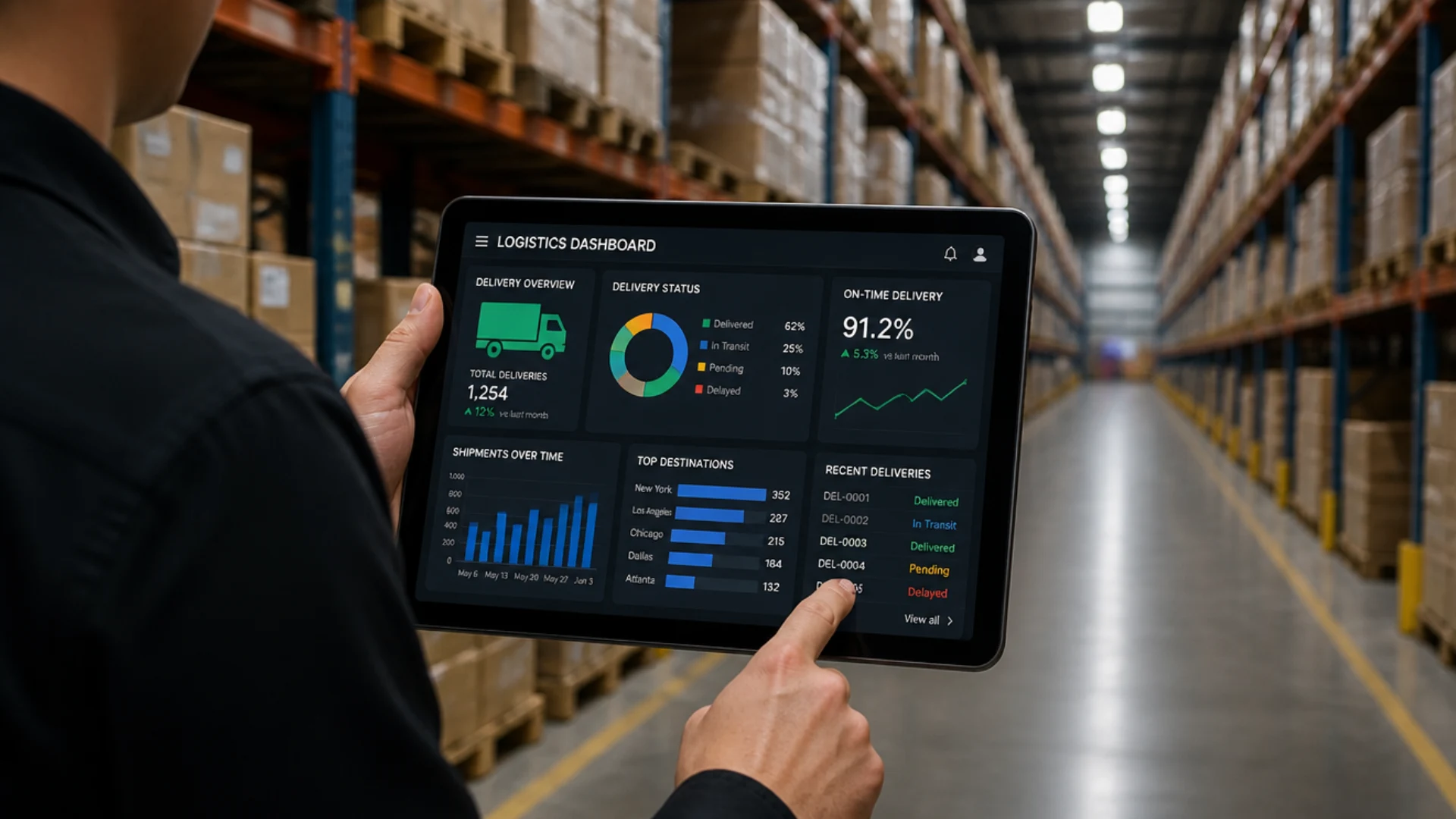
No single piece of technology makes a warehouse “smart.” It is the combination of these systems, and how well they are integrated, that determines how well the facility actually performs.
1. Warehouse Management System (WMS)
A WMS is the operational core of any smart warehouse. It manages inventory positions, order workflows, picking and packing sequences, and shipping coordination from a single platform.
When a new order arrives, the WMS assigns it to a picker, selects the optimal path, and updates inventory the moment the item is pulled.
Some facilities also layer a Warehouse Execution System (WES) on top of the WMS to coordinate real-time task prioritization for both robotic and human workers.
2. IoT Sensors and RFID
IoT devices give warehouses real-time visibility at the item, pallet, and zone levels.
RFID tags attached to products or equipment transmit location data continuously, unlike barcodes that require a direct line of sight and a manual scan.
Sensors also monitor environmental conditions such as temperature and humidity for sensitive goods.
This stream of data feeds the WMS and enables decisions based on what is actually happening, not what was logged an hour ago.
3. Robotics, AMRs, and AGVs
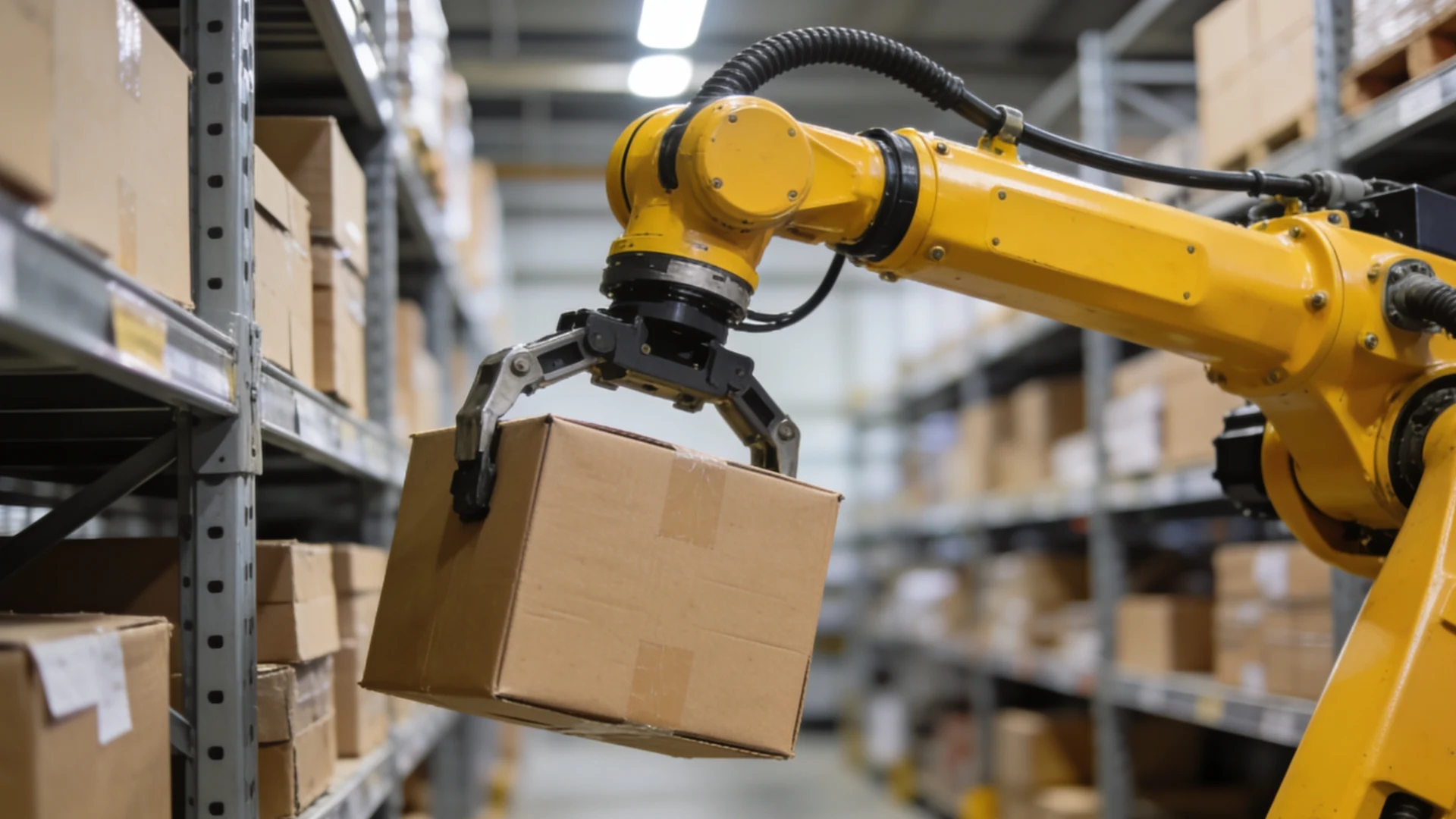
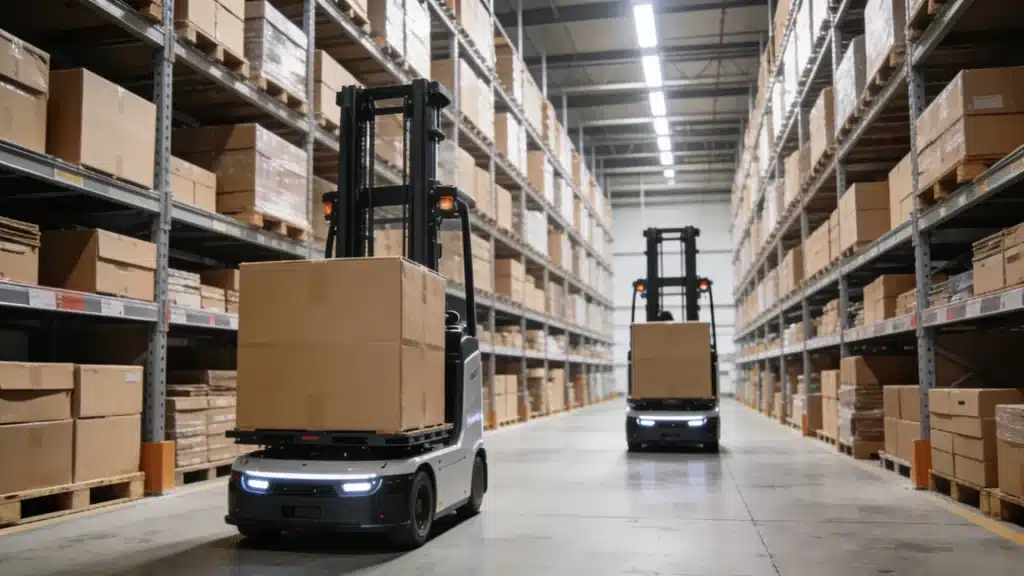
Autonomous Mobile Robots (AMRs) navigate warehouse floors independently, moving bins or pallets between storage locations and picking stations.
Automated Guided Vehicles (AGVs) follow fixed paths for predictable, high-volume movement tasks.
Both reduce the distance workers travel, cut fulfillment time, and allow human staff to focus on work that requires judgment.
Warehouses using robotics typically see operational efficiency gains of around 30% within their first year of deployment, according to SellersCommerce’s March 2026 warehouse automation analysis.
4. AI and Machine Learning
AI applies predictive logic to warehouse operations. Machine learning models analyze historical order data and real-time demand signals to determine optimal inventory placement.
Fast-moving SKUs are positioned closer to picking stations before a surge arrives, not after.
AI also handles picking route optimization, demand forecasting, and predictive maintenance scheduling. Scalar Spaces reports that AI-driven orchestration can reduce warehouse processing times by up to 60%.
If you are evaluating the software layer that ties these systems together, this breakdown of workflow automation tools covers the integration options most relevant to operations teams.
5. Automated Storage and Retrieval Systems (AS/RS)
AS/RS technology replaces wide, low-density floor storage with vertical, high-density storage structures served by automated cranes or carousels.
Vertical lift modules and horizontal carousels can recover up to 90% more usable floor space compared to conventional racking.
A picker requests an item, and the system delivers the correct bin to the workstation rather than the worker walking to find it.
6. Computer Vision and Cobots
Computer vision systems inspect items during receiving and packing to catch defects, verify quantities, and flag labeling errors without requiring a human to check each unit manually.
Collaborative robots (cobots) work directly alongside warehouse staff at picking or packing stations, handling repetitive physical tasks while the worker manages exceptions and quality checks.
Cobots are designed to be safe in shared spaces, which makes them practical even in mixed-use facilities without dedicated automation zones.
7. Digital Twins
A digital twin is a virtual replica of the warehouse, built from real operational data.
Before making physical changes to the layout, adding new robotics, or modifying picking zone configurations, operators can test those changes in the simulation.
If a new storage configuration would create a bottleneck at the receiving dock, the twin reveals it before any racking is moved.
For a deeper look at how physical storage infrastructure supports these automation systems, see this guide on warehouse storage infrastructure for modern logistics.
Benefits of Smart Warehousing for Modern Operations
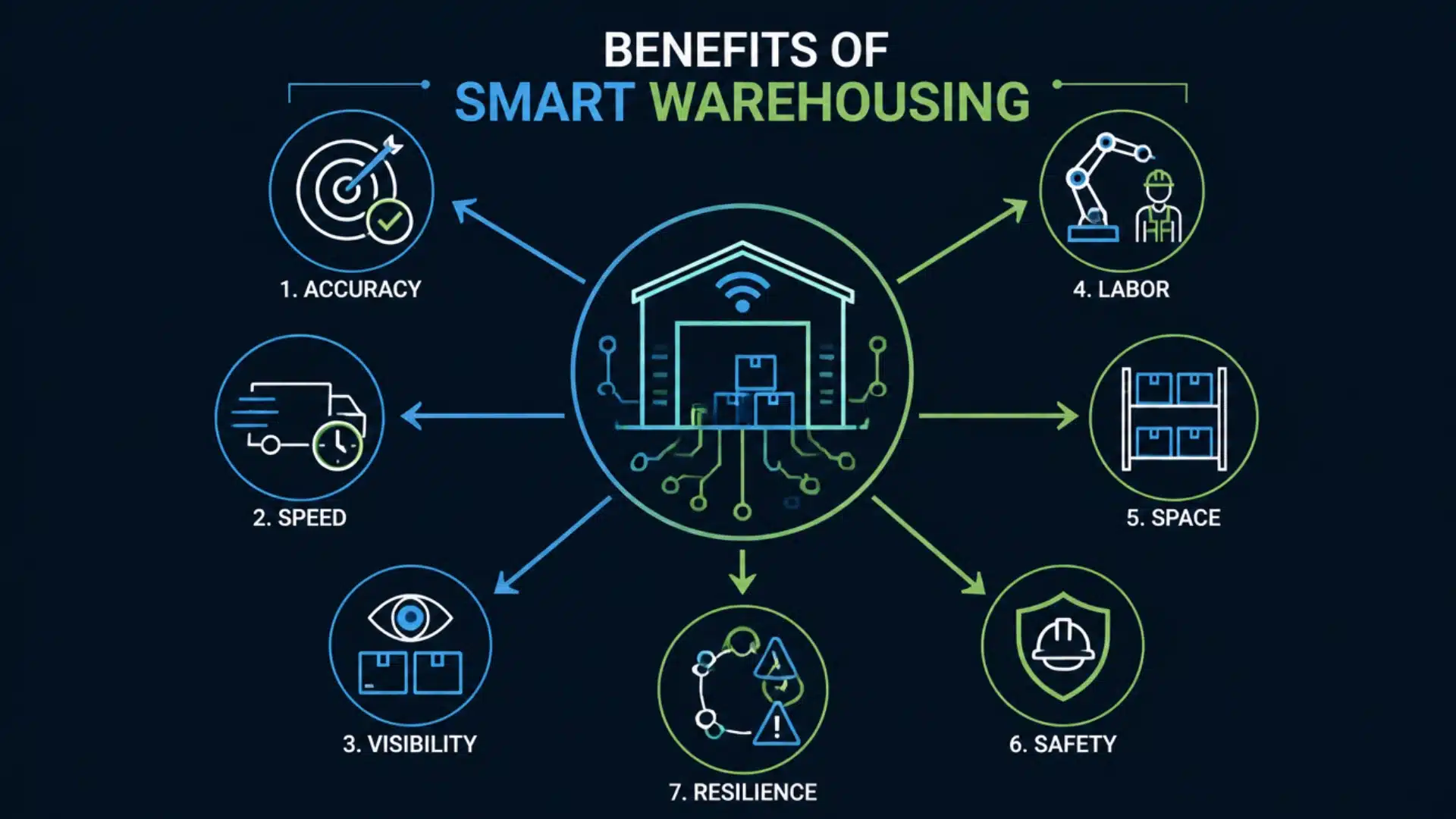
The business case for smart warehousing covers both operational and strategic outcomes. These are measurable improvements that compound as systems mature.
- Better order accuracy: Automation and real-time tracking reduce picking, packing, and inventory mistakes. Amazon, for example, uses robots to locate and move items so employees can stay at packing stations and focus on quality checks rather than navigation.
- Faster fulfillment: WMS-driven workflows, robotics, and optimized picking routes help orders move from receiving to shipping with fewer delays.
- Real-time inventory visibility: Teams can track stock levels, item locations, and movement at any moment rather than waiting for scheduled cycle counts.
- Lower labor pressure: Automation handles repetitive work, allowing staff to focus on supervision, exceptions, and quality checks.
- Better space utilization: AS/RS systems, smart racking, and>
Dimension Traditional warehouse Smart warehouse Inventory tracking Periodic cycle counts, manual entry Real-time RFID and IoT sensor updates Order picking Paper-based or basic scan lists WMS-optimized routes, robotics-assisted Decision-making Reactive, based on historical reports Predictive, based on live data and AI analysis Labor model High headcount for volume Smaller teams supported by automation Storage layout Fixed floor-level racking Vertical AS/RS, dynamically slotted Error rate Higher, driven by manual handling Lower, reduced through automated verification Visibility Siloed, updated on delay Centralized, updated continuously The comparison matters most when evaluating whether a current setup can scale.
A traditional warehouse that works well at 500 orders a day often starts to break down at 2,000, not because the team is performing poorly, but because the information infrastructure cannot keep pace.
How to Implement Smart Warehousing?
Smart warehousing works best when implementation starts small, proves value, and expands gradually. Focus first on the biggest operational gaps before investing in advanced automation.
- Audit current inefficiencies: Review fulfillment speed, inventory errors, labor costs, and manual tasks to identify where technology can create the fastest improvement.
- Choose the right starting point: Select the highest-impact tool first, such as a WMS for control or RFID for better inventory accuracy.
- Use modular solutions: Start with scalable systems that can grow over time instead of committing to a full robotics rollout immediately.
- Connect existing platforms: Make sure new warehouse tools integrate cleanly with ERP, ecommerce, shipping, and legacy systems. Choosing the right data automation software at this stage prevents siloed data from undermining the entire deployment.
- Train the workforce early: Prepare staff before launch so they can manage systems, handle exceptions, and use warehouse data confidently.
- Track KPIs after launch: Measure order accuracy, pick time, labor cost, and inventory visibility to refine the system over time.
Smart Warehousing Readiness Checklist

Before committing to a technology vendor, use this checklist to confirm your operation is ready for the transition.
- The current inventory accuracy rate is measured and documented
- Order error rate and return rate are tracked by SKU
- The existing WMS or ERP system is identified (or confirmed absent)
- Physical warehouse layout has been mapped, and bottlenecks identified
- A budget range for phased implementation is approved
- Key stakeholders (IT, operations, workforce) are aligned on the project scope
- A vendor evaluation process is in place, including integration requirements
- Success metrics are defined before any technology is purchased
For context on how access control and facility security integrate into smart operational environments, this overview of access control in smart buildings covers the infrastructure considerations worth factoring into your planning.
How to Measure Smart Warehousing ROI Metrics
Smart warehousing ROI starts with clear baseline data. Track key metrics before launch, then review the same numbers after 30, 90, and 180 days.
Metric Why it matters Where to find it Order accuracy rate (%) Errors drive returns and reshipment costs OMS or customer service records Pick time per order (minutes) Baseline for robotics and route optimization gains WMS logs or time studies Labor cost per order shipped Measures whether automation is reducing manual workload Payroll and order volume data Inventory accuracy rate (%) Mismatches cause stockouts, overstock, and fulfillment failures Cycle count variance reports Equipment downtime (hours/month) Tracks whether predictive maintenance is reducing delays Maintenance logs Storage space utilization (%) Measures whether AS/RS or slotting changes improve capacity Warehouse capacity reports Understanding how commercial access control systems work within broader facility security is worth reviewing before finalizing your implementation plan; this breakdown of commercial door access control systems covers the key decision points clearly.
Best Practices for Smart Warehousing
Smart warehousing works best when technology supports a clear operational plan. Before adding advanced systems, improve layout, data flow, equipment reliability, and scalability.
- Optimize the layout first: Map traffic flow, identify bottlenecks, and test layout changes before adding automation or moving warehouse racking.
- Use demand forecasting: Place fast-moving inventory near picking zones before demand rises to reduce travel time and improve order speed.
- Start predictive maintenance early: IoT-connected equipment can detect wear and flag issues before failure. This matters more as automation density increases; a single robotic system going offline can halt an entire fulfillment lane.
- Build for future growth: Choose modular systems that can adjust as order volume, product mix, or warehouse size changes.
- Treat sustainability seriously: Use smart lighting, efficient HVAC, and electric automation to reduce energy costs and support long-term operational goals.
- Protect against cybersecurity risks: Every IoT-connected device, including temperature sensors and RFID readers, is a potential network entry point. Smart warehouse deployments should include a defined cybersecurity strategy from the start, not as an afterthought.
Conclusion
Smart warehousing is no longer a distant upgrade for warehouses that want to stay competitive.
It gives businesses a practical way to handle rising order demand, tighter delivery expectations, and growing operational pressure with more confidence.
The best results come when companies avoid rushing into every new tool at once and instead focus on the areas that affect cost, accuracy, and speed the most.
A clear audit, the right technology, trained teams, and consistent KPI tracking can turn automation from a large expense into a measurable business improvement.
As warehouse needs keep changing, smart systems will help teams stay prepared instead of constantly catching up.
Which smart warehousing tool would you try first? Share your thoughts in the comments.
Frequently Asked Questions
Is Smart Warehousing only for Large Companies?
No. Small and mid-sized businesses can start with WMS, barcode scanning, RFID, dashboards, and layout optimization before moving to robotics.
How Does 5G Improve Smart Warehousing Operations?
5G improves smart warehousing by enabling faster device communication, lower latency, better robot coordination, and more reliable real-time tracking across large warehouse facilities.
How Long Does Smart Warehousing ROI Take?
Smart warehousing ROI can appear within 90 days for accuracy and fulfillment gains, while robotics or AS/RS returns may take 6 to 18 months.