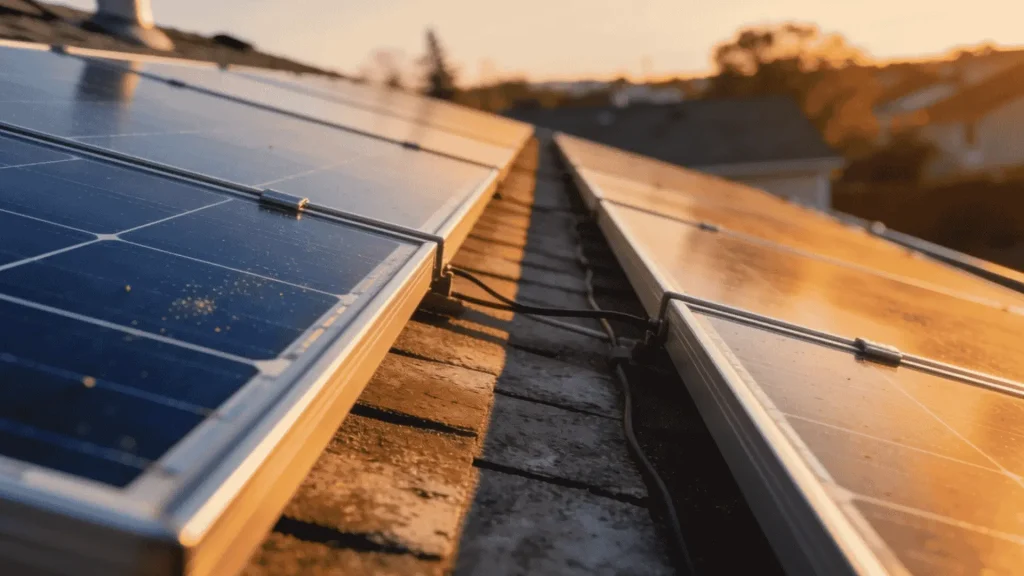
Look at a solar panel, and it seems straightforward. A flat rectangle, mostly glass, sitting on a roof or in a field. What is actually happening inside that panel is anything but simple.
The question of how solar panels are made pulls you into semiconductor physics, high-temperature chemistry, precision slicing, and multi-layer lamination.
Every panel you see is the end result of a process that handles material purity levels measured in parts per billion.
The idea that a thin slice of silicon, sitting still and silent, could turn light directly into electrical current felt almost implausible.
That gap between the simple appearance of a solar panel and the precision behind it is what makes this topic worth explaining carefully.
This guide walks through the full manufacturing sequence, what each component does, and how the technology is changing.
How Do Solar Panels Work Inside the Cell?
A solar panel converts sunlight into direct-current electricity through the photovoltaic effect.
Most panels use silicon because it is a semiconductor, but pure silicon does not conduct electricity well on its own.
Manufacturers improve it by adding trace amounts of other elements, a process called doping. This creates two charged layers: an n-type layer and a p-type layer. The junction between them produces a built-in electric field.
When sunlight hits the cell, photons knock electrons loose from silicon atoms. The electric field pushes those free electrons in one direction, creating a flow of current.
Metal contacts on the cell surface collect that current, and copper wiring carries it out of the panel as DC power.
One silicon solar cell produces about 0.5 to 0.6 volts. A standard residential panel connects 60 to 72 cells in series to reach around 30 to 40 volts total.
This same principle of layered electrical components working together is what drives other clean-energy hardware, including the core electrical components inside electric vehicles.
How are Solar Panels Made, and What are Solar Panels Made Of?
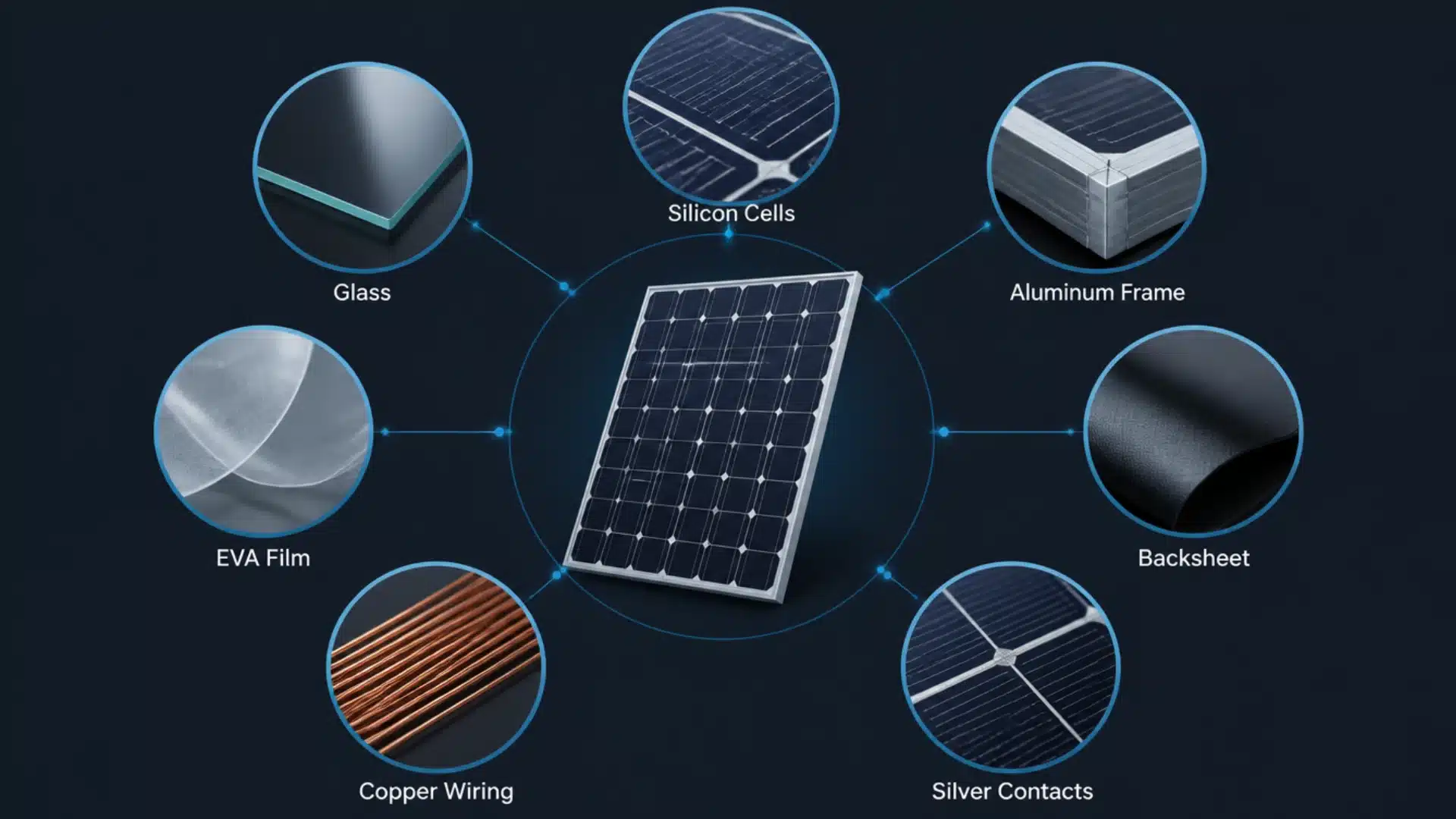
Solar panels are built from six primary materials, each chosen because it performs a job no other component can replace.
By weight, a typical monocrystalline panel is roughly 76% glass, 10% polymer, 8% aluminum, and 5% silicon, with small amounts of copper and silver, plus trace elements such as lead and tin in the solder.
- Glass: Protects the cells while letting sunlight pass through.
- Silicon: Converts sunlight into electricity via the photovoltaic effect.
- Aluminum: Forms the outer frame and supports the panel structure.
- EVA (ethylene-vinyl acetate): Bonds and seals the cell layers during lamination.
- Backsheet or rear glass: Shields the underside from moisture and UV damage.
- Copper: Carries electrical current across the panel.
- Silver: Collects electricity from the cell surfaces via screen-printed contacts.
The most critical material is purified silicon, which must reach solar-grade quality above 99.9999% purity. Tempered glass and EVA film then lock the cells into a moisture-resistant, durable module.
Step-by-Step Solar Panel Manufacturing Process
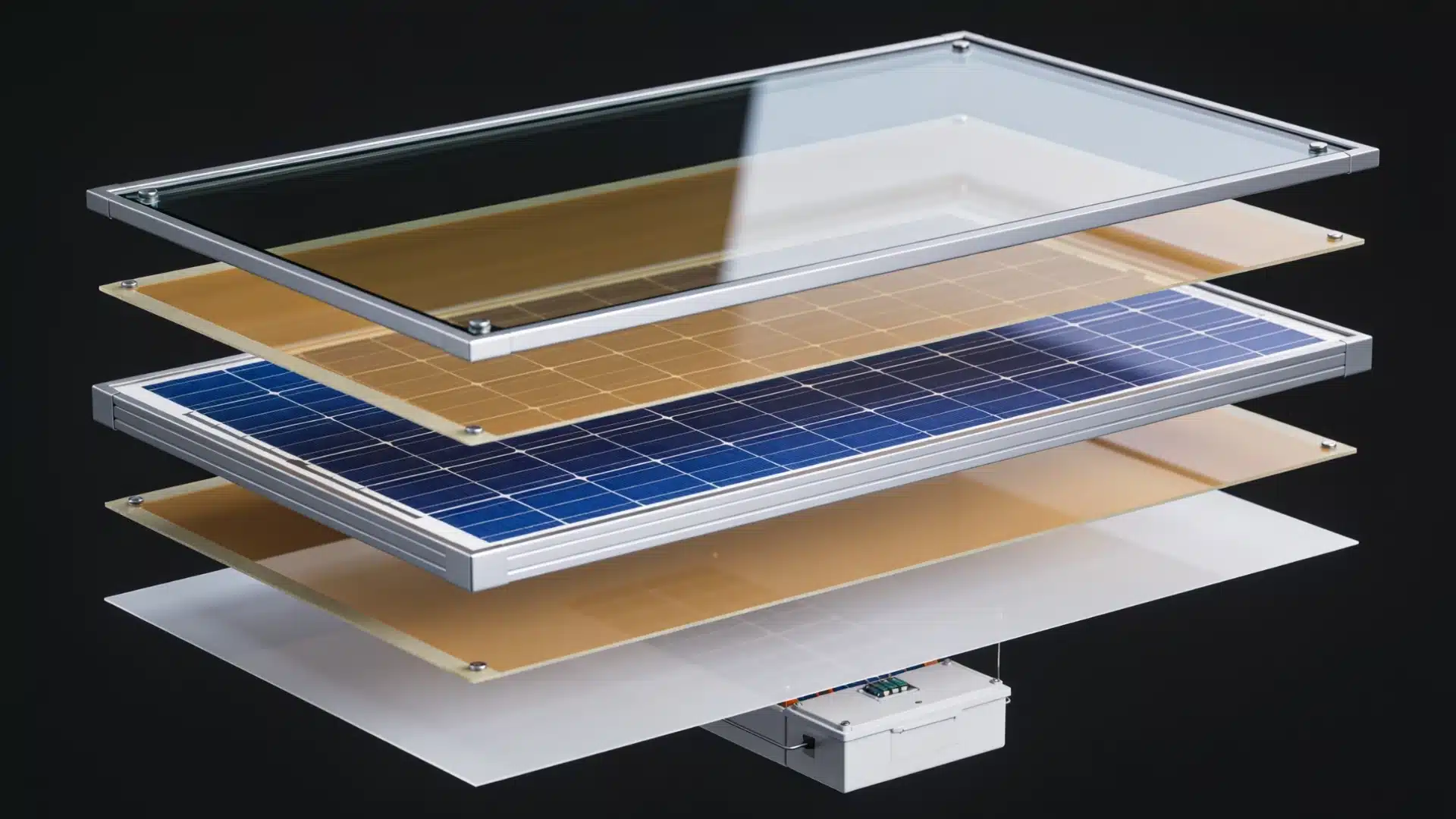
This is the core of the manufacturing process. From raw quartz sand to a finished, tested module, the sequence runs through these stages.
Step 1: Silicon Extraction From Quartz Sand
Manufacturing starts with quartz, a mineral form of silicon dioxide. The quartz is mixed with carbon-rich material and heated in an electric arc furnace to about 1,500°C.
Carbon pulls oxygen away from Silicon Dioxide (SiO₂), releasing carbon dioxide and leaving metallurgical-grade silicon at roughly 98 to 99 percent purity.
This raw silicon works for steel and chemicals, but it still needs further cleaning before photovoltaic use for reliable electricity production.
Step 2: Purification to Solar Grade Silicon
The metallurgical silicon is converted into trichlorosilane gas, then purified through the Siemens method. Hydrogen reduces the gas back into solid silicon, which deposits on heated rods at about 1,100°C.
The result is polysilicon with purity above 99.9999 percent. This stage uses heavy energy and contributes approximately 45 percent of a finished solar panel’s total carbon footprint.
Then pushing factories toward lower energy alternatives across modern production lines around the world.
Step 3: Silicon Ingot Formation
Metallurgical silicon is converted into trichlorosilane gas, then purified through the Siemens process.
Hydrogen reduces the gas back into solid silicon, which deposits on heated rods at around 1,100°C. The result is polysilicon with purity above 99.9999%.
This purification stage is the most energy-intensive step in the manufacturing chain and accounts for a significant share of a finished panel’s total carbon footprint.
Step 4: Wafer Slicing
Ingots are sliced into thin wafers using diamond wire saws.
Most wafers are 160 to 180 micrometers thick, thinner than two sheets of paper. Precision matters here because breakage lowers factory yield and raises cost per watt.
The wire removes silicon as it cuts, a loss called kerf. Reducing kerf loss is one of the industry’s main cost reduction targets.
Step 5: Solar Cell Creation
Wafers are cleaned, textured, and doped to form working solar cells. Phosphorus is often added to create an n-type layer on a p-type wafer, forming the electrical junction.
A silicon nitride coating reduces reflection and gives many cells their dark color.
Silver and aluminum pastes are screen-printed as electrical contacts and fired in a furnace to bond them permanently, completing the cell.
Step 6: Cell Stringing and Module Assembly
Cells are connected in series with thin copper ribbons called busbars.
The cell matrix is layered with tempered glass on top, then EVA film, the cell string, another EVA layer, and a polymer backsheet. Heat and vacuum pressure inside a laminator fuse these layers into one sealed module.
The seal protects cells from moisture, mechanical stress, and thermal cycling over decades of outdoor use.
The same logic that governs long-term durability in laminated electronics applies to how engineers think about storing that electricity efficiently once the panel has generated it.
Step 7: Framing, Junction Box Installation, and Testing
The laminated panel receives an aluminum frame bonded with silicone sealant.
A junction box is fixed to the rear and fitted with bypass diodes, which limit output loss when part of the panel is shaded. Each finished panel is flash-tested under simulated sunlight.
Power output, current-voltage curve, insulation resistance, and safety performance are recorded against the rated specification.
Panels outside tolerance are rejected or downgraded before shipment.
How are Solar Panels Made to Produce Electricity?
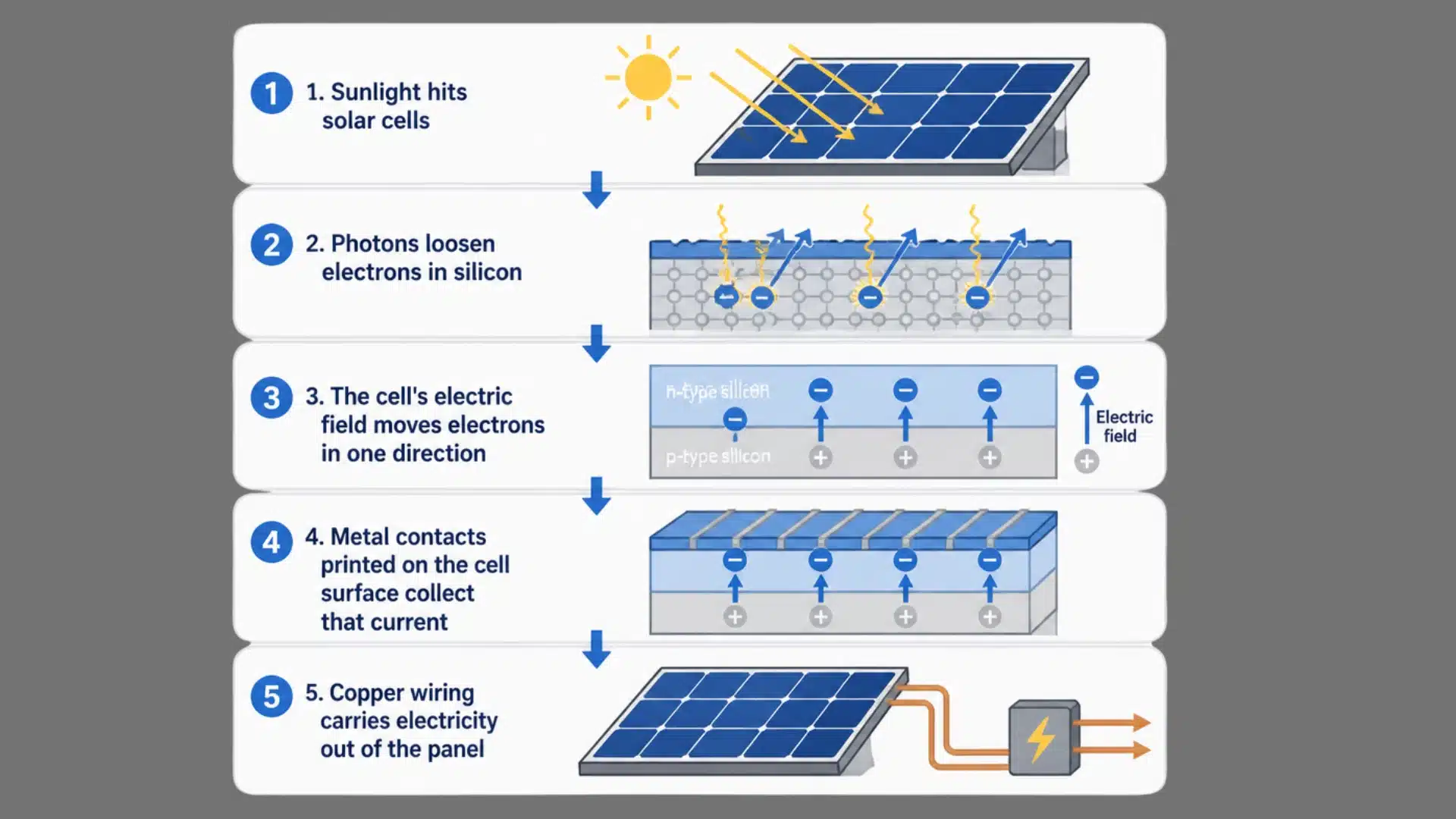
The photovoltaic effect converts sunlight into electricity without moving parts or combustion.
When light reaches a solar cell, photons strike the silicon and free electrons from their atoms. The built-in electric field at the p-n junction pushes those electrons in one direction, producing a direct current.
Fine metal contacts capture that current, and copper wiring carries it out of the panel.
Panel output is rated in watts peak (Wp) under standard test conditions: 1,000 W/m² of irradiance and a cell temperature of 25°C.
Higher irradiance means more photons, more freed electrons, and more current. One thing that often gets lost in purely technical explanations is the long-term math.
A solar panel has an energy payback time, the period it takes to generate back the energy used to manufacture it, of roughly 2-5 years, depending on technology type and geographic location.
Types of Solar Panels and How Manufacturing Differs
Solar panel types vary by material structure, cell design, and rear-side construction. These manufacturing differences affect where each panel type performs best and how it is commonly used.
| Solar Panel Type | Manufacturing Difference | Best Use |
|---|---|---|
| Monocrystalline | Made from one silicon crystal ingot using the Czochralski method | High-efficiency home and commercial systems |
| Polycrystalline | Made from cast silicon blocks with multiple crystal grains | Lower-cost projects where space is available |
| Thin film | Photovoltaic material is deposited as a thin coating without wafers | Lightweight, flexible, or large area applications |
| Bifacial | Uses rear glass or a transparent back layer to capture reflected light | Ground-mount systems near reflective surfaces |
What Happens During Solar Panel Testing and Quality Control?
Testing determines whether a panel will hold up to the 25 to 30-year warranty printed on the box. Every panel goes through at least four checks before leaving the factory:
- Flash test (STC): Each panel is measured under a calibrated flash of light at standard test conditions. Output wattage, current, voltage, and efficiency are recorded and compared against rated specifications.
- Electroluminescence (EL) imaging: An electrical current is passed through the panel in a dark room, causing the cells to emit faint infrared light. Cameras capture this glow and reveal microcracks, poorly diffused junctions invisible to the naked eye.
- Insulation resistance test: Confirms the panel’s electrical components are properly isolated from the frame and external surfaces, a safety requirement.
- Visual inspection: Automated optical systems scan for cosmetic defects, misaligned contacts, chipped cells, and lamination bubbles.
Beyond factory testing, solar panels must pass IEC 61215 design qualification and IEC 61730 safety certification, requiring thermal cycling, humidity freeze, mechanical load, and UV exposure testing.
New Solar Panel Manufacturing Technologies
Solar panel manufacturing is moving beyond standard silicon cell production as brands adopt newer cell designs, stronger materials, and higher-efficiency architectures.
| Technology | What Changes in Manufacturing | Why It Matters |
|---|---|---|
| TOPCon cells | Adds a tunnel oxide passivation layer between silicon and the metal contact | Reduces electron recombination and improves efficiency to around 22 to 24 percent |
| HJT cells | Combines crystalline silicon with thin amorphous silicon layers on both sides | Offers higher efficiency and better heat performance, with Trina Solar reaching 25.44 percent cell efficiency in January 2025 |
| Perovskite tandem cells | Adds a perovskite light-absorbing layer over silicon | Captures a wider light spectrum, with lab efficiencies above 33 percent |
| Dual glass panels | Replaces the polymer backsheet with a second glass layer | Improves durability and moisture resistance and supports bifacial panel designs |
Conclusion
Solar panels may look simple from the outside, but their strength comes from careful material selection and a precise manufacturing process.
Glass, purified silicon, EVA, aluminum, copper, silver, and rear protection layers all serve a clear purpose inside the panel.
From quartz sand purification to wafer slicing, cell creation, lamination, framing, and final testing, every step affects durability, efficiency, and power output.
Understanding how solar panels are made also explains why panel type, material quality, and factory testing matter so much.
Have a question about solar panel materials or manufacturing? Drop it in the comments below.
Frequently Asked Questions
Do Solar Panels Increase Home Value?
Yes, owned solar panels can increase home value, especially when they reduce bills. Impact depends on energy prices, system age, roof condition, and ownership terms.
Are Solar Panels Noisy?
No. Solar panels are silent because they have no moving parts. Only the inverter may create a faint hum, but proper installation keeps noise minimal.
Why is Glass the Heaviest Part of a Solar Panel?
Glass makes up most of a solar panel’s weight because it protects the cells from weather, impact, moisture, and long-term outdoor exposure.
Where are Most Solar Panels Manufactured?
China produces the majority of the world’s solar panels, accounting for a large share of global polysilicon production, wafer slicing, cell fabrication, and module assembly.
Other significant manufacturing countries include the United States, India, South Korea, and Malaysia, though China’s supply chain dominance across the full production chain remains the industry baseline.
Can Solar Panels Be Recycled at the End of Their Lifespan?
Yes, Solar panels can be recycled, and the industry is developing dedicated processes to recover silicon, silver, glass, and aluminum from decommissioned modules.
Current recycling infrastructure is still limited relative to the volume of panels approaching the end of life, but regulatory requirements in regions like the EU are pushing manufacturers toward take-back and recycling programs.