Automation is transforming industries, creating strong demand for professionals who can install, maintain, and troubleshoot robotic systems.
A robotics technician plays a vital role in keeping automated equipment operating safely and efficiently across manufacturing, healthcare, logistics, and many other sectors.
Whether starting a technical career or considering a career change, understanding this role is the first step toward making an informed decision.
I have brought together the essential information to make the career path easier to understand.
Continue reading to learn about the responsibilities, required skills, education, certifications, salary expectations, and career opportunities available for robotics technicians.
Quick Answer: What Is a Robotics Technician?
A robotics technician installs, programs, maintains, troubleshoots, and repairs robotic systems used in automated workplaces.
They help keep industrial robots operating safely and efficiently by reducing downtime, fixing technical issues, and supporting production across industries such as manufacturing, logistics, healthcare, and aerospace.
What Essential Skills Does Every Robotics Technician Need?
Robotics technicians need both technical expertise and workplace skills to keep automated systems operating safely and efficiently. The following skills are essential for performing the job successfully.
- Mechanical Aptitude: Understands motors, gears, bearings, and other mechanical components used in robotic systems.
- Electrical Troubleshooting: Diagnoses and repairs electrical faults in wiring, sensors, controllers, and circuits.
- PLC Fundamentals: Works with programmable logic controllers that control industrial automation equipment.
- Robotics Programming Basics: Makes routine program changes and adjusts robot movements for different tasks.
- Blueprint and Schematic Reading: Interprets technical drawings and wiring diagrams for installation and repairs.
- Pneumatic and Hydraulic Systems: Maintain systems that power robotic equipment and industrial machinery.
- Analytical Thinking: Identifies problems, evaluates causes, and applies effective technical solutions.
- Communication and Teamwork: Works closely with engineers, operators, and maintenance teams on projects.
What Does a Robotics Technician Do?
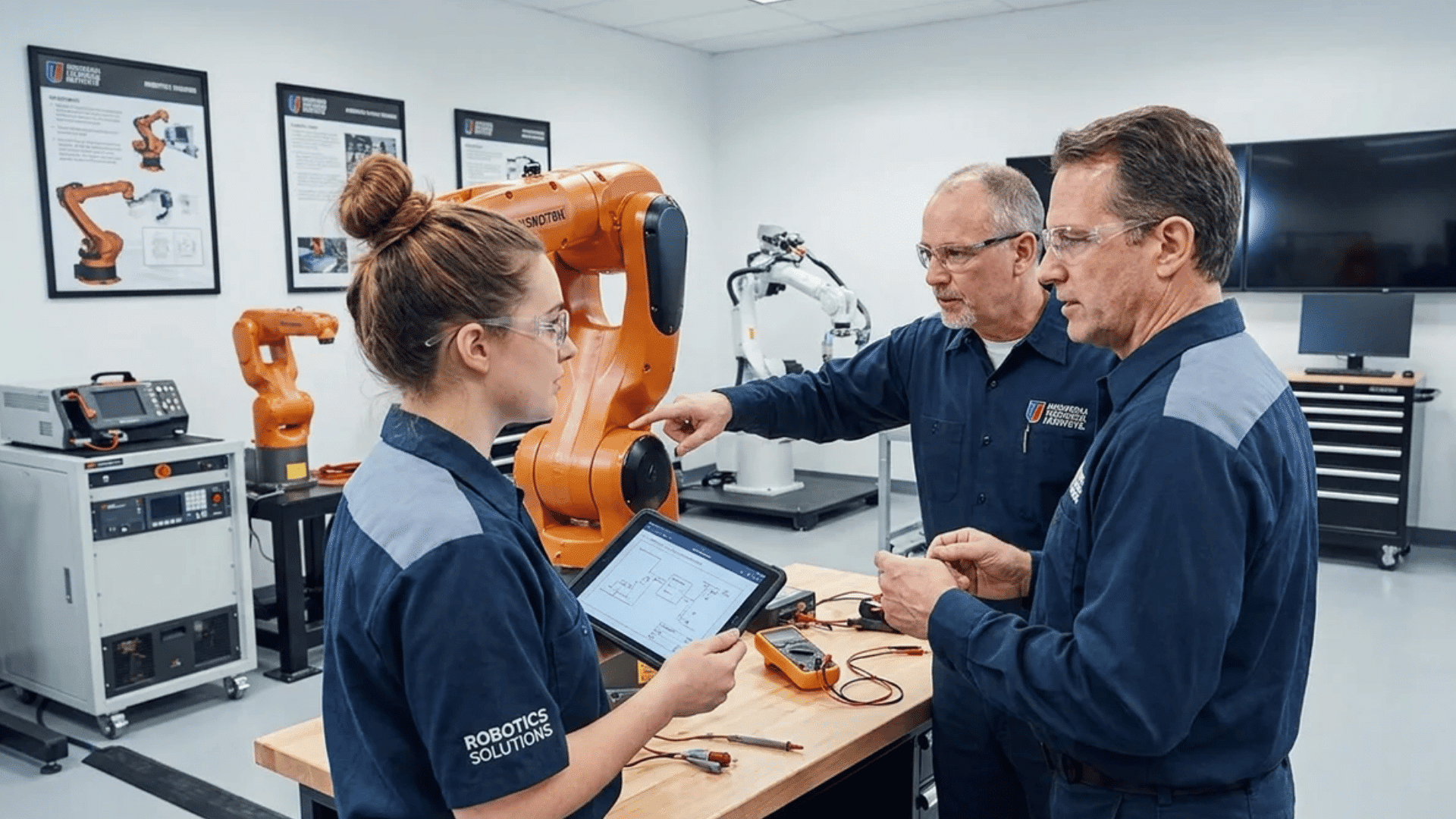
Robotics technicians keep automated systems running efficiently by installing, maintaining, programming, and repairing industrial robots.
1. Install and Configure Robotic Systems
Robotics technicians install industrial robots and related automation equipment in accordance with engineering specifications.
They assemble robotic cells, connect electrical and mechanical components, configure controllers, sensors, and peripheral devices, and verify that every system functions correctly before production begins.
They also perform initial testing, make adjustments, and ensure robots are properly integrated with existing machinery, allowing businesses to achieve efficient, accurate, and reliable automated operations.
2. Perform Preventive Maintenance
Preventive maintenance helps robotic systems operate reliably and reduces costly production interruptions.
Robotics technicians follow scheduled maintenance plans by inspecting equipment, lubricating moving parts, replacing worn components, tightening connections, and checking system performance.
They also monitor robot health, document maintenance activities, and identify potential issues before failures occur.
Regular maintenance extends equipment lifespan, improves productivity, and minimizes unexpected downtime in automated facilities.
3. Troubleshoot Mechanical and Electrical Issues
When robotic systems malfunction, robotics technicians diagnose the root cause using testing equipment, software diagnostics, and technical manuals.
They inspect motors, sensors, wiring, controllers, and mechanical components to identify faults and complete necessary repairs.
After replacing defective parts or correcting system errors, they test the equipment to verify proper operation.
Their troubleshooting skills help restore production quickly while reducing costly downtime.
4. Program and Teach Industrial Robots
Many robotics technicians create, modify, or update robot programs to support production requirements.
They use teach pendants and programming software to define robot movements, adjust operating parameters, update work paths, and improve cycle efficiency.
While complex programming is often handled by robotics engineers, technicians make routine program changes, optimize robotic tasks, and ensure that automated systems continue to perform accurately and safely.
5. Test, Calibrate, and Optimize Robotic Equipment
After installation or repairs, robotics technicians test robotic systems to verify they meet performance and quality standards.
They calibrate sensors, robotic arms, vision systems, and controllers to maintain precision and consistency during operation.
They also evaluate system performance, identify opportunities to improve speed or accuracy, and fine-tune robotic processes. These adjustments help maximize productivity while reducing waste and production errors.
6. Ensure Workplace Safety and Compliance
Safety is one of the most important responsibilities of a robotics technician.
They follow lockout/tagout procedures before servicing equipment, inspect safety guards and emergency stop systems, and ensure that robotic cells comply with workplace safety regulations.
Technicians also perform risk assessments, report hazards, and help maintain a safe environment for employees working alongside automated machinery in industrial facilities.
7. Work with Engineers and Production Teams
Robotics technicians regularly collaborate with robotics engineers, maintenance personnel, operators, and production supervisors.
They assist with installing new automation systems, support production during equipment upgrades, communicate technical issues, and recommend improvements based on system performance.
By working closely with different departments, they help maintain efficient operations, reduce equipment failures, and ensure production goals are consistently achieved.
Education, Training, and Certifications Required
A career as a robotics technician typically begins with technical education and hands-on training. Earning industry-recognized certifications can also improve job prospects and demonstrate specialized skills to employers.
| Qualification/Certification | Purpose | Best For |
|---|---|---|
| High School Diploma or GED | Meets the minimum education requirement and builds foundational skills in math and science. | Beginners |
| Technical Certificate in Robotics or Mechatronics | Teaches robotics, automation, electronics, and maintenance fundamentals. | Entry-level jobs |
| Associate Degree | Provides advanced technical knowledge and practical laboratory experience. | Career growth |
| FANUC Robot Operator Certification | Validates skills in operating and maintaining FANUC industrial robots. | Manufacturing |
| ABB Robotics Certification | Demonstrates knowledge of ABB robot programming and system operation. | Automation |
| Siemens Mechatronic Systems Certification | Confirms expertise in mechatronics and industrial automation systems. | Manufacturing |
| Rockwell Automation Training | Develops skills in PLC programming, controls, and automation solutions. | Industrial automation |
Industries that Hire Robotics Technicians
Robotics technicians work across many industries that rely on automation to improve productivity, precision, and safety.
- Automotive Manufacturing: Installs, maintains, and repairs robotic systems used for vehicle assembly, welding, painting, and quality inspections.
- Electronics Manufacturing: Supports precision robots that assemble circuit boards, semiconductors, and other delicate electronic components.
- Warehousing and Logistics: Maintains automated storage, sorting, picking, and material-handling robots in distribution centers.
- Food and Beverage Production: Services robotic equipment used for food processing, packaging, labeling, and quality control while meeting hygiene standards.
- Pharmaceutical Manufacturing: Ensures robotic systems used for medicine production, packaging, and laboratory automation operate accurately and reliably.
- Aerospace and Defense: Maintains advanced robotic equipment for aircraft manufacturing, precision assembly, inspection, and defense applications.
- Healthcare and Medical Robotics: Supports robotic systems used in surgical assistance, laboratory automation, rehabilitation, and medical device manufacturing.
- Packaging and Consumer Goods: Keeps robotic packaging, palletizing, labeling, and assembly systems operating efficiently in production facilities.
How to Become a Robotics Technician?
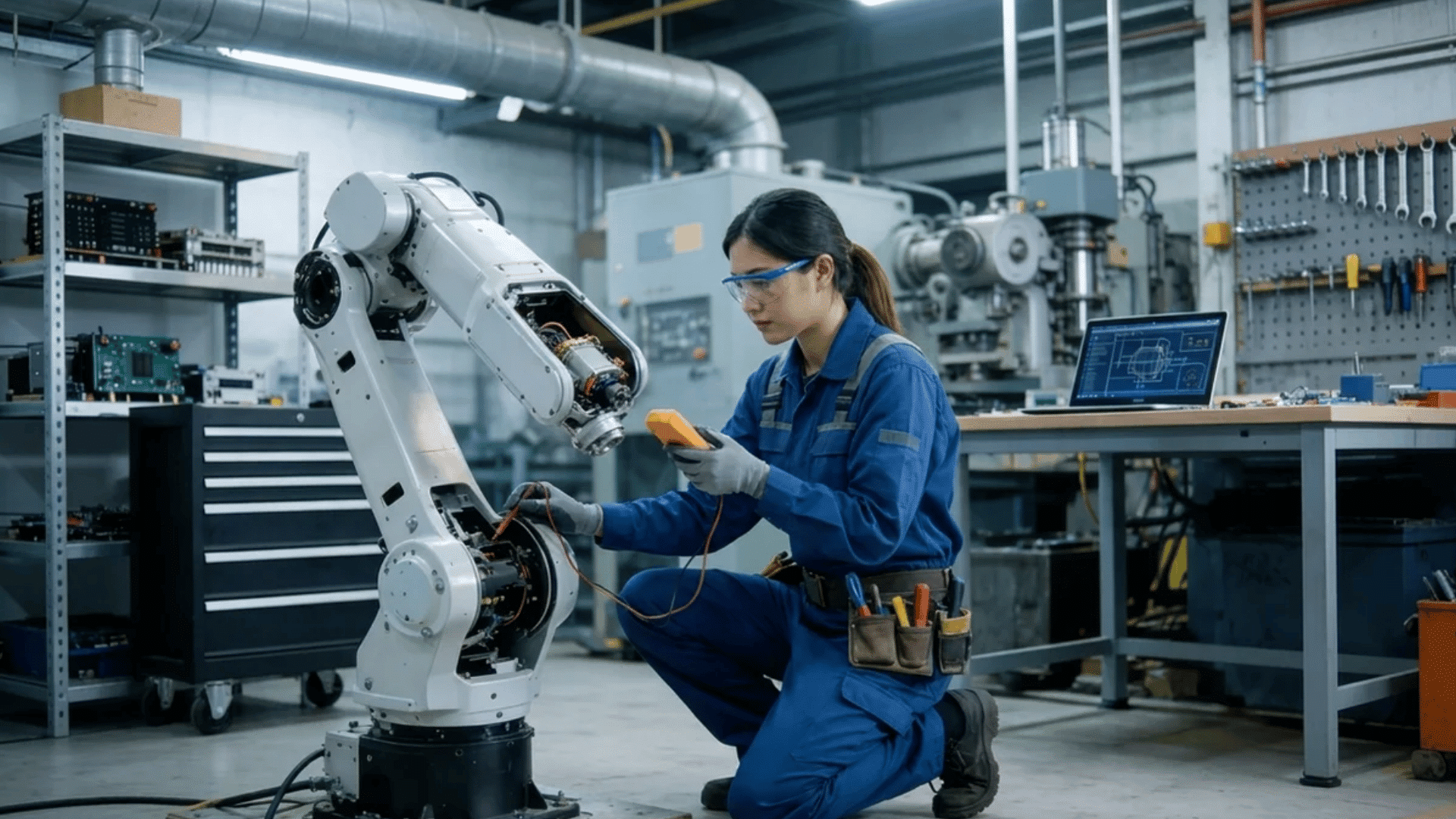
Building a career as a robotics technician requires the right education, technical skills, and practical experience. Following these stages can help prepare for entry-level roles and long-term career growth in industrial automation.
1. Meet the Basic Educational Requirements
A high school diploma or GED is the minimum requirement for most robotics technician positions.
Students should focus on mathematics, physics, computer science, and electronics because these subjects build the foundation for understanding robotic systems.
Courses in technical education, engineering, or vocational training can also provide valuable hands-on experience before pursuing advanced robotics education.
2. Complete Robotics or Mechatronics Training
Most employers prefer candidates with formal technical training in robotics, mechatronics, automation, or industrial maintenance.
Certificate programs offer focused industry skills, while associate degrees provide broader knowledge of mechanical, electrical, and computer systems.
Technical colleges often combine classroom instruction with laboratory practice, helping students develop the practical skills needed to operate modern robotic equipment.
3. Learn PLCs, Automation, and Robotics Programming
Understanding programmable logic controllers (PLCs) and basic robot programming is essential for maintaining automated equipment.
Learn how PLCs control industrial machinery, practice using teach pendants, and become familiar with automation software from manufacturers such as FANUC, ABB, Siemens, or Rockwell Automation.
These technical skills make candidates more competitive for robotics technician positions.
4. Gain Hands-On Experience
Practical experience is one of the most valuable qualifications for employers.
Working on robotics projects alongside Internships, apprenticeships, technical labs, and cooperative education programs provides opportunities to install equipment, troubleshoot systems, and perform preventive maintenance.
Working with real industrial robots builds confidence, improves problem-solving skills, and prepares future technicians for the responsibilities of full-time automation roles.
5. Earn Industry Certifications
Professional certifications demonstrate technical competence and commitment to continuous learning.
Certifications from FANUC, ABB, Siemens, and Rockwell Automation validate skills in robot operation, programming, automation systems, and PLC controls.
While not always mandatory, these credentials strengthen a resume, improve job opportunities, and can help qualify for higher-paying positions in industrial automation.
6. Apply for Entry-Level Robotics Technician Jobs
Create a resume that highlights technical training, certifications, internships, laboratory projects, and relevant skills.
Search for entry-level opportunities in manufacturing, logistics, electronics, and automation companies.
Preparing for technical interviews by reviewing troubleshooting methods, electrical fundamentals, and robotics concepts can improve confidence and increase the chances of securing a robotics technician position.
7. Continue Learning and Advance Your Career
Automation technology changes rapidly, making continuous learning essential for long-term success.
Advanced certifications, manufacturer training, and specialized knowledge in PLC programming, machine vision, artificial intelligence, or industrial networking can expand career opportunities.
With experience, robotics technicians can progress into senior technical roles, automation specialist roles, controls technician roles, or supervisory positions.
Robotics Technician Salary and Job Outlook
Robotics technicians in the United States earn a median annual salary of about $70,760, according to the U.S. Bureau of Labor Statistics (BLS).
Entry-level professionals typically earn around $47,000 to $55,000 per year, while experienced technicians can earn $90,000 to over $109,000, depending on their skills, certifications, industry, and location.
Some of the highest-paying industries include electric power generation, oil and gas extraction, aerospace manufacturing, software publishing, and petroleum manufacturing.
Salaries are also influenced by education, hands-on experience, specialized certifications, and expertise with PLCs and industrial robots.
The job outlook is steady, with continued demand driven by automation, robotic production systems, equipment upgrades, and the need to replace experienced workers who are leaving the field.
Robotics Technician vs Robotics Engineer
Although both careers involve working with robotic systems, their responsibilities and qualifications differ. The table below highlights the key differences between the two roles.
| Feature | Robotics Technician | Robotics Engineer |
|---|---|---|
| Primary Role | Maintains and repairs robotic systems | Designs and develops robotic systems |
| Education | Certificate or associate degree | Bachelor’s degree or higher |
| Daily Work | Installation, maintenance, troubleshooting | Design, programming, testing |
| Programming | Basic to intermediate | Advanced |
| Design Role | Assists with system setup | Leads system design and development |
| Typical Salary (U.S.) | $47,000–$109,000+ | $85,000–$150,000+ |
| Career Growth | Senior technician, controls specialist | Senior engineer, engineering manager |
Tools and Technologies Used by Robotics Technicians
Robotics technicians use specialized tools and software to install, maintain, troubleshoot, and optimize automated systems.
- Industrial Robots: Perform automated tasks such as welding, assembly, packaging, and material handling.
- PLC Software: Programs and monitors programmable logic controllers that operate automated machinery.
- Human Machine Interfaces (HMIs) allow technicians to monitor, control, and troubleshoot robotic systems.
- Teach Pendants: Used to program robot movements, configure settings, and test robotic operations.
- Sensors and Actuators: Detect system conditions and control robotic movements with precision.
- Multimeters: Measure voltage, current, and resistance when diagnosing electrical problems.
- Diagnostic Software: Identifies faults, monitors performance, and supports preventive maintenance.
Is a Robotics Technician a Good Career?
Yes, a robotics technician is a good career for people who enjoy technology, problem-solving, and hands-on work.
It offers stable employment, competitive salaries, and opportunities to work with advanced automation systems across many industries.
While the role requires ongoing learning as technology evolves, gaining experience and industry certifications can lead to higher-paying positions and career advancement in automation or controls.
This career suits detail-oriented, mechanically inclined people who enjoy troubleshooting and teamwork.
As automation continues to expand in manufacturing, logistics, healthcare, and other sectors, robotics technicians are expected to remain valuable, providing strong long-term career prospects and job security.
Benefits and Challenges of Becoming a Robotics Technician
A career as a robotics technician offers rewarding opportunities but also entails responsibilities that demand technical expertise and adaptability.
| Benefits | Challenges |
|---|---|
| Strong job demand driven by industrial automation | Shift work may be required in some industries |
| Competitive salaries with career growth opportunities | Physically demanding tasks such as lifting and standing |
| Hands-on work with advanced robotic systems | Continuous learning to keep up with new technologies |
| Opportunities to advance into automation or controls roles | Troubleshooting equipment under production deadlines |
| Exposure to emerging technologies and smart manufacturing | Following strict workplace safety procedures |
Conclusion
Robotics technicians play an essential role in keeping today’s automated industries running efficiently. From installing and maintaining robotic systems to troubleshooting complex equipment, this career combines technical expertise with practical problem-solving.
With competitive salaries, steady demand, and opportunities to specialize in automation, controls, or advanced robotics, it offers strong long-term potential for those willing to keep learning.
Technical certificates and hands-on training offer several paths into the profession.
Take time to evaluate the required skills, training, and career opportunities to determine whether becoming a robotics technician aligns with future career goals.
Frequently Asked Questions
Is Robotics a Dead Field?
No. Robotics is a growing field, with demand increasing as automation and artificial intelligence expand across industries.
What Jobs Can Pay $400,000 a Year without a Degree?
Earning $400,000 without a degree is rare and usually involves entrepreneurship, business ownership, entertainment, or professional sports.
What Jobs May Decline By 2030?
Data entry clerks, telemarketers, cashiers, and some assembly line jobs are expected to decline as automation becomes more widespread.
What Are the Most Stressful High-Paying Jobs?
Surgeons, anesthesiologists, airline pilots, chief executives, and air traffic controllers are among the most stressful, high-paying careers.
Is a Robotics Technician the Same as an Automation Technician?
No. Robotics technicians focus on robotic systems, while automation technicians maintain a wider range of automated equipment. Many technical skills overlap between the two roles.