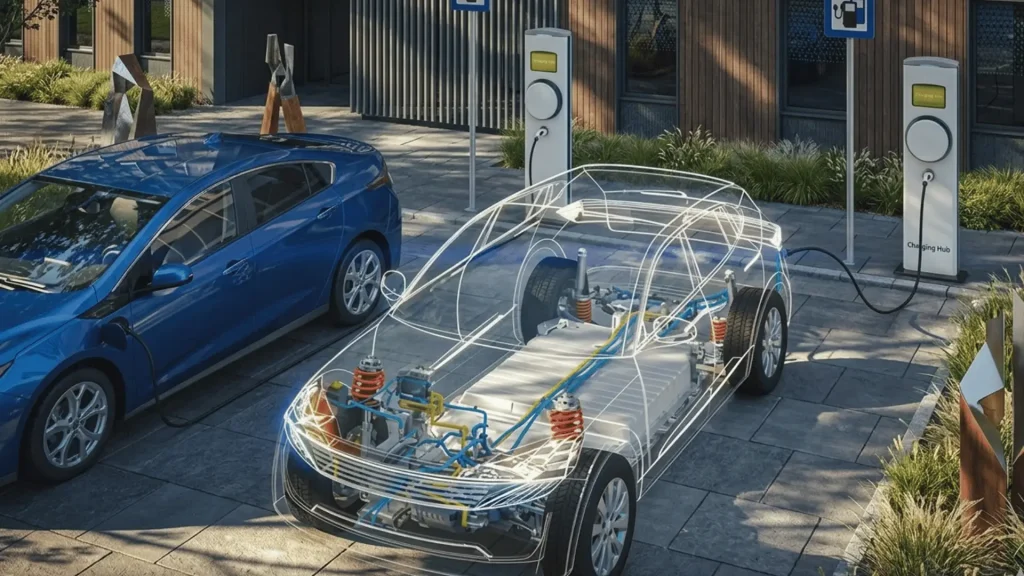
Electric vehicles may look simple from the outside, but underneath the body sits a highly connected system of batteries, motors, controllers, cooling units, and charging hardware working together every second you drive.
That instant acceleration and quiet ride do not happen because of one breakthrough part alone.
Every system inside the vehicle plays a role in how efficiently the car moves, charges, handles heat, and recovers energy on the road.
Understanding these electric vehicle components helps make sense of EV range, charging speed, long-term maintenance, and overall performance.
Whether planning to buy an EV or simply curious about how these modern cars function, learning what happens beneath the surface gives a much clearer picture of why electric vehicles work so differently from traditional gas-powered cars.
What are Electric Vehicle Components?
Electric vehicle components are the systems and parts that allow an EV to store energy, deliver power, charge the battery, and operate safely on the road.
Unlike traditional gas-powered cars that rely on engines and fuel systems, EVs use electric motors, battery packs, inverters, controllers, and charging systems to move the vehicle.
All these components work together as one connected network.
The battery supplies power, the motor creates movement, and supporting systems manage charging, cooling, and energy flow.
Understanding these parts helps explain how electric vehicles achieve smooth acceleration, compared to conventional vehicles.
The Battery Pack: The Most Important Part of an Electric Car
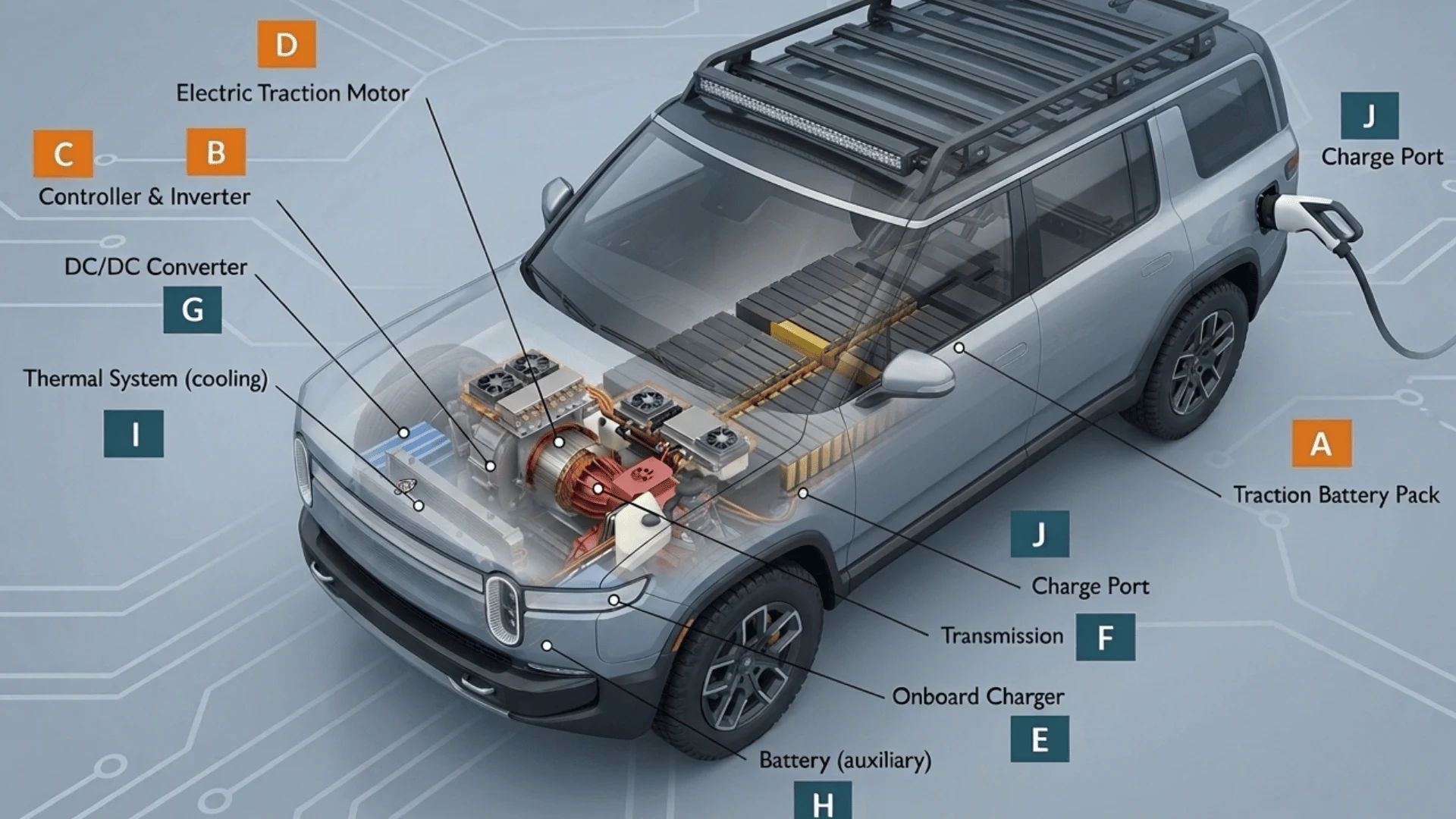
The traction battery pack is the single most critical electric vehicle component, which is measured in kilowatt-hours (kWh).
It stores the energy that powers everything else, and its capacity, chemistry, and condition determine range, charging speed, and long-term ownership cost.
Modern EV battery packs use lithium-ion cells arranged into modules, which are grouped into a pack with its own housing, cooling channels, and management electronics.
Each cell has an anode, a cathode, and an electrolyte that transports lithium ions between them. During charging, ions move from the cathode to the anode and store energy.
During driving, that process reverses, and the flow of ions generates the electricity the motor needs.
The battery management system (BMS) sits inside every pack and handles a job that is easy to underestimate.
It monitors the voltage, temperature, and state of charge of individual cells in real time, balances charge across the pack, and limits current draw or input when conditions move outside safe parameters.
Without a functioning BMS, a battery pack would degrade rapidly or, in extreme cases, become unsafe
Electric Motor: How Your Car Actually Moves
The electric motor converts electrical energy from the battery into the mechanical energy that turns the wheels.
This is where the abstract concept of “stored electricity” becomes actual motion, and the physics involved explain why EVs feel so different to drive.
Electric motors produce torque from zero RPM.
There is no lag waiting for an engine to build power through a rev range. Press the accelerator and the torque is there immediately, which is why even modestly spec’d EVs feel quick off the line.
Most passenger EVs use AC induction motors or permanent magnet synchronous motors. AC motors are durable and handle heat well.
Permanent magnet motors are more efficient across a wider speed range, which is why they appear in most newer models.
The Electric Transmission
Unlike a gas car, most EVs use a single-speed transmission.
Because the electric motor delivers usable torque across a wide RPM range, there is no need for a multi-gear gearbox to keep the engine in its power band.
The transmission transfers mechanical power from the motor to the drive wheels, and its simplicity is one reason EV drivetrains require so little maintenance.
Power Inverter and Motor Controller in Electric Vehicles
The battery stores power as direct current (DC). The electric motor runs on alternating current (AC). The inverter is what bridges that gap.
An inverter takes DC from the battery pack and converts it into the three-phase AC current the motor needs.
The quality and efficiency of this conversion matter because any energy lost in the process becomes heat rather than motion.
The motor controller works alongside the inverter.
It reads the driver’s throttle input and adjusts the frequency and voltage of the AC signal sent to the motor, which controls speed and torque output.
Lift your foot, and the controller dials the motor back. Floor the accelerator, and it ramps up almost instantaneously.
The controller is also what activates regenerative braking when deceleration is detected
How Regenerative Braking Works in an EV?
Regenerative braking captures part of that energy and sends it back to the battery, which improves efficiency and extends driving range, especially in stop-and-go city traffic.
Here is how the process works step by step:
- The driver lifts off the accelerator or presses the brake pedal.
- The motor controller switches the electric motor into generator mode.
- The rotating wheels spin the motor backward, producing electrical current.
- That current flows back through the inverter and into the battery pack.
- The BMS monitors temperature and charge level to control how much energy the battery can safely accept at that moment.
The amount of braking force from regeneration varies by vehicle and by setting.
Many EVs let you dial it up so the car slows significantly when you lift your foot, a style sometimes called one-pedal driving.
Others keep it subtle and blend regeneration with friction brakes more transparently. Neither approach is wrong; they suit different driving preferences.
If you’re curious about how far this concept extends, a dedicated look at self-charging electric car technology explains how regeneration fits into the broader idea of EVs that partially recharge themselves in motion.
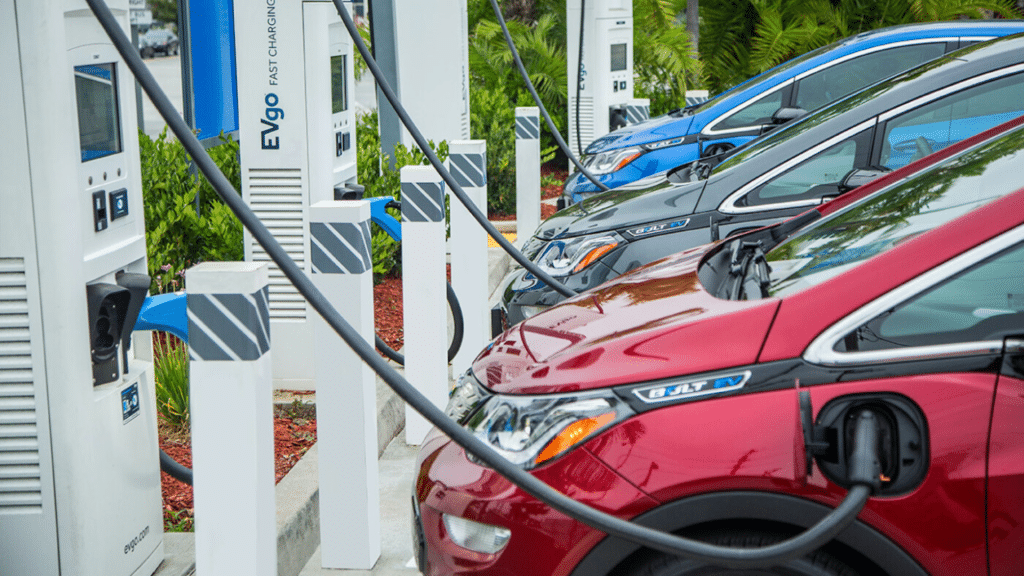
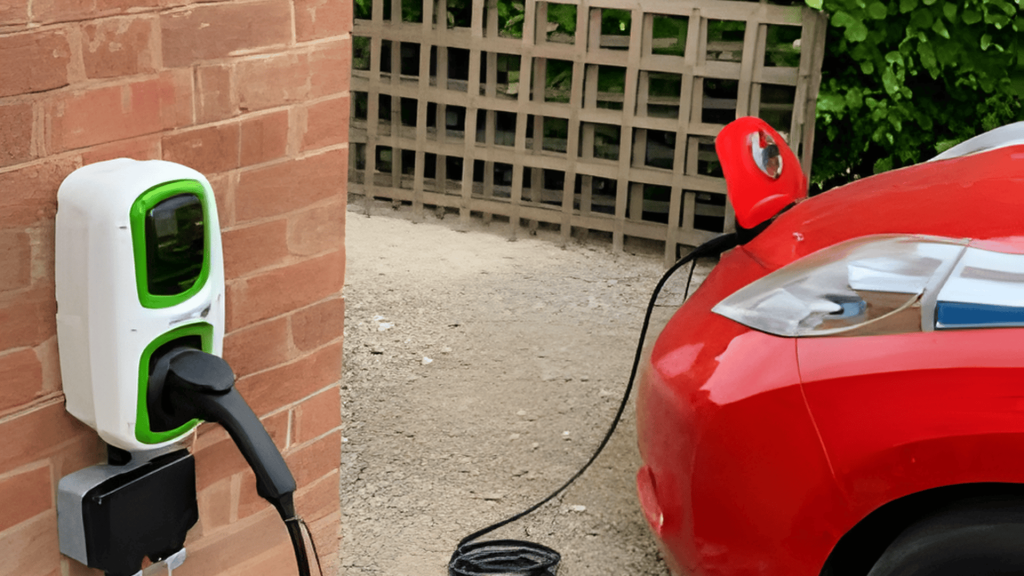
How EV Charging Ports and Onboard Chargers Work?
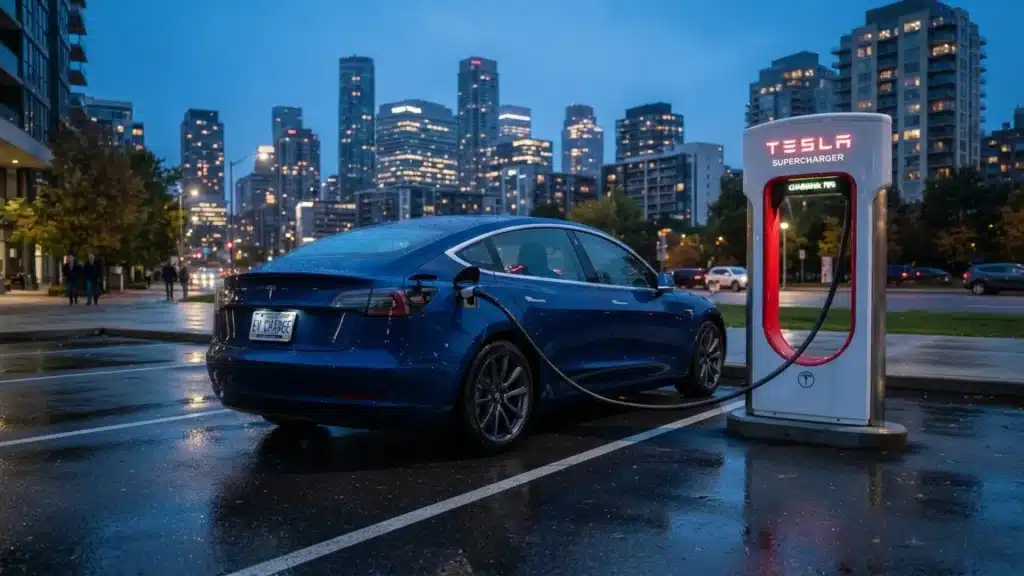
When you plug an EV into a wall outlet or public charging station, the electricity coming in is alternating current.
The battery only accepts direct current. The onboard charger (OBC) handles that conversion.
The charge port is the physical connection point between the vehicle and the external power source.
Behind it, the OBC takes the incoming AC and converts it to the DC voltage and current level the battery pack requires.
| Charging level | Power source | Typical output | Notes |
|---|---|---|---|
| Level 1 | Standard household outlet (120V) | 1.2 – 1.9 kW | Slowest; best for overnight top-ups |
| Level 2 | Dedicated 240V circuit | 7 – 19 kW | Most home and workplace charging |
| DC fast charging | High-voltage DC direct feed | 50 – 350+ kW | Bypasses OBC entirely; fastest option |
DC fast charging bypasses the onboard charger entirely, feeding high-voltage DC directly into the battery through a separate port. That is why it charges so much faster.
The OBC handles only AC charging; it plays no role in regenerative braking, which returns current through the inverter instead.
Thermal Management System in Electric Vehicles
Lithium-ion batteries have a usable temperature window. Too cold and internal resistance rises, reducing range and limiting how fast the battery can accept charge.
Too hot and cell degradation accelerates, shortening the pack’s overall lifespan. The thermal management system keeps everything operating within that window regardless of ambient conditions.
Most modern EVs useliquid-cooling loops that circulate coolant through channels embedded in the battery pack housing.
The same system often extends to the motor and inverter, which generate heat during hard acceleration or sustained high-speed driving.
In winter, the thermal system can also warm the battery before charging or driving, which is why pre-conditioning an EV in cold weather before a trip improves both range and charging speed
Vehicle Control Unit: The Brain of the System
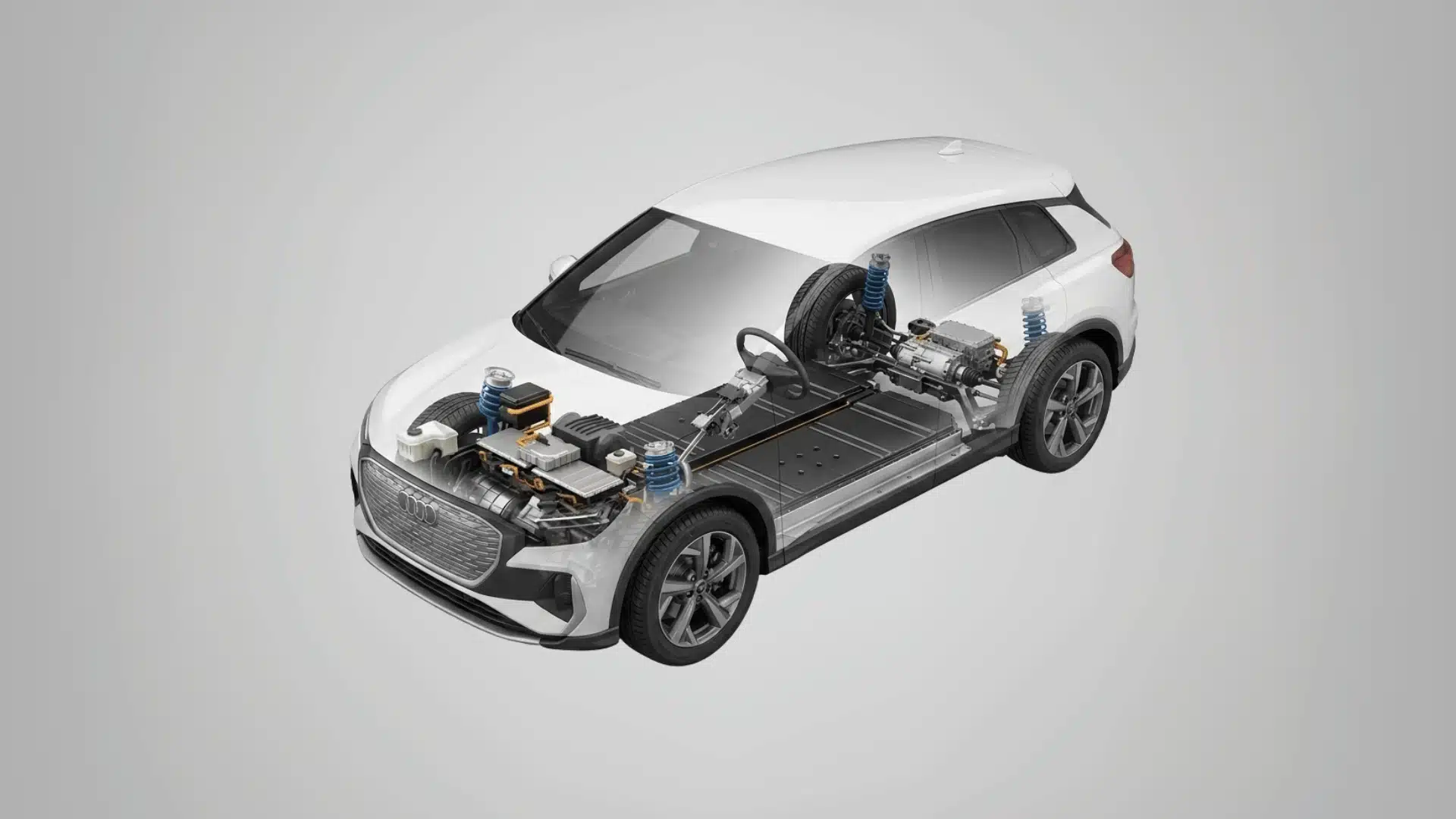
The Vehicle Control Unit (VCU) is the central computer that coordinates all of an EV’s major systems.
It receives data from sensors across the vehicle, battery temperature, motor speed, vehicle speed, driver inputs, and uses that information to manage how every component responds in real time.
The VCU communicates directly with the BMS, motor controller, and thermal management system.
When you press the brake pedal, for example, the VCU decides how much of that deceleration to handle through regenerative braking versus physical brake pads, based on speed, battery state, and road conditions.
Without the VCU coordinating these decisions, the other components would have no way to operate as a unified system.
How the Auxiliary Battery Works in an Electric Vehicle?
The main traction battery powers the drivetrain. A separate 12V auxiliary battery powers everything else: interior lights, door locks, windows, the infotainment system, and low-voltage vehicle electronics.
This two-battery architecture exists because running high-voltage power directly to every accessory in the car would require expensive insulation and safety systems throughout.
The DC-DC converter keeps the auxiliary battery charged by stepping down high voltage from the traction pack to the 12-14V range the auxiliary battery needs.
If the DC-DC converter fails, the auxiliary battery drains, and the car loses its low-voltage systems, even if the main pack is full.
Real-world examples of how these systems integrate can be seen in vehicles like those covered in a detailed look at electric Toyota SUV models, where auxiliary systems are tightly integrated with the main drive architecture.
High Voltage vs Low Voltage Systems in EVs
Understanding the difference between high voltage and low voltage systems helps explain how electric vehicles operate and why certain electrical problems affect only specific parts of the car.
| System Type | High Voltage (HV) System | Low Voltage (LV) System |
|---|---|---|
| Voltage Range | Typically 200V to 800V | Usually 12V to 14V |
| Main Purpose | Powers the drivetrain and charging systems | Powers electronics and control systems |
| Key Components | Battery pack, inverter, motor, onboard charger | Auxiliary battery, lighting, infotainment, sensors |
| Cable Identification | Orange insulated wiring for safety | Standard automotive wiring |
| Safety Requirements | Requires specialized EV training and insulated tools | Similar to conventional vehicle systems |
| Failure Impact | Can disable driving and charging functions | Can prevent startup and disable electronics |
| Common Failure | Inverter or battery-related faults | Dead 12V auxiliary battery |
| Connection Between Systems | Supported through a DC-DC converter | Receives power from the HV system via the converter |
How do all the Electric Vehicle Components Work Together?
Electric vehicle systems work as one connected network, constantly exchanging power, data, and cooling support to deliver smooth acceleration, energy recovery, and reliable daily performance.
- Accelerator Input and Power Request: Pressing the accelerator sends a signal to the motor controller, which tells the inverter how much battery power the motor should receive.
- Inverter and Motor Operation: The inverter converts DC electricity from the traction battery into three-phase AC power, allowing the electric motor to create rotational force and move the wheels.
- Battery and System Monitoring: While driving, the BMS continuously tracks battery voltage, current flow, and temperature to protect the pack and maintain stable performance.
- Thermal and Auxiliary Support: The thermal management system regulates coolant flow for the battery and motor, while the DC-DC converter keeps the 12-volt system powered for lights, displays, and electronics.
- Regenerative Braking Process: Lifting off the accelerator switches the motor into generator mode, sending recovered energy back through the inverter and into the battery whenever conditions allow.
Common Problems with Electric Vehicle Components
EVs have fewer moving parts than combustion vehicles, which means fewer things that can wear out mechanically. That said, their electrical and thermal systems introduce a different set of failure points worth knowing.
- Battery Degradation: Lithium-ion batteries slowly lose capacity over time, especially with frequent fast charging and extreme heat exposure.
- BMS Errors: Battery management system faults can cause charging interruptions, inaccurate range estimates, or sudden power restrictions.
- Inverter Failure: A faulty inverter may trigger warning codes, reduce power delivery, or stop the vehicle from entering drive mode.
- Thermal System Issues: Coolant leaks or pump failures can force the EV to limit charging speed and battery performance for protection.
- Charge Port or OBC Faults: Damaged charge ports or onboard charger failures may prevent normal AC charging from working properly.
- DC DC Converter Failure: When the converter stops working, low-voltage systems and the auxiliary battery begin shutting down.
- Motor Bearing Wear: Worn motor bearings can create grinding or whirring sounds, especially during low-speed driving.
- VCU software faults: Corruption or failed updates to the Vehicle Control Unit can cause erratic system behavior, warning lights across multiple systems, or unexpected power restrictions. Most manufacturers address these through over-the-air software updates.
Conclusion
Electric vehicles are not gas cars with a battery swapped in.
They are systems where every component depends on the others to function properly, and understanding that architecture changes how you approach ownership, maintenance, and model selection.
The battery pack sets the ceiling on range and long-term value. The motor and inverter determine how that energy becomes performance. The VCU coordinates every decision the system makes.
If a warning light has you puzzled or you’re comparing models and want to know what to look for under the hood, this breakdown gives you the vocabulary to ask the right questions.
Have questions about EV systems or are curious about a specific component? Drop a comment below and share which part you’d like explained next.
Frequently Asked Questions
Can an EV Run Without a Functioning Auxiliary Battery?
No. Even with a full traction battery, a dead or failed auxiliary 12V battery will prevent the vehicle from powering its low-voltage electronics, which means the car will not start or respond to key inputs.
What is the Difference Between Level 2 Charging and Dc Fast Charging?
Level 2 charging delivers AC power through the vehicle’s onboard charger, which converts it to DC before it reaches the battery. DC fast charging bypasses the onboard charger entirely, feeding high-voltage DC directly into the battery pack
What is the Most Expensive Component in an Electric Vehicle?
The traction battery pack is typically the most expensive single component in an EV, often accounting for 30 to 40 percent of the vehicle’s total cost.