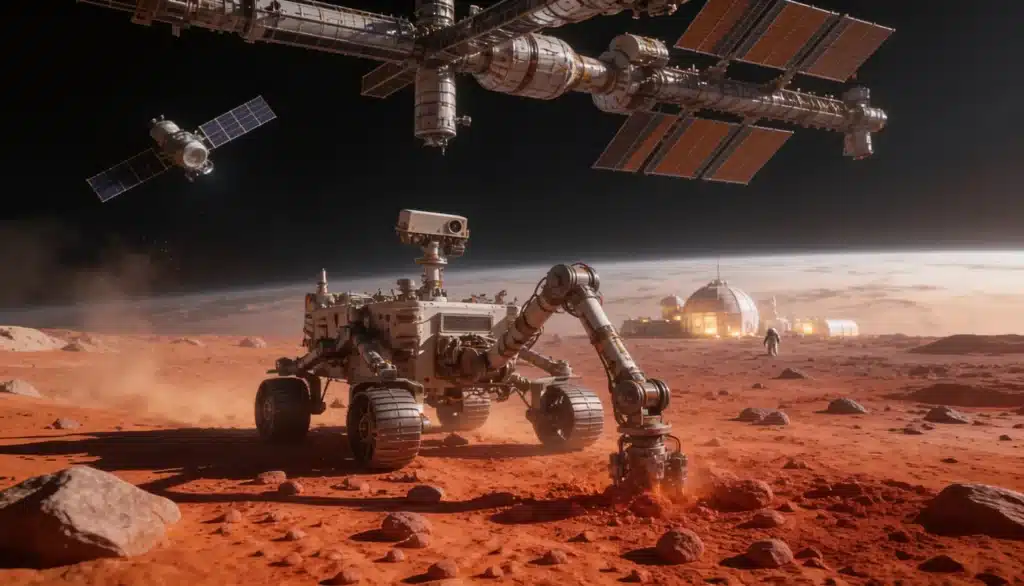
Space sounds exciting until you think about the risk behind every mission. Robotics in space exploration helps solve that problem by sending machines to places humans cannot yet safely reach.
You see it in Mars rovers, robotic arms, satellite servicing systems, and small flying scouts that gather useful data. I find this topic interesting because these robots are not just machines on wheels.
They help scientists study surfaces, support astronauts, test mission sites, collect samples, and prepare for longer spaceflight.
You will get a clear look at how these systems work, why they matter, and what their growing role could mean for future missions. The real story starts with what space robots actually do and why they matter most today.
The Role of Robotics in Space Exploration
Aerospace Robotics uses machines to sense, move, collect data, and support missions beyond Earth. These include rovers, landers, robotic arms, drones, and autonomous spacecraft.
Some are controlled from Earth, while others make small decisions, such as avoiding obstacles. Their main goal is to help humans explore safely by handling risky tasks first.
Robots are used because space is dangerous, distant, and harsh. They do not need air, food, or protection like humans. They can work in extreme conditions such as radiation, low gravity, and cold temperatures for long periods.
They study planets, collect samples, move equipment, and service satellites. Robots also help plan future missions by testing surfaces and mapping areas.
They do not replace humans but act as scouts and helpers, making space exploration safer and more efficient.
Main Types of Aerospace Robots Used in Space
Space robots come in many forms because each mission requires a different kind of support, and much of that variety stems from designing smoother machine motion. Some travel across surfaces, some stay fixed, and some work in orbit.
| Type of Robot | Main Use | Example |
|---|---|---|
| Rovers | Travel across planetary surfaces to study rocks, soil, and the environment | Perseverance |
| Landers | Stay in one place to collect detailed scientific data over time | InSight |
| Robotic arms | Handle tools, move cargo, and collect or transfer samples | Canadarm2 |
| Space drones or helicopters | Fly short distances to scout terrain and assist surface exploration | Ingenuity |
| Autonomous spacecraft | Perform tasks like docking, navigation, and inspection with minimal control | Crew or cargo spacecraft |
| Satellite servicing robots | Inspect, repair, refuel, or reposition satellites in orbit | ISAM systems |
| Humanoid or assistant robots | Assist astronauts with routine tasks, experiments, and maintenance | Astrobee |
These types often work together. A rover may study the ground, a robotic arm may collect samples, and an autonomous system may help the mission move safely.
How Robotics is Used in Space Exploration Today
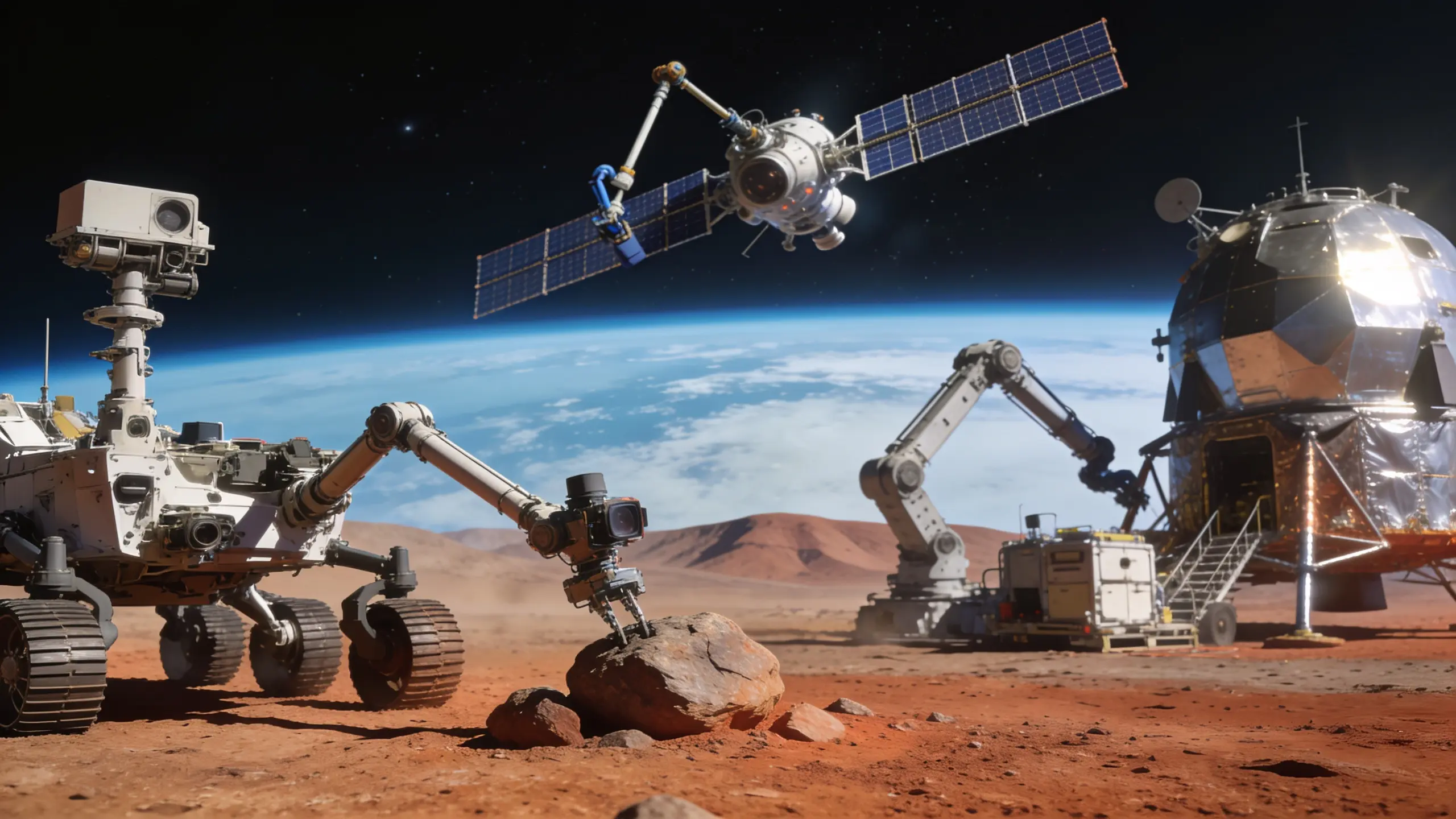
Space robotics already supports real missions by handling science work, crew support, repair planning, and surface checks that would be risky or slow for humans.
1. Studying Planetary Surfaces
Rovers and landers study planets and moons by taking images, measuring soil conditions, examining rocks, and monitoring weather.
Their work helps scientists understand what a place is made of and how safe it may be.
They also collect long-term environmental data that can reveal seasonal changes, dust activity, and temperature patterns. This information supports future exploration and improves scientific understanding of other worlds.
2. Collecting and Handling Samples
Robots can drill, scoop, seal, and store samples without needing astronauts on the surface.
These samples can show clues about water, minerals, past environments, and possible signs of ancient life on planets like Mars.
Many missions are designed to preserve samples carefully so they remain suitable for future analysis. Accurate sample collection also helps scientists compare findings from different regions of a planet or moon.
3. Supporting Astronauts in Orbit
Robotic arms and helper robots, not unlike machines that assist daily routines back on Earth, support astronauts by moving supplies, holding tools, and assisting with work outside spacecraft.
This reduces the risk of spacewalk tasks and gives crews more time for science, repairs, and mission checks.
Some robotic systems also inspect equipment in areas that are difficult for astronauts to reach. Their assistance improves efficiency while reducing crew workload during long missions.
4. Inspecting and Servicing Spacecraft
Robotic systems can inspect satellites, test repair methods, and help with refueling or repositioning plans.
This matters because satellites are costly, hard to replace, and important for communication, weather tracking, and Earth observation, functions that depend on how satellites stay connected.
By detecting problems early, robots may help extend the operational life of spacecraft. This reduces replacement costs and helps keep important services running without interruption.
5. Mapping Future Mission Sites
Robots help map landing zones, surface risks, slopes, rocks, and possible resources before humans arrive.
Their data helps mission teams plan safer routes, choose better landing sites, and prepare for future work on the Moon or Mars.
Some missions also search for resources such as water ice that could support future crews. Detailed maps allow engineers to design equipment and habitats suited to local terrain and conditions.
Space Robots Used in Current Exploration Missions
Several robotic missions are active today or traveling toward their targets. They show how robots help with science, astronaut support, asteroid study, and future mission planning.
Perseverance rover: Perseverance is working on Mars to search for signs of ancient microbial life. It is also collecting rock and regolith samples that could be picked up by a future mission and returned to Earth for further study.
Curiosity rover: Curiosity continues to study Mars inside Gale Crater. Its work focuses on rocks, soil, climate clues, and past conditions that may have supported life. Recent findings also show that organic molecules can still be preserved on Mars.
Europa Clipper: NASA’s Europa Clipper mission is traveling to Jupiter and is expected to arrive in April 2030. It will orbit Jupiter and make 49 close flybys of Europa to study whether this icy moon may have conditions suitable for life.
JUICE mission: ESA’s Jupiter Icy Moons Explorer, also called JUICE, is on its way to Jupiter. After arrival in July 2031, it will study Jupiter and its ocean-bearing moons, including Ganymede, Callisto, and Europa.
Psyche mission: NASA’s Psyche spacecraft is traveling to a metal-rich asteroid between Mars and Jupiter. It is expected to begin exploring asteroid Psyche in August 2029, helping scientists better understand planetary cores and the early formation of the solar system.
OSIRIS-APEX: OSIRIS-APEX is the extended mission of OSIRIS-REx. It is heading toward asteroid Apophis and studies changes to Apophis after its close approach to Earth in 2029.
Astrobee: Free-flying Astrobee robots work inside the International Space Station. These machines can operate either remotely or autonomously, helping with inventory management, experimental documentation, cargo-movement tests, and astronaut-support research.
Benefits of Robotics in Space Exploration
Robots make space missions safer, longer-lasting, and more flexible. Their benefits show up before launch, during the mission, and after data begins to come back.
| Benefit | Why It Matters |
| Lower human risk | Robots can go before astronauts |
| Longer mission work | Robots can operate for years |
| Better surface data | Rovers and landers study places directly |
| Support in orbit | Arms and servicing systems help with repairs |
| Lower life-support needs | Robots do not need oxygen, food, or water |
| Better planning | Robots test routes and landing zones first |
These benefits are practical, not just technical. A robot can take on slow, risky, or repetitive work while humans focus on judgment, mission planning, and complex choices.
This is why robots are now part of serious spaceflight plans. They help teams do more with less risk.
Challenges and Limits of Space Robotics
Robots are useful, but they are not perfect. Every space robot has to survive launch, landing, harsh conditions, limited power, and long delays between Earth and the mission site.
Common challenges include high build cost, difficult testing, radiation damage, dust problems, slow movement, and limited repair options. A stuck wheel, a weak battery, a faulty sensor, or a software issue can affect an entire mission. Common mistakes in thinking about space robots:
- Assuming robots can fix every problem alone
- Thinking all robots are fully independent
- Forgetting communication delay during distant missions
- Ignoring power limits on cold or dusty surfaces
- Treating space robots like normal Earth machines
Space robotics works best when human teams plan carefully and give robots clear goals. The robot does the fieldwork, but people still guide the mission.
Future Role of Robots in Spaceflight
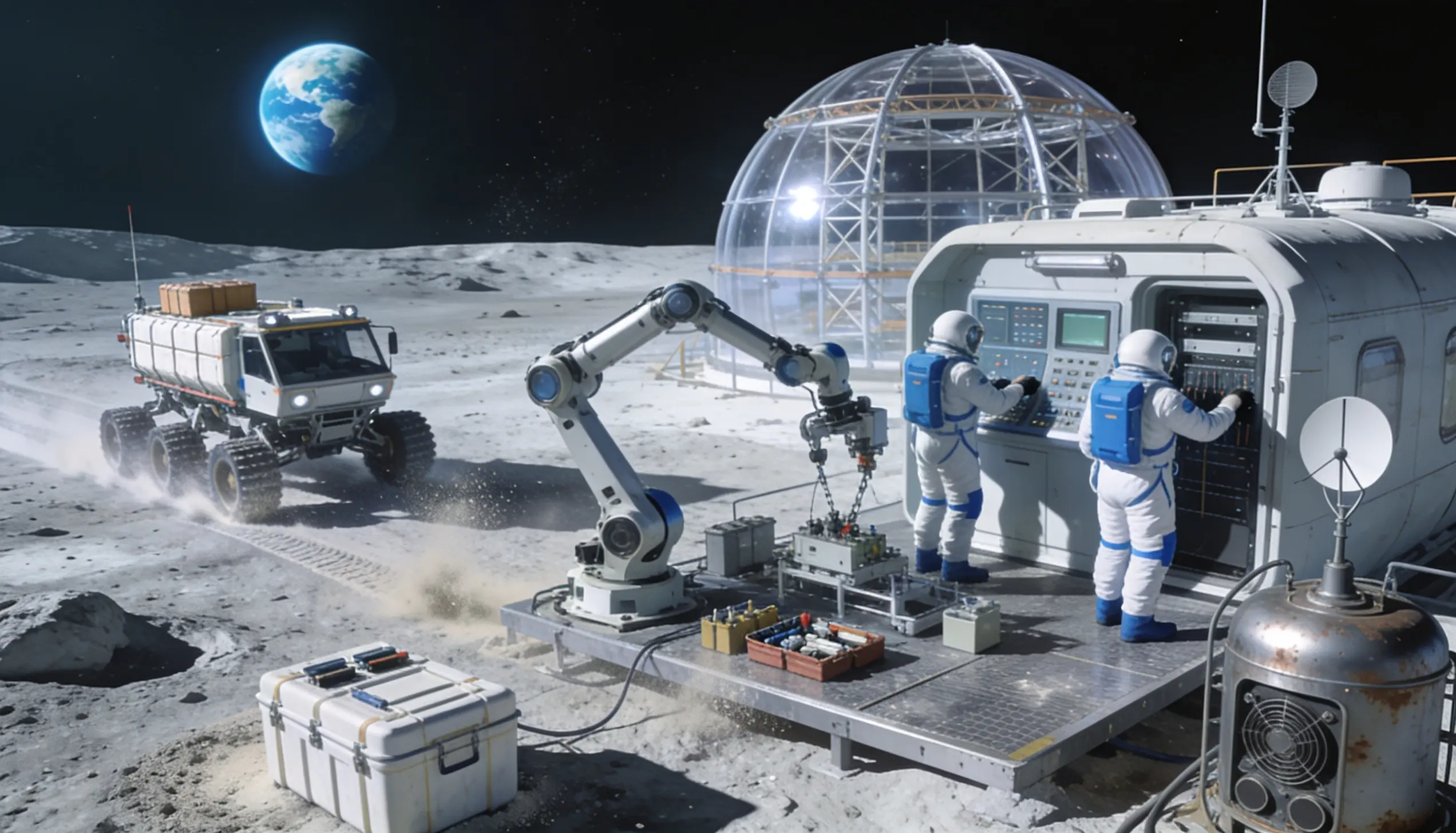
Future space missions will need stronger robotic support because crews may travel farther and stay longer.
On the Moon and Mars, robots can check landing zones, assess surface hazards, and search for useful resources such as water ice. Smarter rovers may also travel farther with less direct control from Earth.
For space construction, robotic systems could help move parts, inspect equipment, and support the building of habitats, landing pads, and large structures in orbit. This is useful because some space systems may be too large to launch in their fully assembled form.
Astronauts may also rely on robots for routine and risky work. A robot can inspect hard-to-reach areas, carry supplies, or help with repairs. The goal is not to replace humans, but to make future missions safer and easier to manage.
Final Thoughts
Space robots make distant missions feel more possible because they handle work that would be risky, slow, or hard for people alone.
I see robotics in space exploration as a practical way to study new places, support astronauts, collect samples, inspect equipment, and prepare future landing sites.
You can now see how rovers, landers, robotic arms, flying scouts, and autonomous systems each play a clear role. The key point is simple: robots help humans learn more while lowering danger and improving mission planning.
As spaceflight grows, you will likely see robots working even closer with astronauts. Share your thoughts in the comments or check out my related blog posts on space technology.
Frequently Asked Questions
What Happens to Space Robots After a Mission Ends?
Many space robots stay where their mission ended. Engineers may still study their final data to understand system health, surface conditions, and design lessons.
Can Space Robots Carry Life from Earth to Another Planet?
Space agencies clean robots before launch to reduce Earth microbes. This helps protect other worlds and keeps scientific results from being contaminated.
Are Private Companies Involved in Space Robotics?
Yes, private companies build robotic tools for satellites, spacecraft inspection, lunar missions, and commercial space work, often alongside national space agencies.
What Subjects Are Useful for a Career in Space Robotics?
Robotics, coding, mechanical design, electronics, physics, and aerospace engineering are helpful. Testing skills also matter because space hardware must work reliably.