Robotics is in the middle of a major design shift, and there’s no end in sight. Expectations and considerations are changing as machines expand beyond industrial environments and appear in everyday settings, such as streets and people’s homes.
This change means performance is no longer the only consideration. Movement must look controlled and intuitive, while the physical form must appear refined rather than mechanical to appeal to everyday consumers.
Engineers are moving away from exposed, modular assemblies toward integrated and compact designs that are appealing to the eye. The result is a new generation of robots that function efficiently and move with a level of fluidity that aligns with human expectations, as seen in films and TV.
From Rigid Systems to Integrated Motion
Traditional robotic systems have clearly separated components. Motors, gearboxes, sensors and wiring are assembled as discrete elements, often resulting in bulky and visible infrastructure.
This approach prioritizes durability and precision, particularly in industrial applications where appearance and interaction are secondary concerns or sometimes not considered at all.
Engineers now design systems that consolidate multiple functions into unified components. Integrated actuators serve as a prime example. By combining actuation, sensing and control within a single unit, these systems reduce the need for external connections and intermediary structures.
This integration directly affects motion quality. Smaller, more efficient joints correct misalignment by 99% in some cases and allow for smoother transitions between movements according to Harvard researchers.
Reduced mechanical separation minimizes delays and inconsistencies. This is bringing humanoid robot movement closer to natural human motion.
Compact Design and Its Impact on Performance
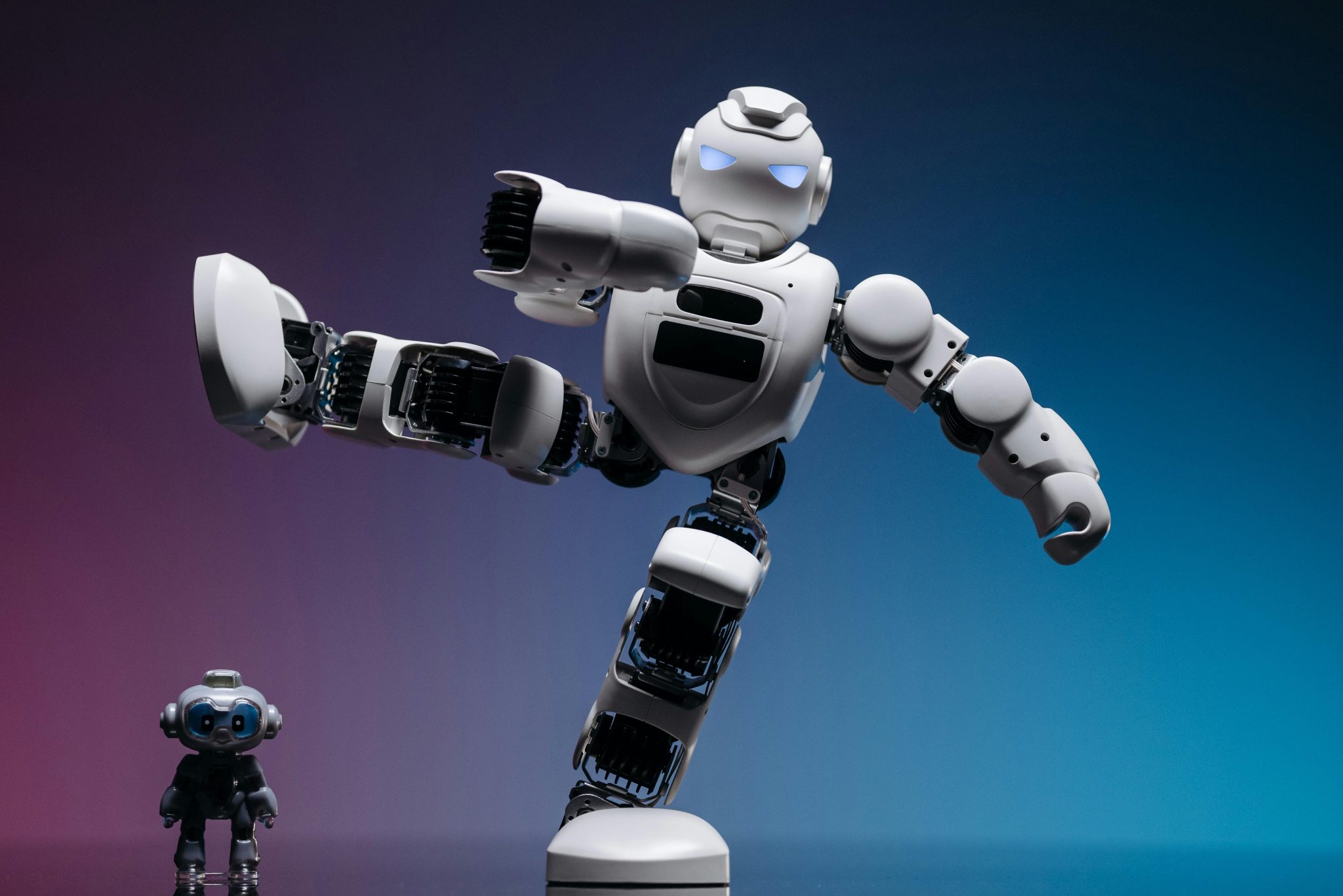
Robots can operate in tighter environments and adapt to a wider range of applications when they occupy less space.
This is particularly important in consumer robotics design, where space constraints and aesthetic considerations are significant. Robot vacuum cleaners are a prime example. They’re flat and can turn on a dime to reach corners and maneuver under tables and chairs.
Compact design also enhances structural efficiency. Shorter distances between components reduce energy loss and improve responsiveness according to research published in MDPI. By minimizing unnecessary bulk, engineers can create systems that are both lighter and more capable.
A streamlined form also contributes to a more approachable appearance. If you’re designing for real-world environments, prioritize reducing joint size and system footprint to improve usability and integration.
The Role of Hidden Complexity
Modern robotics systems achieve cleaner designs and deliver more power in less space by increasing torque density and hiding wiring. Increased torque density enables more precise control and smoother motion.
Internalized wiring reduces the risk of damage, particularly in homes and public areas where spills and touching the machines are common.
Hidden wiring also simplifies maintenance and eliminates visual clutter, allowing the robot’s form to appear more cohesive and intentional. Engineers should internalize wiring and minimize exposed components wherever possible to improve performance and visual clarity.
The Mechanisms Behind Fluid Motion
Fluid robot motion depends on a set of mechanical systems working in tandem to create movement that feels continuous and precise. Some important mechanisms and systems are needed to accomplish this.
Advanced Actuation Systems
Advanced actuation systems form the foundation of movement, essentially acting as the muscles of a robot. The accuracy and reliability of a robot depend on the actuators embedded in its body.
High-Efficiency Transmissions Systems
High-efficiency transmission systems convert actuation into usable force. Mechanisms such as strain wave gears deliver high torque within compact joints, supporting smooth articulation while maintaining accuracy and stability.
Real-Time Sensing and Feedback
Real-time sensing and feedback ensure consistent movement. Encoders track position and velocity, while force sensors detect interaction with the environment. Inertial measurement units monitor orientation and balance, enabling the system to continuously adjust in response to changes in motion or load.
This constant stream of feedback prevents movement from becoming abrupt or disjointed.
Compliance-Focused Control Systems
Compliance-focused control systems refine the application of force. Series elastic actuators introduce controlled flexibility between the motor and the load, improving shock absorption and interaction safety. Variable stiffness mechanisms allow the system to adjust its stiffness based on the task, helping maintain both precision and adaptability.
Implications for Everyday Robotics
Robotic design decisions directly impact consumer adoption, as consumers are keenly aware of how a robot behaves, and can be easily put off by designs they deem unnatural or uncanny.
According to research published in ScienceDirect, a robot that moves smoothly appears more predictable and can foster trust, whereas abrupt or mechanical movement can cause hesitation.
When evaluating robotic movement, focus on how smoothly it transitions between actions, not just how quickly it completes a task.
Integrated designs also streamline manufacturing, as fewer external components reduce assembly complexity and improve consistency. This contributes to scalability, which remains a critical factor in the broader adoption of robotics technologies.
Some projections suggest manufacturing could be fully autonomous by the 2030s, accelerating the need for compact and reliable robotic systems.
Forward-Thinking Design for Everyday Robotics
The convergence of engineering and design increasingly defines the direction of robotics. How effectively mechanical systems deliver a seamless and intuitive experience is as important as performance metrics in modern design.
This shift reflects a broader understanding of robotics as user-facing technology, and as expectations evolve, the emphasis on compactness and fluid motion will only intensify.