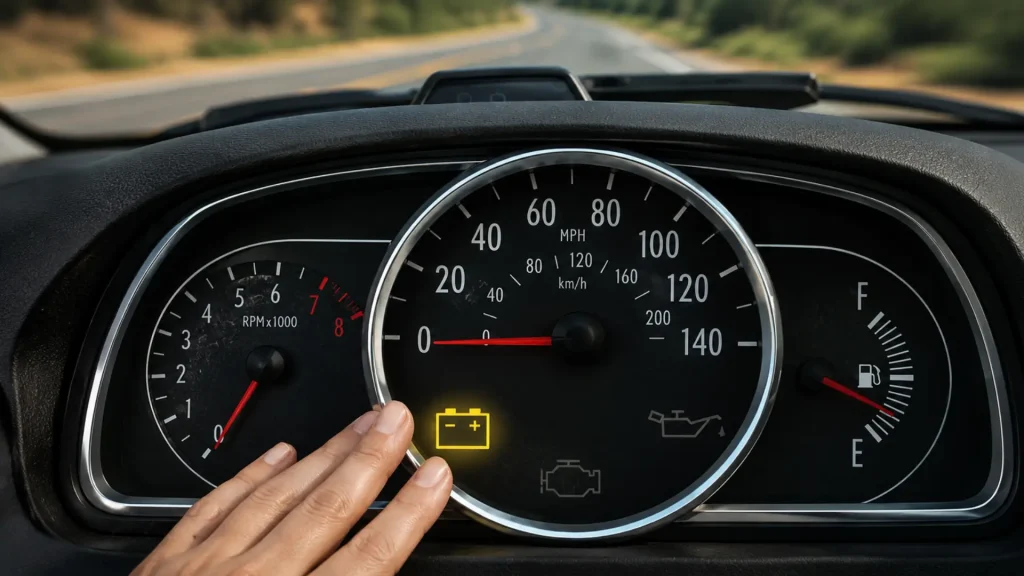
An electric parking brake problem can turn a normal drive into a stressful moment fast. One second, everything feels fine, and the next, your dashboard shows a parking brake malfunction warning with no clear explanation.
It may happen when starting the car, shifting into gear, or trying to park, which can make the message feel more serious than it usually is.
In many cases, the issue comes from a weak 12V battery, a faulty switch, damaged wiring, or a control module glitch. Still, it is not a warning to ignore.
Knowing what the message means, what you can safely check, and when to get a scan can save time, stress, and unnecessary towing.
What an Electric Parking Brake Problem Message Actually Means
Traditional handbrakes use a lever and cable to physically tighten the rear brakes. An electric parking brake does the same job, but it uses switches, sensors, motors, and a control module instead.
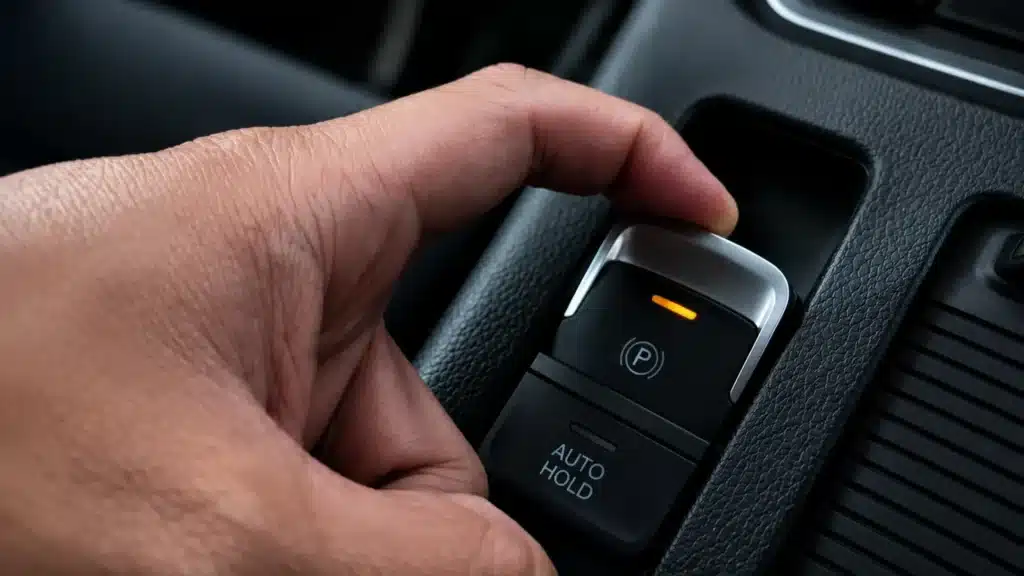
When you pull the switch, the module sends a signal to small motors at the rear calipers, telling them to clamp the brakes. When you release it, the motors back off.
This setup is cleaner and easier to use, but it also depends on steady voltage and clear electronic signals. A warning appears when the module detects something outside its normal range.
That could be low battery voltage, a faulty switch, damaged wiring, motor resistance, or a software fault, not always complete brake failure.
Common Causes of Electric Parking Brake Problems
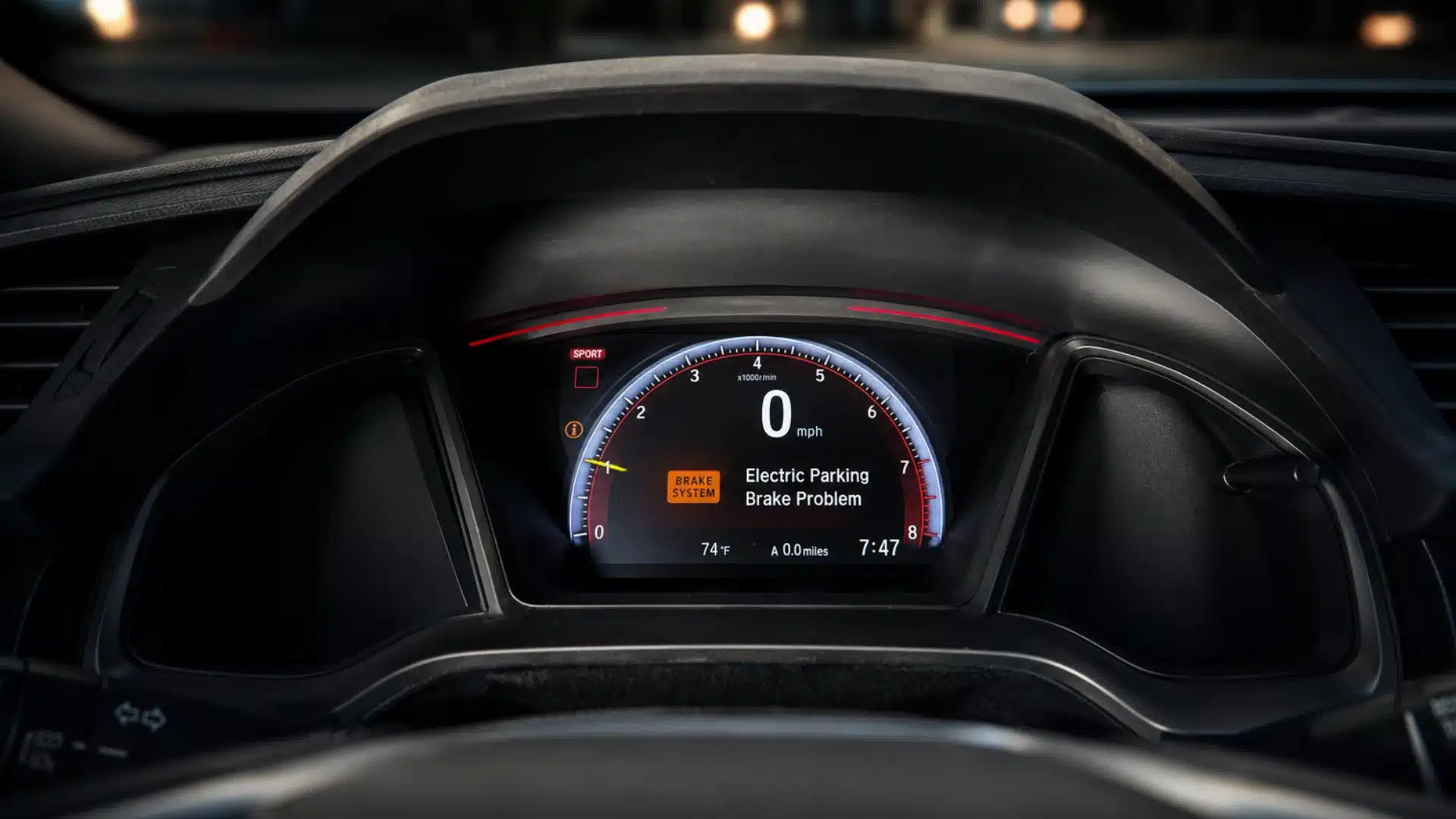
Most cases trace back to a handful of repeat offenders. Weak batteries cause more EPB warnings than actual mechanical failures do, because the module needs stable voltage to run its self-check and won’t engage or release cleanly if that voltage dips.
- Weak or failing 12V battery: The EPB module requires a stable voltage to run its diagnostics. A battery on its way out, even one that still starts the car, can trip false warnings.
- Dirty or worn console switch: Debris or corrosion inside the switch can send an incomplete signal, which the module reads as a fault.
- Worn servo motor: The small motor at each caliper wears down over time and can eventually stick or fail to respond to commands.
- Damaged wiring harness: Chafed, corroded, or pinched wires between the switch, module, and calipers interrupt the signal path entirely.
- Low brake fluid: Some systems tie the EPB warning to hydraulic fluid level, since the two systems share sensors in certain models.
- Software or module glitch: A momentary communication error between control modules can trigger a warning that clears on its own after a restart.
Most electric parking brake problems stem from minor electrical or mechanical issues, so checking the basics first can save time and money and prevent unnecessary repairs.
Signs Your Parking Brake is Failing
Watch for these before the system fails outright:
- The brake indicator flickers or stays lit even when the switch is fully released
- You hear the motorcycle or click without the brake actually engaging
- The brake engages on its own when you haven’t touched the switch
- The car takes noticeably longer to release the brake after you press the pedal
- A grinding or scraping sound comes from the rear wheels when the brake disengages
If these signs keep recurring, the parking brake should be inspected soon before the fault becomes a bigger safety or repair issue.
Is It Safe to Drive with a Parking Brake Malfunction
In most cases, yes, for a short distance. The warning affects the parking function, which only matters when the car is stationary.
If the message appears while you’re already moving and the brake pedal still stops the car normally, you can typically continue to a safe location or your mechanic.
The exception is when the brake engages unexpectedly while driving or won’t disengage at all. Both situations mean the car may not move freely or may pull in an unpredictable way.
Pull over safely, shift to park on level ground, and don’t force the issue by revving the engine while the brake is engaged.
If you’re not confident the car will hold on an incline, use wheel chocks or find flat ground before you leave it unattended.
Note: This section is for informational purposes only and does not constitute mechanical or safety advice. Consult a qualified mechanic before making driving decisions based on a warning light.
How to Troubleshoot an Electric Parking Brake Problem
Work through these steps in order before assuming you need a shop visit.
- Test the battery voltage. A healthy resting voltage sits around 12.4 to 12.6 volts. Anything meaningfully lower is a strong lead, especially on a car more than three years old.
- Restart the vehicle. Turn the car off, wait about thirty seconds, and start it again. This clears a surprising number of temporary module errors.
- Check the brake fluid reservoir. Low fluid can trigger a shared warning on models where the sensors overlap. Top it off with the manufacturer-specified fluid if it’s low.
- Inspect the console switch. Look for visible debris or a switch that feels stiff or inconsistent compared to how it used to feel.
- Pull the fault codes. An OBD-II scanner reads module-specific codes that point to the exact circuit involved. Many auto parts stores will scan it for free, though a dealer-level tool reads deeper into Honda-specific EPB codes.
- Reset the system. If nothing else works, some technicians disconnect the battery briefly to force a hard reset of the EPB module. This isn’t always effective and can reset other settings in the car, so it’s worth trying only after the earlier steps.
Persistent faults that survive a restart and a fluid check usually mean something mechanical or electrical needs attention, not just a reset.
Corroded wiring connectors are a common culprit in vehicles that have spent time in humid climates or experienced water intrusion, the same failure pattern that shows up in flood-damaged vehicles years after the fact.
Reddit Discussion About Electric Parking Brake Problem
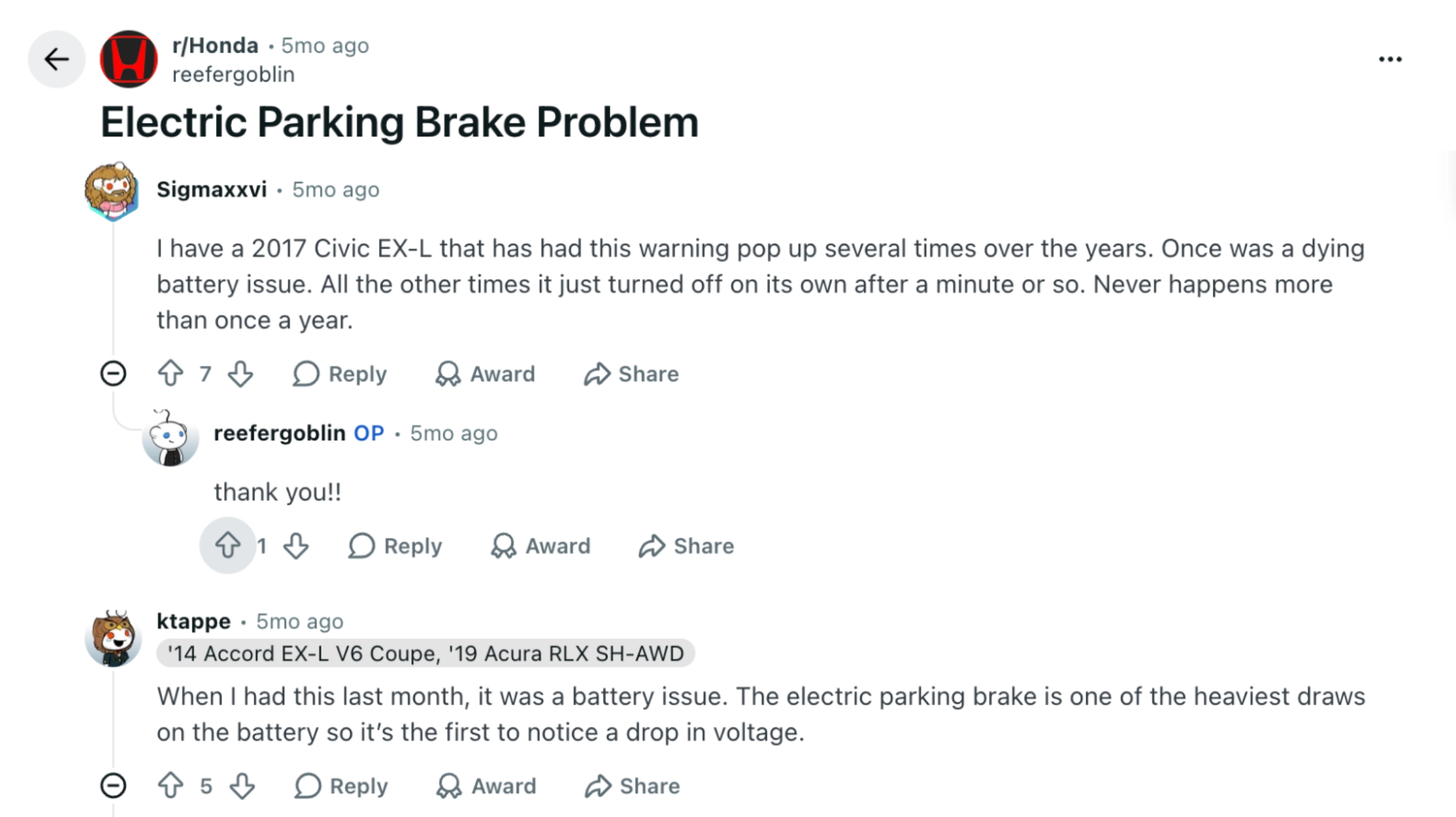
Reddit users discussing an electric parking brake problem on Honda models pointed to the battery as a common cause.
One 2017 Civic EX-L owner said the warning had appeared several times over the years, but only once was linked to a dying battery. Other times, the message cleared on its own within a minute, and that happened rarely.
Another user with an Accord and Acura shared that their recent parking brake malfunction was also battery-related, explaining that the electric parking brake can notice voltage drops early because it draws heavily from the battery.
The main takeaway is simple: before replacing EPB parts, check battery health, voltage stability, and whether the warning returns consistently.
When to Fix It Yourself or Call a Mechanic
Some electric parking brake warnings can be handled with basic checks at home, but repeated alerts, stuck brakes, or fault codes usually need a mechanic.
| Situation | Best approach |
|---|---|
| The warning clears after a restart and doesn’t return | Monitor it, no action needed yet |
| Battery tests weak or old (3+ years) | DIY replacement is straightforward on most models |
| The switch feels dirty, but the brake still functions | DIY cleaning with electronics-safe contact cleaner |
| Warning persists after restart and fluid check | Mechanic visit for a code scan |
| Brake engages unexpectedly or won’t release | Mechanic visit, avoid driving further than necessary |
| Grinding, sticking, or motor noise at the caliper | Mechanic visit, likely a servo or caliper issue |
Anything beyond a code scan usually calls for specialized diagnostic tools built for the specific module in your car, which is one reason EPB repairs on newer vehicles tend to be done at a shop rather than in a driveway.
Known Electric Parking Brake Recalls
Several automakers have issued recalls for electric parking brake (EPB) problems over the years. While the causes differ, many involve wiring or components that can prevent the parking brake from working correctly or cause it to engage unexpectedly.
- Honda (2016 Civic): Recalled more than 350,000 vehicles after the parking brake could fail to engage when the ignition was turned off, creating a potential rollaway risk.
- Honda (Later Models): Although the recall only covered the 2016 model year, some owners of newer Civics have reported similar symptoms through forums and complaints.
- General Motors (2025 Chevrolet Blazer EV): Recalled certain models because the rear parking brake wiring harness may become damaged or corroded, leading to unintended brake activation or loss of parking brake function.
- Ford (2023 F-150): Issued a recall after rear-axle wiring rubbed against the axle housing, wearing through the insulation and triggering unintended parking brake engagement in hundreds of reported cases.
- Common Pattern: Many EPB recalls are linked to damaged or poorly routed wiring exposed to heat, friction, or repeated movement.
If your vehicle is a few years old, check your VIN using the NHTSA Recall Lookup Tool before assuming an electric parking brake warning is only a temporary glitch.
Final Brake
An electric parking brake problem can feel stressful when the warning light comes on suddenly, but most cases start with simple causes like a weak battery, low brake fluid, a stuck switch, or a sensor issue.
The key is not to ignore it or guess your way through repairs. Start with the basic checks, then get the fault code scanned if the parking brake malfunction keeps returning.
That code can point you toward the real problem and help you avoid wasting money on parts you do not need.
Modern cars depend on small electronic systems working together, so early checks matter. Have you seen a similar warning on your dashboard? Drop the exact message in the comments.
Frequently Asked Questions
Can I Drive with the Parking Brake Warning Light on?
Usually, yes, if the brake is not engaged and the brake pedal feels normal. If the car behaves strangely or the brake engages on its own, stop driving and get it checked.
Why Does My Parking Brake Engage on Its Own While Driving?
This usually indicates a wiring fault or a software issue in the control module, often linked to brake hold or adaptive cruise features. Since it can trigger the system unexpectedly, get it checked promptly.
How Do I Reset the Electric Parking Brake without a Scan Tool?
Restarting the car can clear temporary faults. If not, disconnect the 12V battery for a few minutes, but expect settings like the clock and radio presets to reset.
Does a Dead or Weak Battery Affect the Parking Brake?
Yes. A weak battery can trigger an electric parking brake warning because the EPB module requires a stable voltage to operate properly, even if the car still starts.