
Picture this: A basketball team scores 10 unanswered points, a tennis player breaks serve after several loose games, a soccer side pins its opponent back for 5 minutes without scoring. Each sequence feels like momentum, but the scoreboard only confirms that something has happened. It does not show whether the change is durable, what caused it, or whether the surrounding match conditions support the same pattern continuing. A useful reading starts by separating the visible event from the process beneath it and the context around it. The heat of the moment can make these events look definitive, even when the evidence underneath remains thin or contradictory.
That distinction also applies to psychological momentum. A 2026 real-time volleyball study recorded 2,103 player assessments during practice matches. Points won through a team’s own successful play produced stronger perceived momentum than points gained through an opponent’s error, while late self-inflicted errors had a sharper negative effect. The study measured how players felt during the match, not a universal change in performance. Its value lies in showing that the same point can carry different meaning, depending on how and when it occurs.
From a Score Swing to a Usable Signal
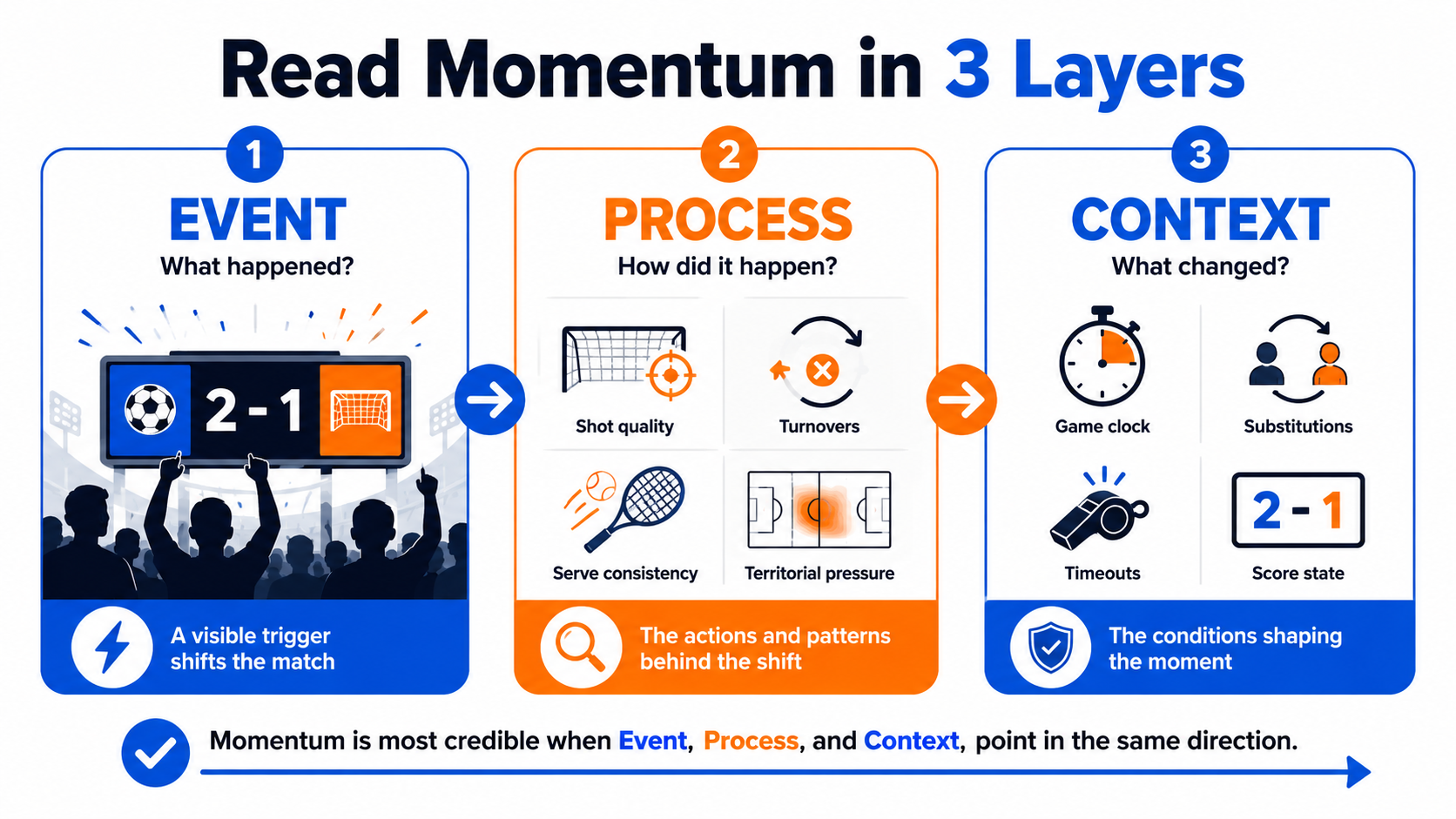
Three layers make live sports data easier to read. The event layer records the obvious trigger. The process layer asks what quality of play produced it. The context layer checks when it happened, who was involved, and what conditions had changed.
Suppose a basketball team produces an 8-0 run, and a viewer opens the Sports section at Lucky Rebel. The scoring burst belongs to the event layer, but it is only the start of the analysis. The process layer asks whether the team is reaching the rim, creating open shots, forcing turnovers, or simply converting difficult attempts at an unusual rate. The context layer then checks lineups, foul trouble, game stage, recent substitutions, and whether a timeout has interrupted the sequence.
This order matters whenever a separate sports platform is being used alongside a broadcast because the platform can reflect the current score without explaining the mechanism behind it. A genuine signal is a change in how the game is being played, supported by the situation, rather than the visual excitement of consecutive points alone.
A companion article on reading live momentum through game data supplies practical examples across basketball, tennis, and soccer. It makes the distinction between the scoreboard and underlying indicators, such as shot quality, turnovers, first-serve percentage, unforced errors, possession, shots, and expected goals. Those indicators are questions to investigate, not proof that a run must continue.
Apply the Same Test Across Different Sports
In basketball, an 8-0 run built on layups after turnovers has a clearer process than one built on contested jump shots. The first sequence points to defensive pressure and repeatable access to high-value areas. The second may reflect excellent execution, but the viewer needs more information before calling it a structural shift. Foul trouble or a lineup change can strengthen the signal because it explains why the process changed.
Tennis compresses the same test into individual points. A break of serve is the event. The process might include a falling first-serve percentage, shorter rallies ending in errors, or weaker second serves. The context includes the score within the set, the server’s recent service games, and whether the pattern persists after the changeover. One poor game can be decisive without establishing a broader trend.
Soccer often produces momentum without an immediate goal. Territorial pressure, repeated entries into the penalty area, rising shot volume, and chances from dangerous locations provide process evidence. Context still matters. A team protecting a lead may deliberately surrender possession, while a recent substitution may explain a sudden increase in pace. Possession alone is therefore incomplete. It becomes informative when paired with what the team is doing with the ball.
Match Time Changes the Meaning of the Data
The context layer prevents a common mistake: treating the same metric as equally informative throughout a contest. A PLOS One analysis of 1,141 NBA games found that rapid possession segments became more common toward the ends of quarters, while slower segments were more prominent through middle phases. The authors also cautioned that their findings may not transfer unchanged to leagues with different rules and playing styles.
That pattern does not mean faster play automatically signals stronger momentum. Late-quarter urgency, clock management, deliberate fouling, and rotation choices can all alter pace. The metric becomes useful only after the viewer asks why it changed. The same principle applies to a tennis error at 1-1 in the opening set and at break point late in the third, or to a soccer shot when both teams are settled, compared with one taken during a desperate final push.
Momentum is best treated as a working interpretation, not a hidden force waiting to be detected. Start with the event, test the process, then add the match context. When all three layers point in the same direction across several passages of play, the signal deserves attention. When only the score has moved, the honest reading is that the evidence is still incomplete.