If you have ever worked on a software project that became difficult to update or manage, you already know how important good design can be.
One concept that helps developers build cleaner and more organized applications is software modularity.
Understanding software modularity can make it easier to see why many modern software systems are built the way they are.
In this article, I’ll explain the basic idea behind software modularity in simple terms. You’ll learn how it works, why it is important in software design, and the benefits it brings to development teams.
I’ll also cover common examples, best practices, and some challenges developers may face when using a modular approach.
By the end, you’ll have a clear understanding of this key software design concept and how it supports better software development.
What Is Software Modularity?
Software modularity is a software design approach that divides a large application into smaller, independent units called modules.
Each module is responsible for a specific function and can be developed, tested, updated, and maintained separately.
Instead of building one large block of code, developers create multiple modules that work together to form the complete system.
This approach makes software easier to manage as projects grow in size and complexity. When a change is needed, developers can often update a single module without affecting the rest of the application.
It also helps teams work more efficiently because different developers can focus on different modules at the same time.
Software modularity is widely used in modern software development because it improves code organization, reduces maintenance challenges, and supports the creation of scalable and reliable applications.
How Does Software Modularity Work?
Software modularity works by breaking a software application into smaller, self-contained modules that handle specific tasks. These modules interact through defined interfaces, allowing them to work together while remaining largely independent.
- Dividing the Software into Modules: The application is split into separate components, with each module responsible for a particular function or feature.
- Creating Clear Interfaces: Modules communicate through predefined interfaces, ensuring smooth interaction without exposing internal details.
- Reducing Dependencies: Each module is designed to operate independently, minimizing the impact of changes made to other parts of the system.
- Enabling Independent Development: Different teams can work on separate modules simultaneously, improving productivity, and this is where automated development workflows make the biggest difference
- Supporting Easy Updates and Testing: Individual modules can be tested, fixed, or upgraded without affecting the entire application.
Key Components of Software Modularity
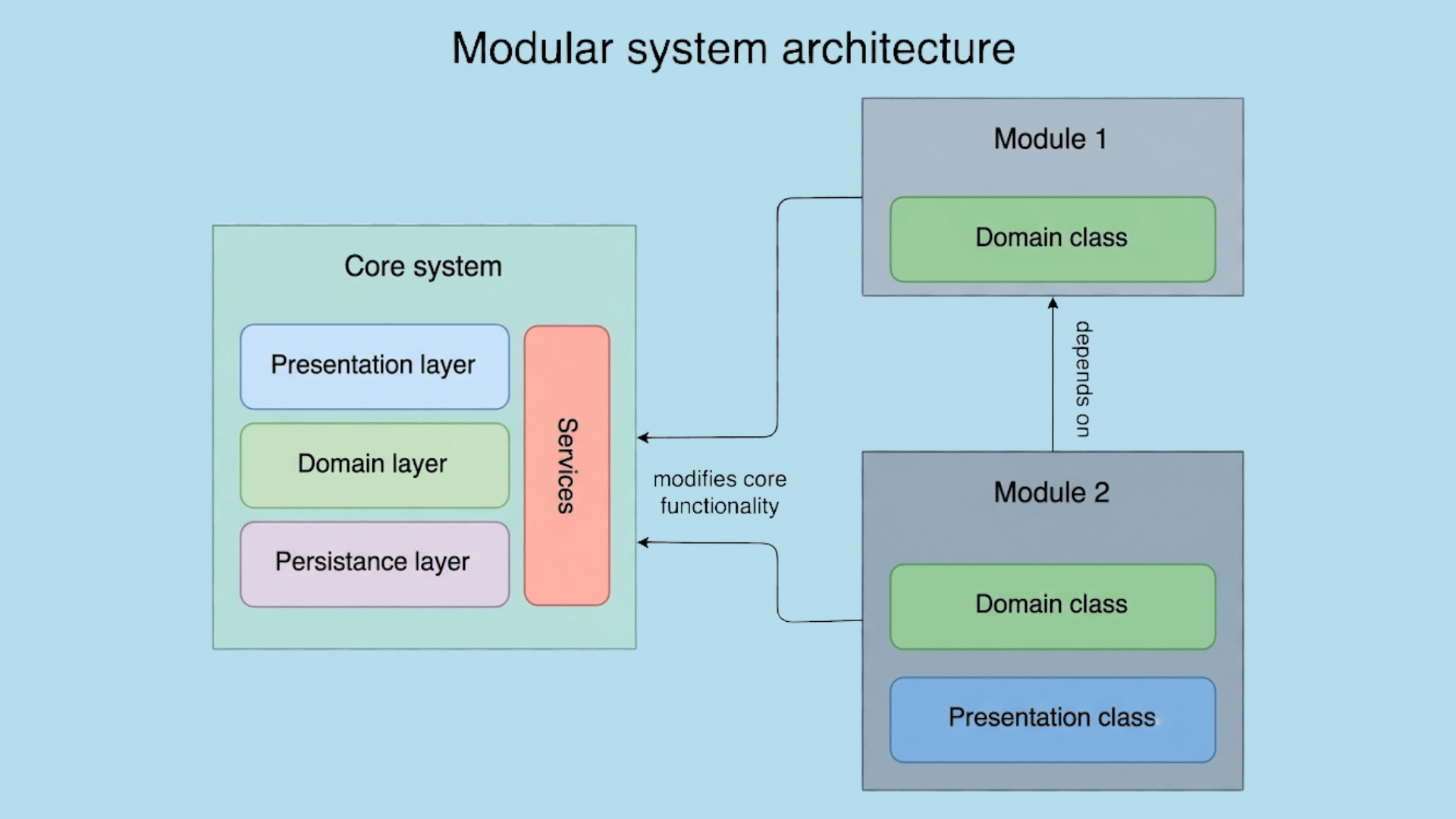
Software modularity is built on key components that improve software organization, flexibility, and maintainability. Together, these elements help modules work independently while ensuring the entire system functions smoothly.
1. Modules
Modules are the core building blocks of a modular software system. Each module is designed to perform a specific function and contains the code, data, and logic needed for that task.
By dividing software into separate modules, developers can organize large applications into smaller, more manageable parts.
This makes development, testing, and maintenance easier because changes can often be made to one module without affecting others.
Modules also help teams work more efficiently by allowing different developers to focus on separate parts of the application.
2. Interfaces
Interfaces define how modules communicate and exchange information with one another. They provide a clear set of rules that modules must follow when interacting.
Instead of accessing a module’s internal code directly, other modules use its interface to request services or share data. This separation improves flexibility and reduces the risk of errors during updates.
From what I have read about software architecture, clear interfaces are one of the main reasons large applications remain manageable as they grow over time.
Well-designed interfaces also make software easier to expand because new modules can be added without requiring major changes to existing components.
3. Encapsulation
Encapsulation is the practice of keeping a module’s internal details hidden from the rest of the system. Only the necessary functions and information are exposed through the module’s interface.
This approach protects the module from unintended interference and prevents other parts of the software from depending on its internal structure.
As a result, developers can modify or improve the module without affecting unrelated components.
Encapsulation improves software security, maintainability, and reliability while helping keep complex systems easier to manage.
4. Cohesion
Cohesion refers to how closely related the responsibilities within a module are. A highly cohesive module focuses on a single task or purpose rather than handling multiple unrelated functions.
High cohesion improves code organization and makes modules easier to understand, test, and maintain.
When all elements within a module work toward the same objective, developers can identify and fix issues more quickly.
Strong cohesion also supports better modularity because modules remain focused, independent, and easier to reuse in different software projects.
5. Coupling
Coupling measures the level of dependency between modules in a software system. In modular design, the goal is to minimize coupling so that modules can operate independently.
Low coupling means changes made to one module are less likely to affect others, reducing the risk of errors and simplifying maintenance.
It also makes software more flexible and scalable because modules can be updated, replaced, or expanded with minimal disruption.
Managing coupling effectively is essential for building reliable and adaptable software applications.
Modular Decomposability and Meyer’s Five Criteria
Bertrand Meyer defined five properties that a good modular design method should satisfy. These criteria are widely cited in the software engineering literature and provide teams with a practical checklist for evaluating their approach.
- Modular Decomposability: The system can be broken into sub-problems that are solvable independently, reducing overall complexity.
- Modular Composability: Modules can be combined to form new systems, even in different environments from where they were originally created.
- Modular Understandability: Each module can be understood in isolation without needing to read the full codebase.
- Modular Continuity: A change in system requirements affects only individual modules, without cascading effects across the whole system.
- Modular Protection: An error or failure within a module stays contained within that module and does not propagate to unrelated parts of the application
Why Is Software Modularity Important?
Software modularity is important because it makes software easier to develop, maintain, and scale.
It helps developers organize complex applications into smaller, manageable parts that can be updated independently.
As software projects grow, managing a large codebase can become challenging. Modularity reduces this complexity by separating the application into distinct modules, each with a specific responsibility.
This approach allows developers to identify and fix issues more quickly while minimizing the impact on other parts of the system.
It also improves collaboration, as multiple teams can work on different modules at the same time. In addition, modular software is easier to test, reuse, and expand when new features are needed.
By improving flexibility and maintainability, software modularity helps organizations build reliable applications that can adapt to changing business and user requirements.
Benefits of Software Modularity
Software modularity provides several benefits that make software easier to develop, maintain, and scale. By dividing applications into independent modules, developers can manage complexity and improve overall efficiency.
- Easier Maintenance: Individual modules can be updated, fixed, or improved without changing the entire application.
- Improved Scalability: New features and functionalities can be added more easily by creating or modifying specific modules.
- Faster Development Cycles: Multiple developers or teams can work on different modules simultaneously, speeding up the development process.
- Better Team Collaboration: Clear module boundaries help teams divide responsibilities and coordinate work more efficiently.
- Enhanced Code Reusability: Existing modules can often be reused in other projects, reducing development time and effort.
- Simplified Testing: Modules can be tested independently, making it easier to identify and resolve issues before deployment.
Types of Software Modularity in Software Design
Software modularity can be implemented in different ways depending on how a software system is designed and organized. Each type focuses on separating functionality to improve maintainability, flexibility, and development.
| Type of Software Modularity | Description | Example |
|---|---|---|
| Functional Modularity | Organizes software into modules based on specific functions or tasks. Each module performs a distinct operation. | A payroll system with separate modules for salary calculation, tax management, and reporting. |
| Object-Oriented Modularity | Groups related data and behaviors into objects or classes. This approach promotes code reuse and encapsulation. | An e-commerce application with separate classes for products, customers, and orders. |
| Layered Modularity | Divides software into layers, such as presentation, business logic, and data access. | A web application with separate user interface, application logic, and database layers. |
| Component-Based Modularity | Builds applications using reusable software components that can be independently developed and integrated. | A content management system using reusable plugins and widgets. |
| Service-Oriented Modularity | Structure software as a collection of independent services that communicate through defined protocols. | An online shopping platform with separate services for payments, inventory, and shipping. |
Best Practices for Implementing Software Modularity
Implementing software modularity effectively requires careful planning and design decisions. Following proven practices can help developers create modules that are easier to maintain, scale, and reuse over time.
- Keep Modules Focused: Design each module to handle a single responsibility or closely related set of functions to improve clarity and maintainability.
- Define Clear Interfaces: Establish well-documented interfaces so modules can communicate consistently without exposing internal implementation details.
- Minimize Dependencies: Reduce unnecessary connections between modules to prevent changes in one area from affecting others.
- Prioritize High Cohesion: Ensure that all elements within a module contribute to the same purpose, making the module easier to understand and manage.
- Promote Reusability: Create modules that can be reused across projects and applications to save time and effort.
- Document Module Functionality: Maintain clear documentation for module responsibilities, interfaces, and dependencies to support long-term maintenance and collaboration.
When Should You Use Software Modularity?
You should use software modularity when building applications that need to be easy to maintain, scale, and update over time.
It is especially useful for large or complex projects where different parts of the software serve distinct functions.
Software modularity helps developers manage complexity by dividing an application into smaller, independent modules.
This approach is beneficial when multiple teams are working on the same project, as each team can focus on a specific module without interfering with others.
It is also a good choice when software is expected to grow, since new features can be added more easily.
In my experience, modularity becomes increasingly valuable as projects expand because it reduces maintenance challenges and keeps the codebase organized.
If developing enterprise applications, web platforms, or cloud-based systems, modularity supports long-term flexibility and efficiency.
Software Modularity vs Monolithic Architecture
Software modularity and monolithic architecture are two different approaches to software design. Understanding their differences can help choose the right structure based on project requirements and scalability needs.
| Aspect | Software Modularity | Monolithic Architecture |
|---|---|---|
| Structure | Divides an application into smaller, independent modules. | Combines all components into a single, unified codebase. |
| Maintenance | Individual modules can be updated without affecting the entire system. | Changes often require updating and testing the whole application. |
| Scalability | Specific modules can be scaled based on demand. | The entire application typically needs to be scaled as a whole. |
| Development Speed | Multiple teams can work on different modules simultaneously. | Teams often work within the same codebase, which can create dependencies. |
| Testing | Modules can be tested independently, making issue detection easier. | Testing usually involves larger portions of the application. |
| Flexibility | New features can be added by creating or modifying specific modules. | Adding features may require changes across multiple areas of the codebase. |
| Code Reusability | Modules can often be reused in other projects or applications. | Reusing functionality outside the application can be more difficult. |
| Complexity Management | Helps manage large and complex software systems more effectively. | Can become difficult to manage as the application grows. |
| Best Suited For | Large, scalable, and long-term software projects. | Small to medium-sized applications with simpler requirements. |
Future Trends in Software Modularity
Software modularity continues to evolve as software systems become larger and more complex. Emerging technologies and development practices are driving new approaches to building flexible, scalable, and maintainable applications.
- Greater Adoption of Microservices: Organizations are increasingly using microservices to break applications into smaller, independent services that can be developed and deployed separately.
- Increased Use of Cloud-Native Architectures: Modular design is becoming a key component of cloud-native applications, enabling businesses to scale resources more efficiently.
- AI-Assisted Software Development: Artificial intelligence tools are helping developers create, manage, and optimize modular code structures more quickly and accurately.
- Reusable Software Components: Development teams are placing more emphasis on creating reusable modules that can be shared across multiple projects and platforms.
- Enhanced Automation and DevOps Integration: Modular systems integrate well with automated testing, continuous integration, and continuous deployment, improving software delivery.
- Stronger Focus on Scalability: Future software solutions will continue to rely on modular architectures to support growing user demands and evolving business requirements.
Common Software Modularity Mistakes to Avoid
Software modularity can deliver significant benefits, but its effectiveness depends on how it is implemented. Avoiding common mistakes helps teams build systems that remain maintainable, scalable, and easy to manage.
| Mistake | Impact |
|---|---|
| Creating Too Many Small Modules | Excessive fragmentation can make the system harder to understand and manage, increasing complexity rather than reducing it. |
| High Coupling Between Modules | Strong dependencies between modules make updates more difficult and increase the risk of unintended side effects. |
| Poorly Defined Interfaces | Unclear interfaces can lead to communication issues between modules and make integration more challenging. |
| Ignoring Documentation | A lack of documentation makes it harder for developers to understand module responsibilities and to maintain the system over time. |
| Low Cohesion Within Modules | Modules that handle unrelated tasks become difficult to maintain, test, and reuse effectively. |
| Overlooking Testing | Failing to test modules independently can allow defects to spread across the application, creating larger issues. |
| Not Planning for Scalability | Modules designed without future growth in mind may require major restructuring as the application expands. |
| Reusing Modules Without Evaluation | Reusing modules that are not suited to a project’s requirements can introduce inefficiencies and compatibility issues. |
Conclusion
Software modularity is more than just a software design technique. It is a practical approach that helps developers build applications that are easier to maintain, scale, and improve over time.
If you are working on a small project or a large enterprise system, understanding modularity can help you create cleaner and more organized software.
As I researched this topic, one thing became clear: modularity often enables complex applications to remain manageable as they grow.
By breaking software into independent modules, teams can work more efficiently while reducing long-term maintenance challenges.
I hope this guide has helped you better understand what software modularity is and why it matters in modern software development.
Have you used modular design in your own projects? Share your experiences, challenges, or insights in the comments below.
Frequently Asked Questions
What Is the Simple Definition of Software Modularity?
Software modularity is the practice of dividing a software application into smaller, independent modules that perform specific functions.
What Is an Example of Software Modularity?
An e-commerce platform may use separate modules for product management, payments, inventory tracking, and customer accounts.
What Is the Difference Between Modularity and Microservices?
Modularity organizes software into independent components, while microservices extend this concept by running components as separate services.
Can Software Modularity Improve Software Performance?
While modularity primarily improves maintainability and scalability, well-designed modules can also help optimize system performance.
Is Software Modularity Suitable for Small Projects?
Yes, modularity can benefit small projects by improving code organization and making future updates easier to manage.