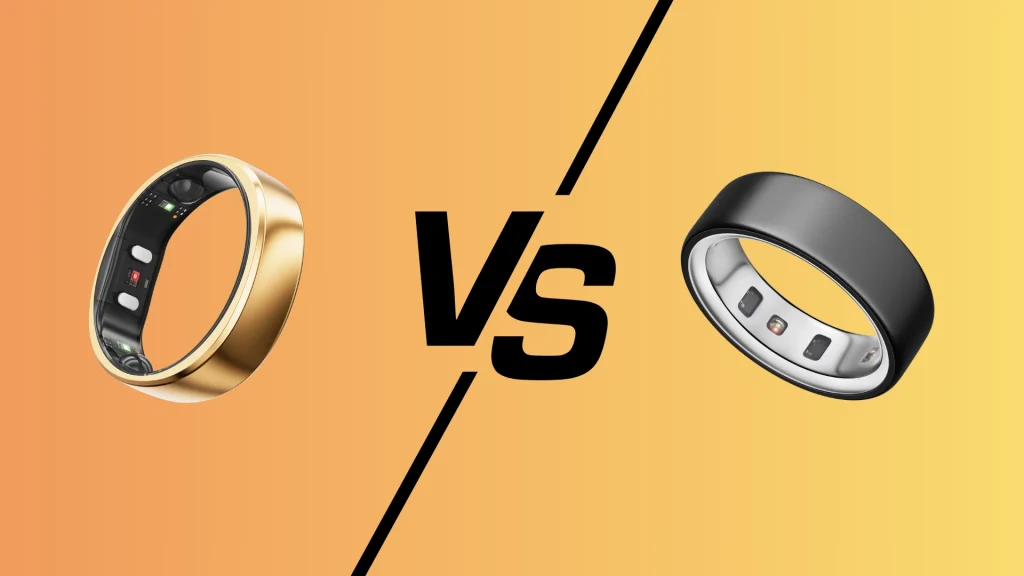
Tracking health sounds simple until the data starts feeling confusing or incomplete.
After eight years of testing wearables, from bulky fitness bands to the latest smartwatches, I kept coming back to the same problem: most devices are either too distracting to wear at night or too imprecise to trust in the morning.
Smart rings changed that equation for me, offering a quieter and more comfortable way to stay connected to daily wellness.
But when it comes to Ringconn vs Oura, the decision is not as easy as it looks.
Both promise better sleep tracking, recovery insights, and effortless monitoring, yet the experience can feel very different once worn every day.
Some users want clear guidance, while others just need reliable numbers without extra cost.
That small difference can change everything. If there has ever been a moment of wondering which ring actually fits real life better, this comparison is exactly where that clarity begins.
What is a Smart Ring and Why Are People Switching to It?
Smart rings are compact wearable devices designed to track health data without the bulk of a smartwatch.
In the context of Ringconn vs Oura, both rings use photoplethysmography (PPG) sensors, accelerometers, and skin temperature monitors to monitor heart rate, heart rate variability, blood oxygen levels, and skin temperature throughout the day and night.
These rings sit snugly on the finger, allowing continuous tracking with fewer interruptions compared to smartwatches that often need charging or feel intrusive.
Many users are switching to smart rings because of their minimal design and ease of use.
They are especially effective for sleep tracking since the finger provides more stable readings than the wrist.
Another key advantage is passive data collection, where the ring works quietly in the background without requiring constant interaction.
About RingConn and Oura
RingConn and Oura are two leading names in the smart ring space, but they come from very different backgrounds.
In the Ringconn vs Oura comparison, Oura is the more established brand, founded in 2013 in Oulu, Finland, with its first smart ring launched in 2015.
The company mainly focuses heavily on sleep and recovery tracking.
On the other hand, RingConn is a newer company, founded around 2021 and gaining attention after its launch through crowdfunding in 2022, positioning itself as a more affordable and subscription-free alternative.
While Oura has years of research and global adoption behind it, RingConn entered the market with a focus on accessibility, longer battery life, and simpler health tracking, making the competition between the two increasingly relevant today.
RingConn vs Oura: Key Differences
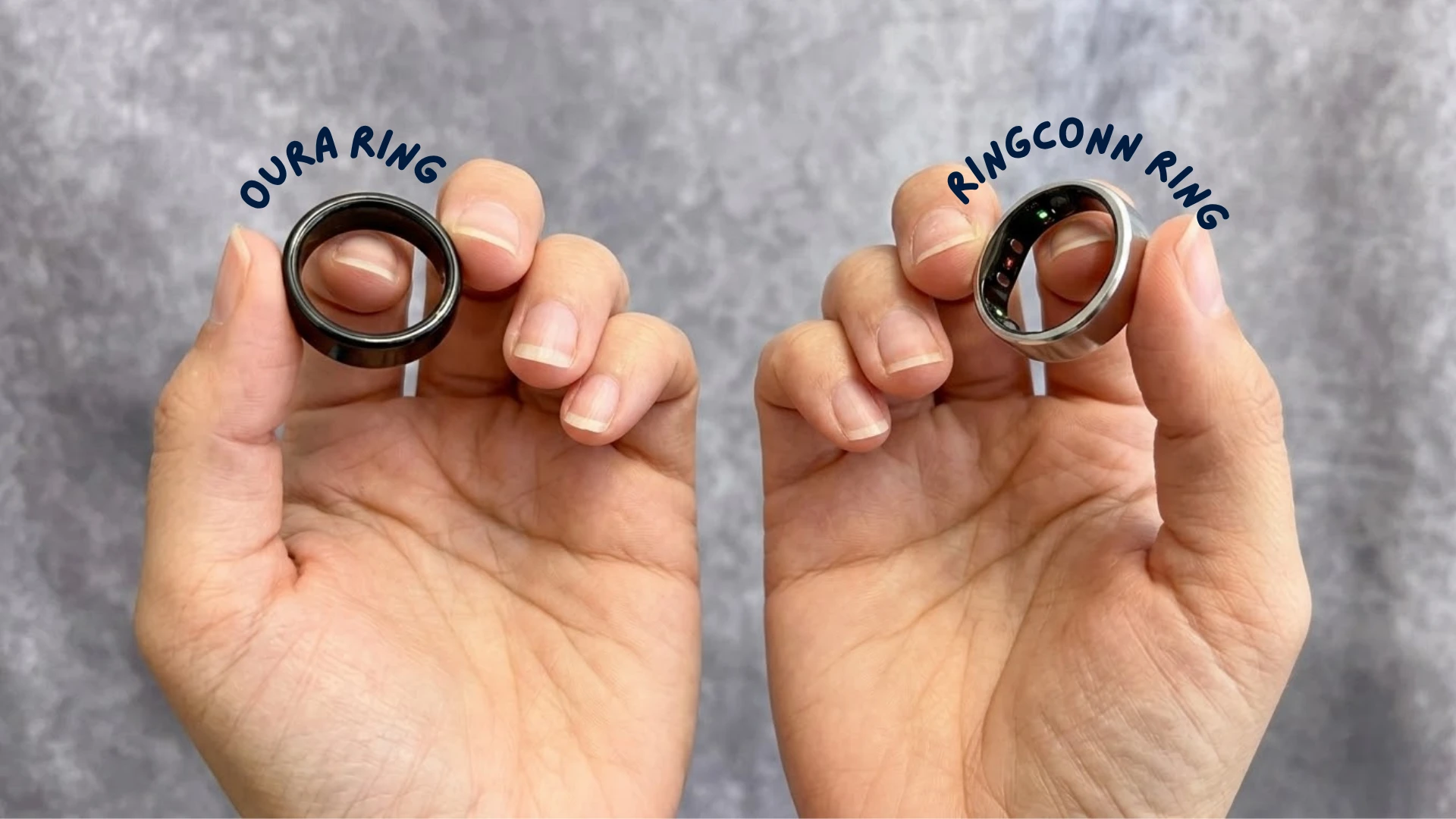
RingConn focuses on comfort, longer battery life, and a one-time purchase model, while Oura leans toward advanced data analysis, app experience, and deeper health insights.
1. Design, Comfort, and Build Quality
In the Ringconn vs. Oura comparison, both rings use premium titanium for durability and a lightweight feel, but their physical design differs in noticeable ways.
RingConn stands out with a thinner profile of around 2mm, while Oura is slightly thicker at about 2.8mm, making it feel a bit more prominent on the finger
Weight also varies: RingConn averages 2-3 grams depending on size, while Oura ranges from about 3.3 to 5.2 grams.
Oura provides a wider size range, typically from US sizes 4 to 15, along with multiple finishes like matte, brushed, and rose gold.
RingConn offers fewer finishes and a slightly narrower size range, usually from size 6 to 14.
2. Health Tracking
In the RingConn vs Oura comparison, both rings track key health metrics such as heart rate, heart rate variability, blood oxygen levels, skin temperature, and sleep stages.
Both devices use optical sensors and motion tracking to continuously collect data, especially during sleep, where they perform best and enhance health tracking.
However, Oura has an advantage in accuracy due to its advanced algorithms and multi-sensor system that improves data consistency even if the ring shifts slightly.
RingConn still delivers reliable data, but it focuses more on raw metrics rather than refined interpretation, which can make the experience feel less guided.
The RingConn Gen 2 features built-in sleep apnea monitoring, tracking breathing patterns, and blood oxygen levels throughout the night to provide an AHI (Apnea-Hypopnea Index) score for better sleep health insights.
3. App Experience and Data Insights
The app experience is a major difference between RingConn vs Oura, especially for beginners.
Oura offers a clean and easy-to-use app that turns complex data into simple scores like sleep, readiness, and activity, making it easier to understand daily health trends.
It synthesizes all your biometric data into three actionable scores: Sleep, Activity, and its signature Readiness Score, which tells you whether your body is ready to push hard or needs recovery
It also connects with over 40 health apps, creating a more connected ecosystem.
RingConn, on the other hand, provides detailed charts and raw data, which may appeal to users who prefer analyzing their own metrics.
However, it lacks the same level of polish and guided insights, making it slightly less beginner-friendly.
4. Battery Life and Charging Performance
Battery life is where RingConn vs Oura shows a clear difference.
RingConn offers a battery life of 10 to 12 days on a single charge, making it ideal for users who prefer less frequent charging.
In comparison, Oura typically lasts about 5 to 8 days, depending on usage and enabled features like blood oxygen tracking.
Charging also differs slightly, with both rings taking around 1 to 1.5 hours to fully recharge.
Overall, RingConn offers more convenience for long-term use, especially for travel or continuous wear without interruptions.
RingConn vs Oura: At a Glance
Both rings track core metrics like sleep, heart rate, and recovery, but the way they present and use that data sets them apart.
A quick glance at their key differences helps highlight which one aligns better with specific needs.
| Feature | RingConn | Oura Ring 4 |
|---|---|---|
| Subscription | No lifetime app access | $5.99/month or $69.99/year |
| Battery Life | 10-12 days | 5-8 days |
| Thickness | 2mm | 2.8mm |
| Weight | 2-3g | 3.3-5.2g |
| Sleep Apnea Detection | Yes (Gen 2 only) | No |
| Readiness Score | Partial (4 separate scores) | Yes (AI-guided) |
| Women’s Health | Basic cycle tracking | Best-in-class + Natural Cycles sync |
| App Integrations | Apple Health, Google Fit | 40+ apps, including Strava |
| HSA/FSA Eligible | Yes | Yes |
| Water Resistance | 100m (IP68) | 100m |
| Size Range | US 6–14 | US 4–15 |
Pricing Differences in RingConn vs Oura
RingConn offers better value than the Oura Ring with its lower upfront cost and no ongoing fees.
The RingConn Gen 2 starts at $199 for the Air model or $299 for standard finishes like silver, matte black, or gold, while its rose gold version costs $469.
In contrast, Oura Ring 4 begins at $349 for basic silver or black, rises to $399 for brushed options, and hits $499 for gold or rose gold finishes.
Oura requires a mandatory $5.99 monthly or $69.99 annual subscription to unlock full features like detailed insights, adding ~$72 yearly, which RingConn avoids entirely.
Over one year, Oura totals about $371 to $571, depending on the model, versus RingConn’s flat $199-$469; after two years, Oura climbs to $443-$643 while RingConn stays the same.
This subscription-free model makes RingConn cheaper long-term for budget-conscious users seeking sleep, activity, and health tracking without recurring costs.
Real User Experiences with RingConn vs Oura
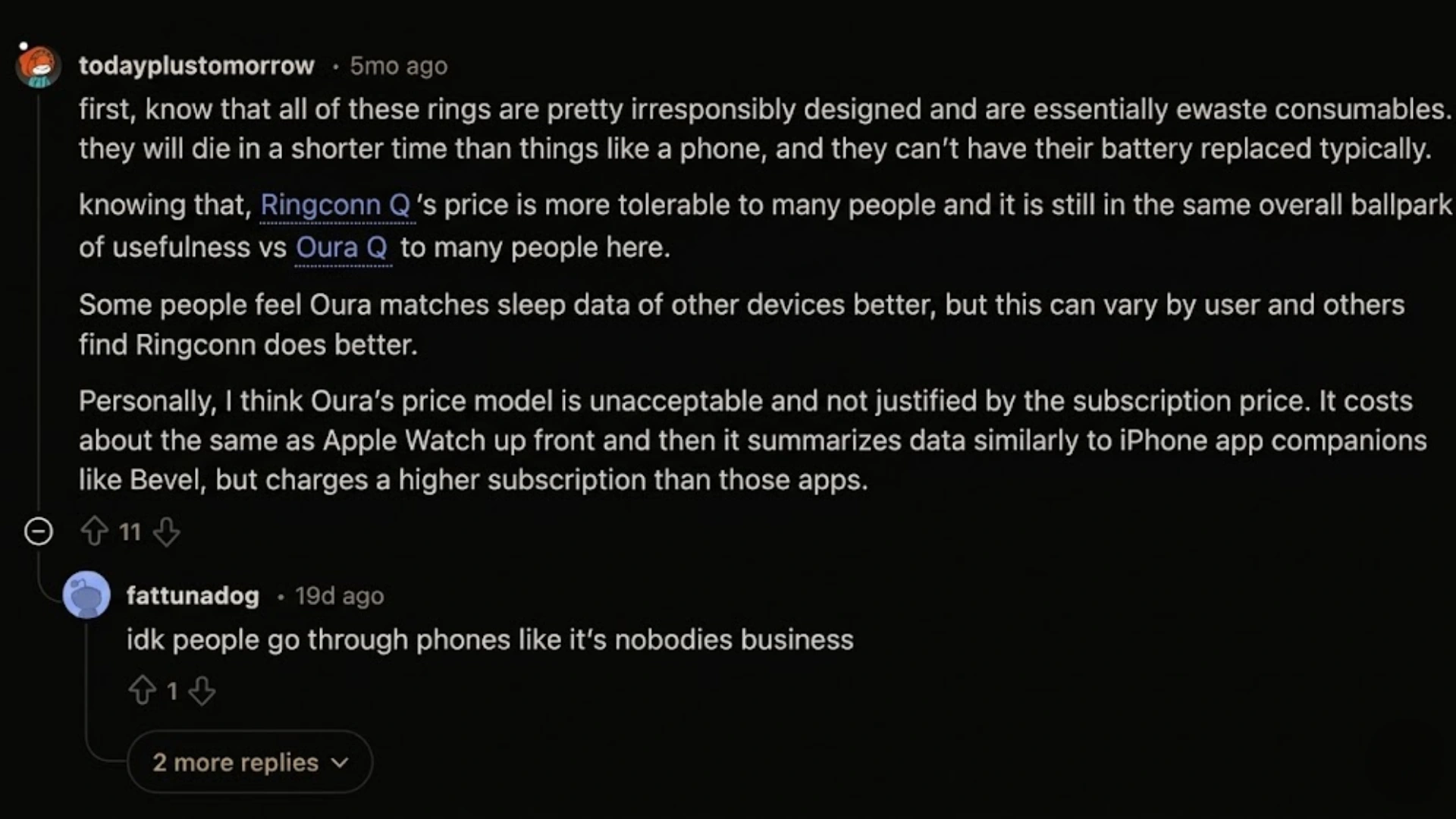
Reddit discussions reveal a mixed but insightful picture when comparing RingConn and Oura.
Many users feel both devices deliver similar health and sleep tracking performance, with only minor differences in accuracy.
Some mention Oura being slightly better at tracking sleep timing, but not enough to justify its higher cost.
Price is a major talking point. Users often question Oura’s premium pricing and ongoing subscription, especially when RingConn offers comparable features at a lower one-time cost.
However, Oura does earn praise for its polished app and more refined software experience.
On the other hand, RingConn is appreciated for its value and improving performance over time. A few users also raised concerns about battery life and long-term durability for both devices.
Overall, Reddit users lean toward RingConn for affordability, while Oura attracts those who prefer a smoother app experience.
What is the Lawsuit Against Oura v RingConn?
Oura sued RingConn in a patent infringement lawsuit over the design of smart rings.
Oura claimed RingConn copied the special form factor and internal layout of the Oura Ring, which includes how the electronic parts and sensors are arranged inside the small wearable device.
The main case was filed with the US International Trade Commission in 2024.
In 2025, the ITC agreed with Oura, ruled that RingConn infringed the patents, and ordered a ban on importing and selling those rings in the United States starting October 21, 2025.
On the same day, the companies settled out of court. RingConn agreed to pay royalties for a multi-year license to use the patented technology and keep selling its rings and app in the US.
Oura then dropped all its claims against RingConn. This ended the legal fight and allowed competition to continue under a licensing deal.
RingConn vs Oura: Which One Should You Buy?
Choosing between RingConn and Oura depends on what matters most in daily use.
In the RingConn vs Oura comparison, RingConn is a strong choice for users who want a simple, budget-friendly smart ring with no monthly subscription and longer battery life.
It works well for basic health tracking and comfort during all-day wear.
On the other hand, Oura is better suited for users who want deeper health insights, guided data, and a more polished app experience.
It offers a better interpretation of sleep and recovery data, which can be useful for long-term wellness tracking. If the goal is value and low maintenance, RingConn makes sense.
If advanced tracking and smarter insights are the priority, Oura is the better option.
Conclusion
Both smart rings bring something different to the table, and that is what makes the comparison so interesting. After spending years with both types of devices, the honest answer is simple.
RingConn focuses on simplicity, longer battery life, and a one-time cost, which suits users who want a low-maintenance experience without worrying about extra fees or frequent charging.
Oura, on the other hand, stands out with detailed insights, a refined app, and stronger health guidance, making it feel more advanced and helpful for tracking long-term wellness patterns.
The right pick depends on whether basic tracking or deeper data matters more in everyday life. Each ring delivers value in its own way, without trying to be the same or replace each other completely.
Which smart ring, Ringconn vs Oura, would you pick and why? Comment down below.
Frequently Asked Questions
Why Are People Ditching Oura Rings?
Some users move away from Oura due to the monthly subscription, higher upfront cost, and preference for simpler devices like RingConn that offer similar tracking without ongoing fees.
Which Ring is Suitable For Fertility Tracking?
Oura is more suitable for fertility tracking due to accurate temperature sensing, cycle insights, and advanced data interpretation, which help track patterns related to ovulation and overall reproductive health.
Does Oura Give Off Radiation?
Oura uses low-energy Bluetooth, which emits minimal non-ionizing radiation similar to smartphones and wearables. Exposure levels remain well within safety limits set by global health standards.