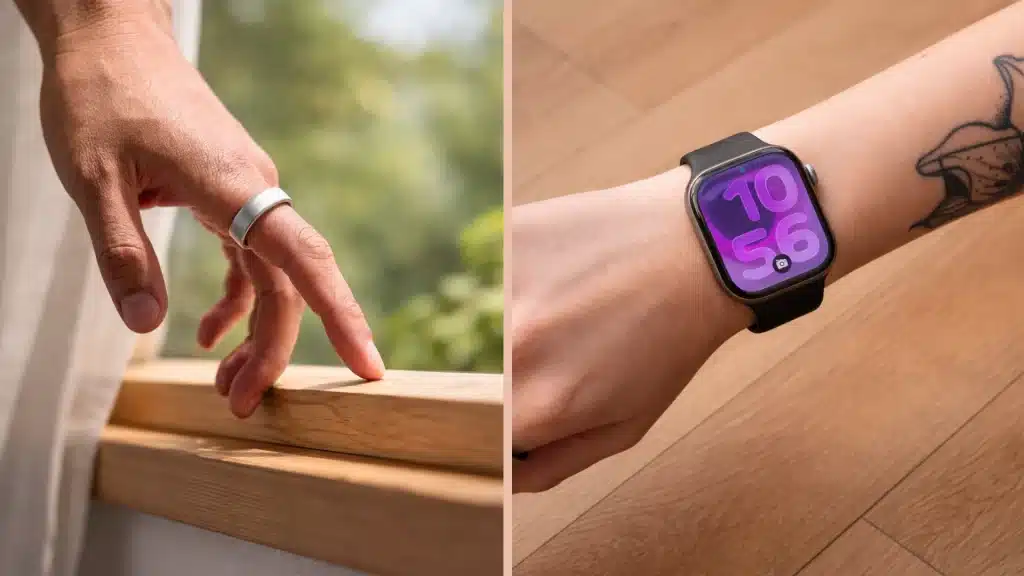
Tracking health used to mean guesswork, which included counting steps, estimating sleep, and hoping workouts were actually working.
Then wearables changed everything, but now the real question begins: which one actually fits daily life better?
For that matter, when doing the comparison of the Oura ring vs theApple watch, the choice is not just about features. It is about how each device feels, how often it gets used, and whether it truly helps build better habits.
Some people want quiet insights without distractions, and others want real-time feedback, reminders, and a device that keeps them moving.
That moment of confusion is where most buyers get stuck. Both promise better health, but in very different ways. And choosing wrong can mean ending up with a device that gets ignored after a few weeks.
About Oura Ring & Apple Watch
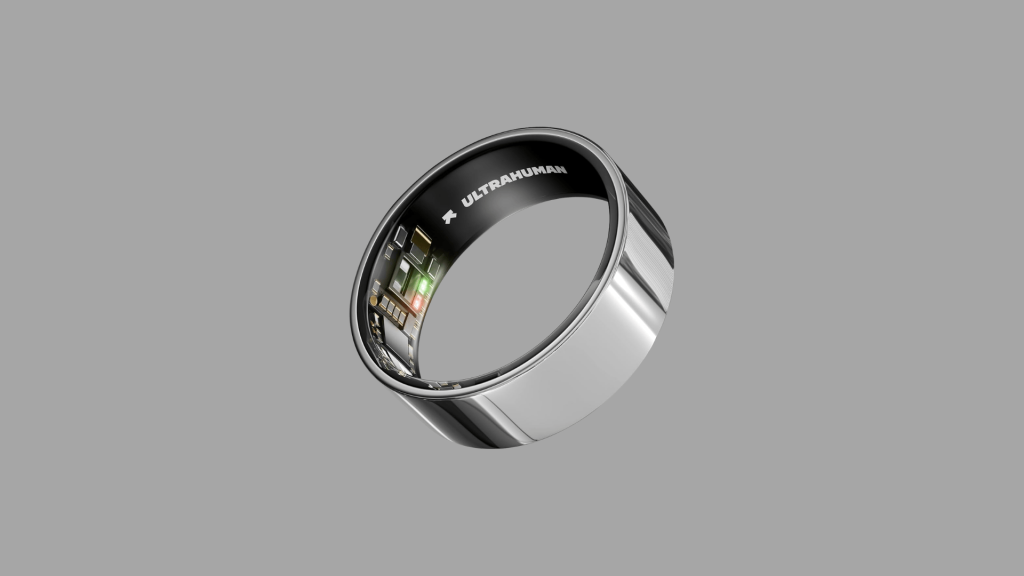
Oura Health launched the Oura Ring in 2015 as a screen-free tracker focused on sleep, recovery, and overall wellness, with a minimalist design that works quietly in the background without constant interaction.
In the same year, Apple introduced the Apple Watch as a full-featured smartwatch focused on fitness, communication, and daily productivity, offering real-time data, apps, and notifications throughout the day.
The two devices represent different approaches: Oura focuses on passive health insights, while Apple Watch combines tracking with connected smart features.
Both are well established but serve different needs and lifestyles.
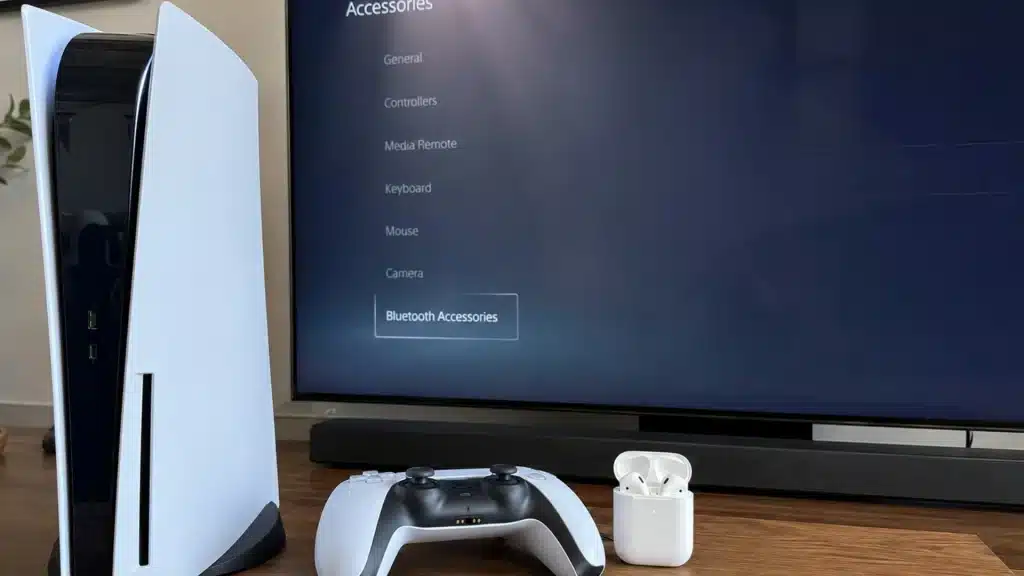
One important detail to know before choosing is compatibility, as the Oura Ring works with both iOS and Android, while the Apple Watch is limited to iOS only.
Design and Comfort: Ring vs Watch in Daily Life
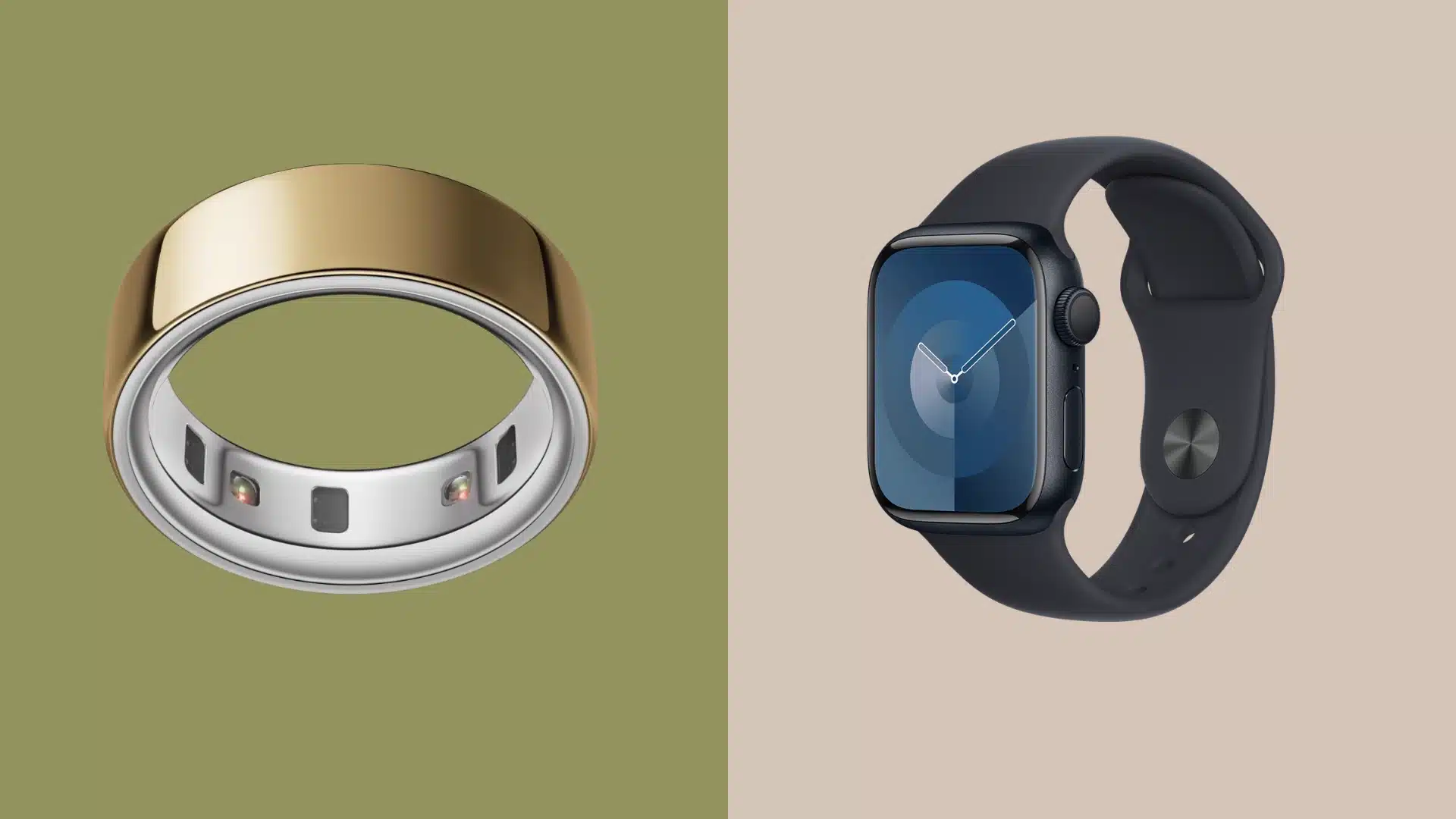
The Oura Ring is extremely lightweight, weighing around 3 to 5 grams, with a slim titanium body that is just 2.8 mm thick, making it easy to wear all day and even during sleep without discomfort.
It is water-resistant up to 100 meters and includes sensors like infrared LEDs, temperature tracking, and heart rate monitoring built into a compact ring.
The Oura Ring 4, the current generation, has a smoother inner surface compared to the Gen 3, which had raised sensor bumps, a meaningful comfort improvement for all-night wear.
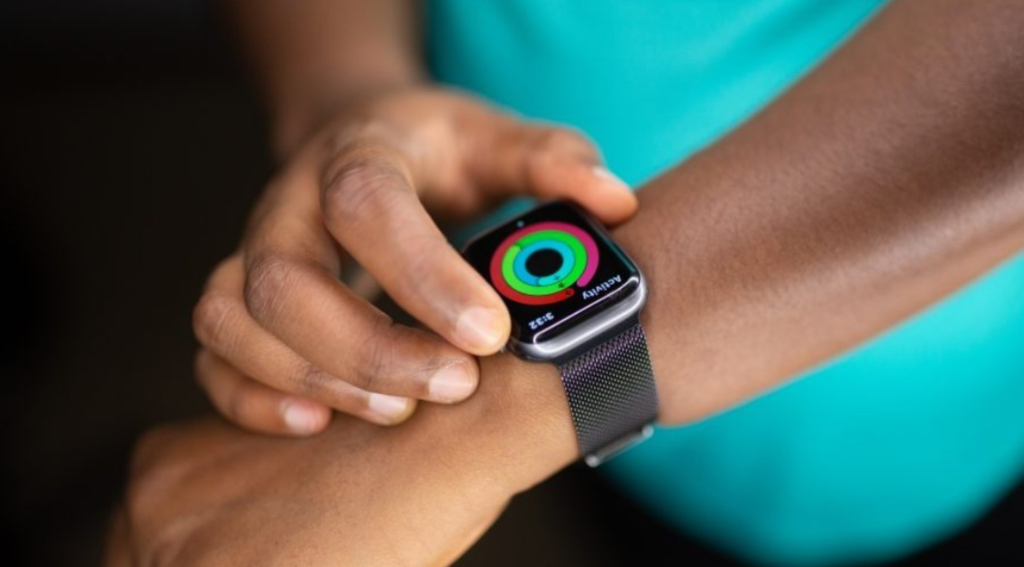
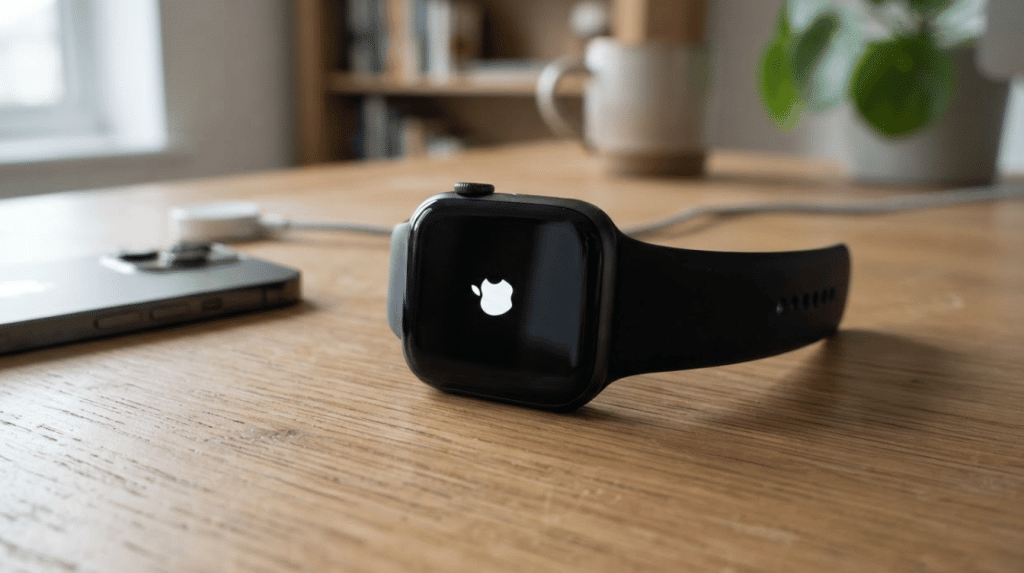
In contrast, the Apple Watch is larger and heavier, typically weighing 30 to 38 grams depending on the model, with a 42 mm or 46 mm display that sits on the wrist.
It offers an always-on screen, customizable bands, and advanced sensors like ECG, GPS, gyroscope, and heart rate tracking.
The Apple Watch Series 11 uses the same slim design introduced with the Series 10: thinner and with a wider screen that extends closer to the edges, improving visibility and making it easier to read from different angles compared to older models.
In the Oura ring vs Apple Watch, the ring feels minimal and distraction-free, while the watch provides more functionality but feels more noticeable throughout the day.
Fitness & Sleep Tracking: Oura Ring vs Apple Watch
The Oura Ring is built mainly for sleep and recovery tracking, using infrared sensors, temperature monitoring, and heart rate variability (HRV) to measure sleep stages like REM, deep, and light sleep with great detail.
It collects data continuously overnight and provides readiness scores based on recovery and rest.
Oura also tracks your chronotype, which reflects your natural sleep and wake preference, and uses it to personalize circadian rhythm insights.
This added sleep context I see is not something the Apple Watch currently provides.
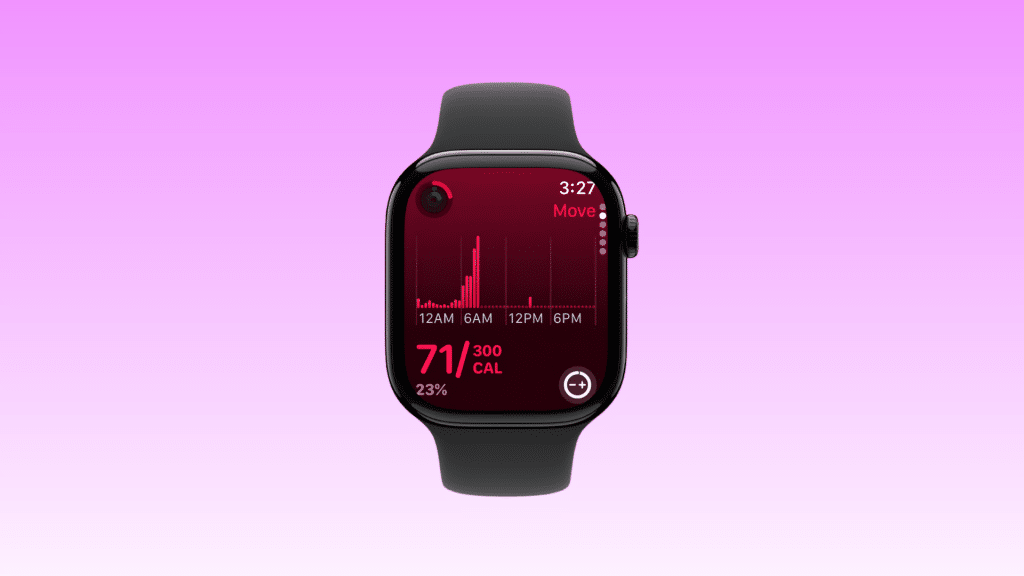
On the other hand, the Apple Watch focuses more on fitness tracking, offering GPS, real-time heart rate monitoring, workout detection, and over 80 exercise modes for active users.
It also tracks sleep stages but relies more on motion and basic heart rate data, making it less detailed for sleep analysis.
The Apple Watch Series 11 also includes FDA-cleared sleep apnea detection, designed to monitor for signs of moderate to severe sleep apnea.
Oura stands out for accurate sleep insights, while Apple Watch performs better for workouts, activity tracking, and real-time performance data.
Women’s Health and Cycle Tracking
Both devices support menstrual cycle tracking using skin temperature data, but the Oura Ring goes deeper.
It integrates directly with Natural Cycles, Flo, and Clue, using continuous overnight temperature baselines that tend to flag ovulation windows more accurately than wrist-based sampling.
Apple Watch also supports cycle tracking through Apple Health and Natural Cycles, but collects temperature data less frequently.
For women tracking hormonal health, fertility, or cycle-related stress patterns, Oura’s nightly temperature readings typically deliver more consistent predictions.
Health Tracking and Accuracy: Which One is More Reliable?
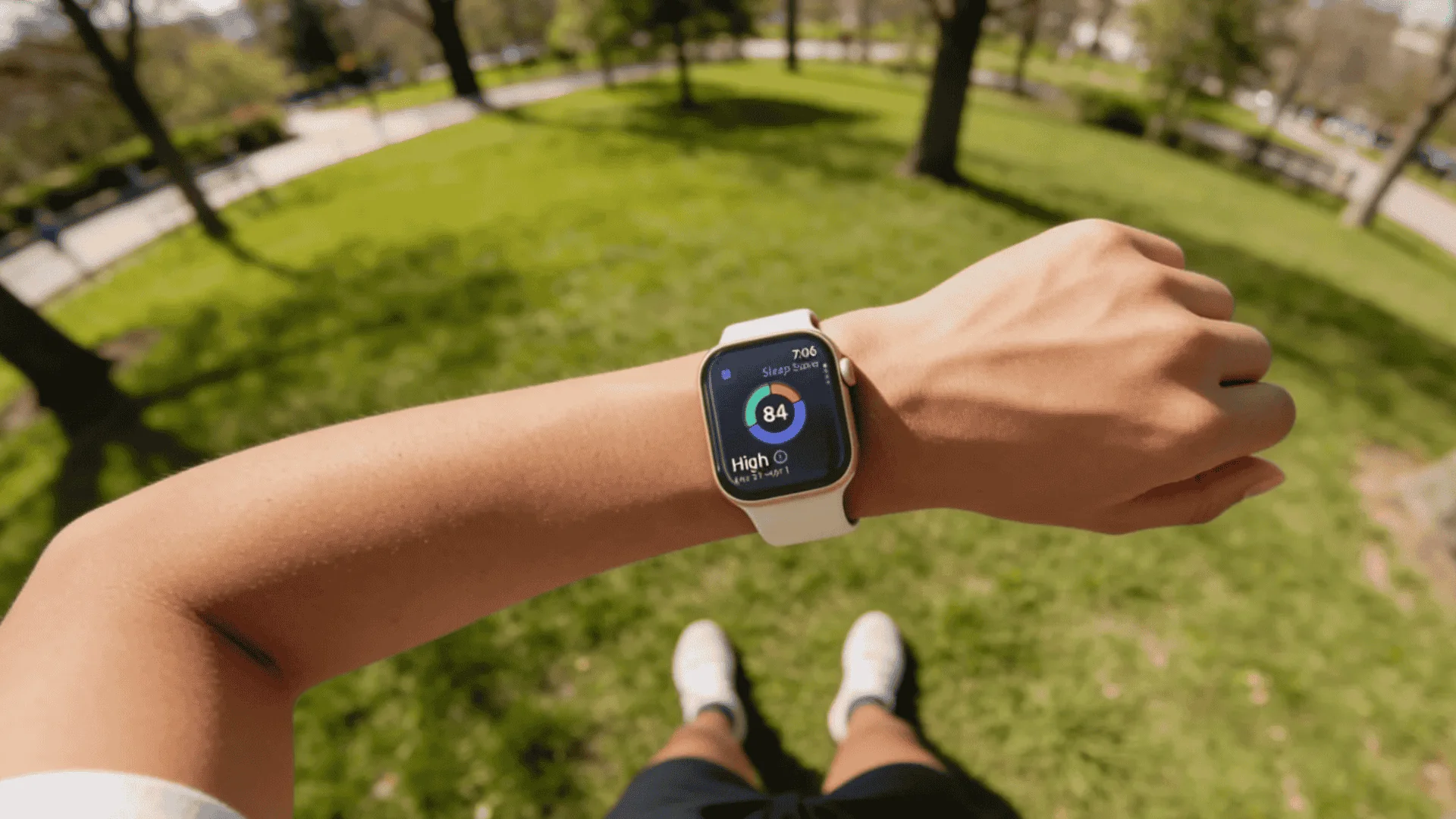
When comparing the Oura ring vs the Apple Watch for health tracking and accuracy, both devices use advanced sensors but differ in how they collect and interpret data.
The Oura Ring uses infrared photoplethysmography (PPG) sensors placed on the finger to track heart rate, heart rate variability (HRV), body temperature, and sleep metrics continuously, especially during rest and sleep.
According to Oura’s official data, its HRV and resting heart rate measurements have shown very high accuracy in peer-reviewed studies.
The Apple Watch, on the other hand, uses wrist-based sensors including optical heart rate sensors, ECG, blood oxygen monitoring, and temperature sensors.
It offers medical-grade features like irregular rhythm notifications and ECG readings.
It is worth noting that while both devices perform well for resting heart rate and blood oxygen tracking, energy expenditure remains a weaker area for both.
The ring’s consistent overnight readings make it the stronger passive tracker, while the watch performs better for real-time monitoring and health alerts.
If you want to understand how wearables improve health tracking at a practical level before committing to either device, it is worth reviewing the core capabilities both approaches share.
Stress Tracking: A Key Difference Most Buyers Miss
Stress tracking works differently across the 2 devices, and it matters more than most comparison articles acknowledge.
The Oura Ring’s Daytime Stress feature monitors the balance between your sympathetic and parasympathetic nervous systems throughout the day using HRV and heart rate signals and offers guidance accordingly.
Apple Watch added a physiological stress metric that also reads HRV and heart rate throughout the day, but presents it as a broader combined metric rather than a granular daily timeline.
If you are exploring stress monitoring wearables specifically, the differences in how each device surfaces that data are worth examining before you decide.
Oura Ring vs Apple Watch Models and Price
All models require an Oura Membership ($5.99/month or $69.99/year) for full features. The first month is often free with a new ring purchase. With Apple Watches, no subscription is required.
| Model | Current Price Range | Notes |
|---|---|---|
| Oura Ring 4 | $349 – $399 | Current flagship. Titanium models. |
| Oura Ring 4 | $399 – $499 | Higher-end colors/finishes. |
| Oura Ring 4 Ceramic | $499 | Newer scratch/sweat-resistant version. |
| Oura Ring Gen3 Heritage / Horizon | $299 – $449 (limited stock/clearance) | Discontinued. Not recommended as primary purchase. |
| Oura Ring Gen3 | Up to $449 – $549 | Mostly clearance or third-party. |
| Apple Watch Series 11 (GPS, 42/46mm) | Upto $399 | Current base model. |
| Apple Watch Series 11 GPS + Cellular | $499 – $529 | Adds $100 over GPS. |
| Apple Watch Ultra 3 | From $799+ | Newest rugged model. |
One pricing consideration that tends to get overlooked: over 3 years, a $349 Oura Ring 4 with an annual membership adds up to roughly $560.
That is comparable to the outright cost of an Apple Watch Series 11 GPS model, which carries no ongoing fee.
Battery Life & Smart Features
Both devices offer very different experiences, shaped by their designs and functionality.
The Oura Ring delivers strong battery performance, lasting around 5 to 7 days on a single charge due to its screen-free design and low power consumption.
It focuses solely on health tracking, with no notifications, apps, or on-device interactions, and all data is viewed through the mobile app.
In contrast, the Apple Watch is built as a full smartwatch with features like calls, messages, apps, GPS, music control, and real-time notifications, which significantly impact battery life.
According to Apple, most models last about 18 hours on a full charge, while premium versions like the Ultra can reach up to 42 hours under certain conditions.
In Oura Ring vs Apple Watch, Oura clearly wins in battery efficiency, while Apple Watch stands out with powerful smart features and everyday connectivity.
Real User Reviews on Oura Ring 4 & Apple Watch 10
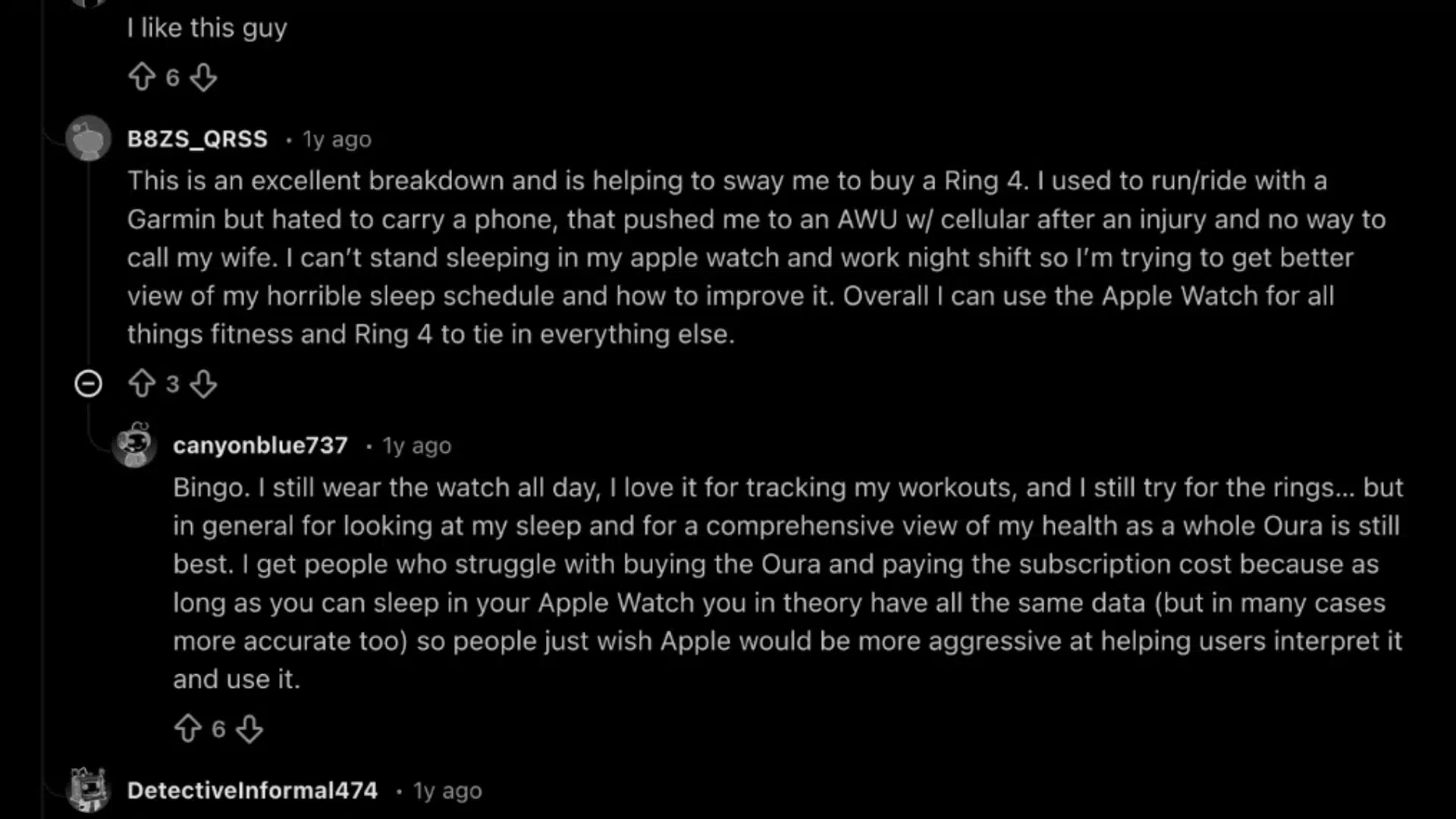
Reddit discussions highlight a clear split between data accuracy and usability when comparing the Oura Ring and the Apple Watch.
Many users agree that Apple Watch delivers highly accurate metrics across heart rate, sleep, and overall tracking.
However, several reviewers point out that the experience feels data-heavy, with limited guidance on what those numbers actually mean in daily life.
On the other hand, Oura stands out for turning raw data into meaningful insights.
Users frequently mention how it connects sleep, heart rate, and recovery into a single readiness perspective, making it easier to understand stress and lifestyle impact.
Comfort also plays a big role, and many prefer wearing a ring overnight instead of a watch.
Overall, Reddit users often lean toward Oura for sleep and recovery, while Apple Watch remains stronger for fitness tracking.
Who Should Buy Oura Ring vs Apple Watch?
I believe that the right choice depends on the lifestyle and daily habits of the individuals.
If sleep, recovery, and passive wellness tracking are your priority and you are comfortable with a subscription, the Oura Ring is the better fit.
Oura Ring works best for users who want passive tracking, long battery life of up to 5-7 days, and a comfortable device for 24/7 wear.
The Oura Ring 4 base model is a solid choice for most users, while the Oura Ring 4 Ceramic suits those who want durability and a premium feel.
If you are leaning toward the ring, its best to know whether the Oura Ring is worth it for different lifestyles. But if you want real-time fitness data, smart features, workout tracking, and safety alerts, the Apple Watch wins.
It is ideal for users who want GPS settings and app support during exercise.
The Apple Watch Series 11 GPS model is great for everyday fitness, while the Apple Watch Ultra 3 is better for advanced training and outdoor use.
Conclusion
Finding the right balance between health tracking and daily usability is what makes the choice between the Oura Ring vs the Apple Watch important.
Oura Ring is designed for users who want deeper insights into sleep, recovery, and overall wellness without constant interaction.
Apple Watch, in contrast, is built for active users who rely on real-time fitness data, notifications, and smart features throughout the day.
Both devices perform well in their own space, but the better option depends on personal habits and priorities.
Think about what will actually improve your routine and long-term consistency: rings vs smart watches vs fitness bands. Small daily habits matter more than features alone
Have you used either device? Share your experience in the comments below and help others decide.
Frequently Asked Questions
Can You Wear the Oura Ring and Apple Watch at The Same Time?
Yes, and many users do. The 2 devices complement each other: Oura handles overnight sleep and recovery data, while Apple Watch covers daytime workouts, notifications, and real-time metrics.
Wearing both on the same day is common, with users checking Oura’s Readiness Score each morning to guide how hard they push during training tracked by the Apple Watch.
Why Are People Getting Rid of Oura Rings?
Some users stop using Oura Rings due to the monthly subscription requirement, limited workout tracking, and lack of real-time features. Others prefer devices with screens and more interactive fitness tracking.
Is Oura Ring Spying on You?
No, Oura Ring is not considered spyware. It collects health data like heart rate and sleep patterns, which is stored securely and used for insights, following standard privacy and data protection practices.
Can an Apple Watch Call 911 if Your Heart Stops?
No, Apple Watch cannot detect when your heart stops or automatically call 911 for that. However, it can call emergency services through SOS or automatically after falls or crashes.
Does the Oura Ring Work Without a Subscription?
The Oura Ring records basic health data without a subscription, but most meaningful insights, including the Readiness Score, Sleep Score, and Daytime Stress timeline, require an active Oura Membership.
Without it, the raw data is accessible, but the interpreted guidance that makes the ring useful is locked. Apple Watch has no equivalent ongoing fee for its health features.