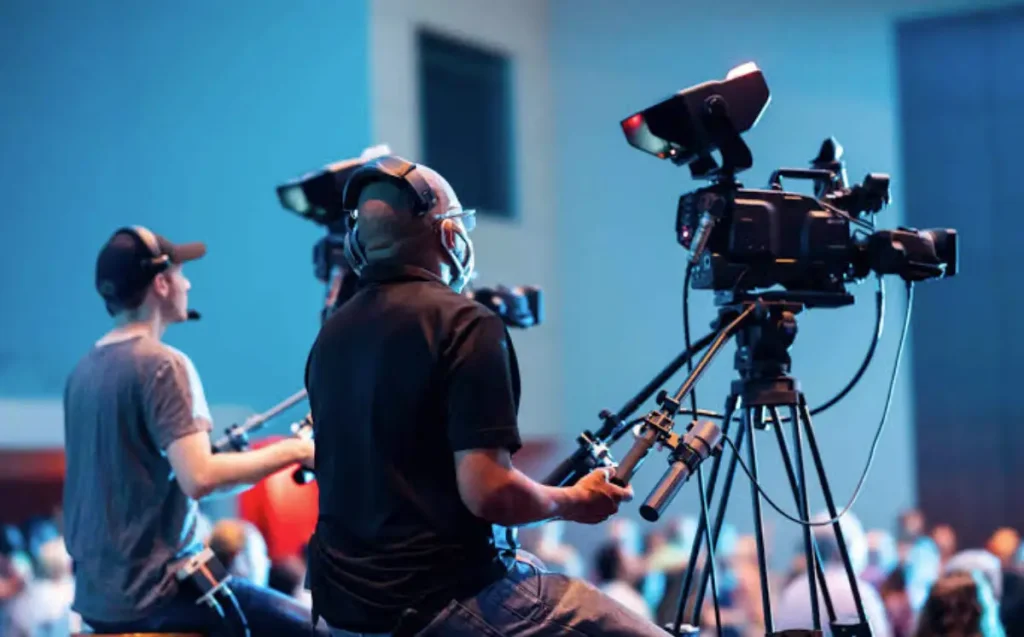
Whether you’re covering a corporate conference, a live music event, or a multi-camera sports broadcast, the quality of your production is only ever as good as the equipment underpinning it. Live production is unforgiving. There’s no fixing or editing when you’re on air, so having the right gear, properly matched to the job, is essential.
What Equipment Is Essential for Live Production?
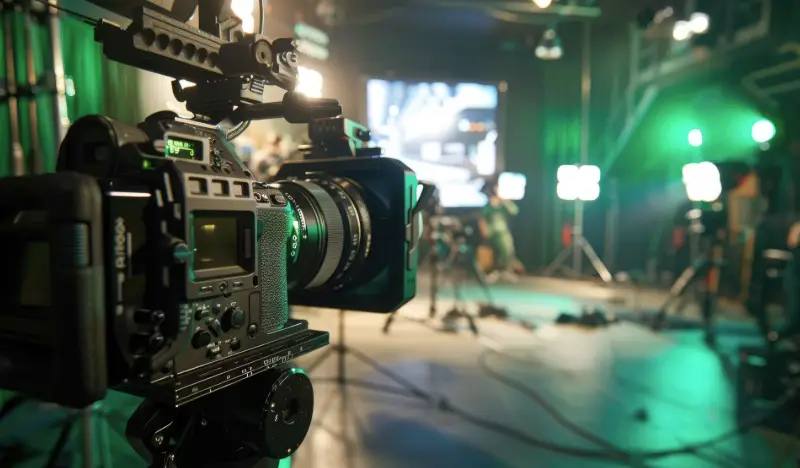
Most suppliers organise their live production ranges into four core categories: signal management, portable devices, studio equipment, and audio, and that’s a sensible framework for thinking through what you actually need. Here’s a walkthrough of the essential live production equipment you need to build a reliable broadcast chain.
Signal Management: The Nervous System of Your Production
Signal management forms the unspectacular but essential backbone of any live production set-up. It is the equipment that enables the transfer of video, audio and data from point A to point B, without loss and in sync.
Central to this group are the video switchers (or vision mixers) that enable the director or technical operator to seamlessly change the input of various cameras within the live production environment. Together with the video switchers are converters and scalers that convert video signals from different formats, such as SDI to HDMI, or upscale a lower-resolution video to match the other video signals within your program.
Cabling and connectivity are another topic to consider. SDI, HDMI, and even the emerging IP transports (such as NDI, SRT) each have their applications. Deciding beforehand on what type of connections and cables will suit your venue is crucial to avoiding many potential problems on the big day. Proper Genlock and timing devices ensure perfect synchronisation of all sources in a multiple-camera recording, without which the transition between the cameras results in disturbing glitches.
For anyone building a rig from scratch, it’s worth thinking about signal management first, before audio or camera gear, because it dictates how everything else connects and communicates.
Portable Devices: Production on the Move
Not all live production is done in a studio setting. In the case of outside broadcasts, field interviews, or events where the filming takes place at an external location, you need devices that are small, power-efficient, and durable to endure being packed in flight cases and moved from one location to another.
Portable video encoders and streaming systems are common here, enabling streaming over cellular bonding or satellite links directly to the studio or streaming platform without the need for an outside broadcast truck.
Among other portable devices are battery-powered monitors, wireless video transmitters and portable audio mixers. When considering a portable kit, weight and power consumption become as important as picture or sound quality. A well-designed device becomes useless if it cannot operate for four hours in the field on one battery charge. Cellular bonding capability is increasingly a deciding factor for anyone covering breaking news or live sport from remote locations, since it allows multiple network connections to be combined for a more stable, higher-bandwidth signal.
Studio Equipment: The Permanent Base
Studio production calls for a different set of priorities: reliability, control, and the ability to run long broadcasts without any disruption. It encompasses equipment such as a camera control unit (CCU), teleprompter, studio lighting system, and production switchers designed for permanent installation.
Regarding cameras, robotic and remote-controlled camera systems have gained popularity, especially for smaller studios looking to cut down crew but retain shot variety. Likewise, multiviewers, which enable the viewing of multiple camera sources and graphics on a single screen, have become indispensable for directors and technical directors.
The cost involved in setting up studio equipment is higher than the cost of portable equipment; however, this is compensated by increased reliability and uniformity of images produced over time. When setting up a studio, it’s important to think ahead, not just about current requirements but future trends of formats too. 4K and IP-based workflows are becoming the norm rather than the exception, and buying equipment with headroom to grow avoids costly replacements down the line.
Audio: Often Underestimated, Always Critical
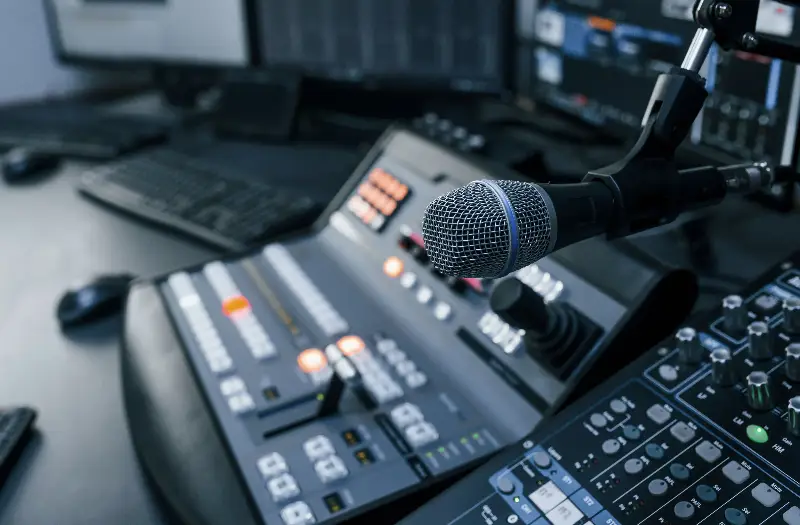
It’s a well-worn truism in broadcast circles that audiences will forgive poor picture quality far more readily than poor sound. Audio equipment for live broadcasting includes a wide variety of options, including different types of microphones (hand-held, lapel, shotgun, and boundary microphones), wireless microphones, audio mixers, and in-ear monitoring equipment for performers and presenters.
The importance of connection cannot be overemphasised either. XLR connection is still the industry standard for professional microphones thanks to its balanced signal and locking connectors. Small-scale productions often use 3.5 mm or USB ports, mainly because of their portability. If you are recording live music or a presentation by multiple speakers, a proper mixer that has all necessary channels and headroom capacity becomes an absolute must. You never want to run out of input during a live broadcast.
When it comes to planning live events, wireless microphone systems are definitely worth considering, as radio interference can be a genuine risk in crowded venues or areas with heavy Wi-Fi traffic. Choose systems with reliable frequency coordination and test them on-site before going live.
Bringing It All Together
These four categories do not operate in isolation; they are all integral parts of a live production equipment system. The best approach is to assess your production needs first (size of venue, number of crew members, mobility considerations, type of broadcast) and then work your way up from there, rather than randomly selecting equipment pieces.
Those new to live production should begin small and gradually expand their inventory, rather than trying to set up an overly complex system from the outset. And whatever the scale of your production, always test your signal chain end-to-end, from camera through the switcher and encoder to final output. In live broadcasting, preparation is the difference between a smooth show and a very stressful evening.