Smart manufacturing is turning industrial marking from a simple “stamp and go” step into a connected, data-rich part of the production line.
If you’ve been looking at a fiber laser marking machine lately, you’ve probably noticed how fast the specs and software options are moving. That’s not a coincidence. Factories want marks that last, yes, but they also want those marks tied to real-time data, quality checks, and traceability systems.
This guide breaks down what’s actually changing on the shop floor, why it matters for your team, and what to watch when you plan your next upgrade. Think of it as a plain-English map through the noise.
Marking Is Now a Data Step
In older setups, marking often meant: load part, run program, mark, move on. The mark itself was the end goal. In smart manufacturing, the mark is a data point. It links a physical item to a digital record that travels through your MES, ERP, and quality systems.
You’ll see this in practice when serial numbers, 2D codes, or micro-text get scanned at multiple stations. Each scan updates the item’s history: which batch, which machine, which operator, which test results. The marking cell becomes a gatekeeper for traceability, not just decoration.
IoT-Enabled Marking Cells Talk to the Rest of the Line
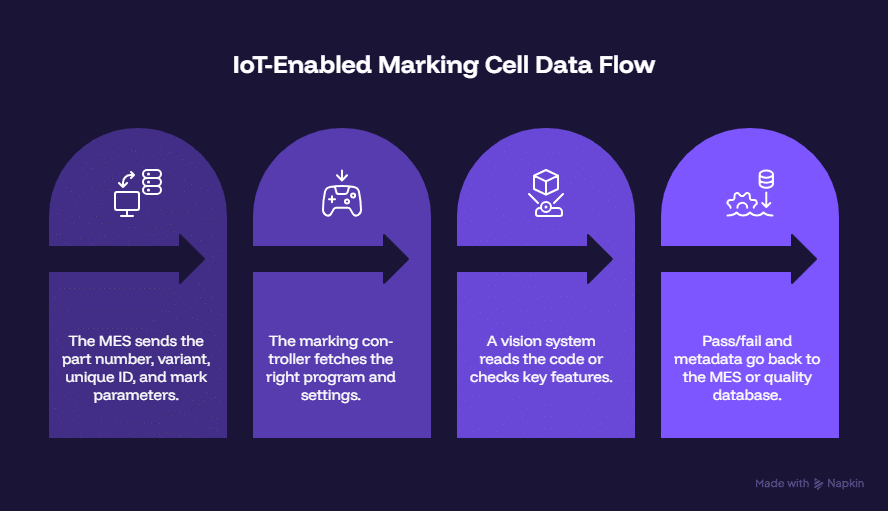
Smart factories treat marking cells like any other connected asset. They pull job data from upstream systems and push results downstream. A typical flow looks like this:
- The MES sends the job: part number, variant, unique ID, and mark parameters.
- The marking controller fetches the right program and settings.
- A vision system reads the code or checks key features.
- Pass/fail and metadata go back to the MES or quality database.
This loop cuts manual data entry and reduces mix-ups. It also makes audits simpler because the system can show who marked what, when, and with which settings.
When you evaluate equipment, look for open interfaces (OPC UA, REST APIs, or well-documented SDKs). You want your IT and automation teams to integrate without fighting closed ecosystems.
No-Consumables Processes Win on Cost and Uptime
Laser marking has grown fast because it removes a lot of the headache tied to inks, solvents, and printheads. A fiber laser marking machine, for example, can run for years with minimal consumables and little daily maintenance. That’s a big deal when you run multiple shifts and hate unplanned stops.
Compare that to contact or ink-based systems, where you track nozzle life, ink levels, solvent use, and cleanup time. Those tasks add up. They also introduce variability if operators skip steps or use the wrong fluids.
Smart manufacturing leans toward processes that are stable, repeatable, and easy to monitor. Lasers fit that model well, especially when paired with automated parameter libraries and remote diagnostics.
Inline Vision Verification Closes the Quality Loop
A mark that can’t be read is worse than no mark at all. Smart lines treat verification as part of the marking step, not an afterthought. Inline cameras check contrast, completeness, and readability right after the laser fires.
If a mark fails, the system can:
– Flag the part for rework or scrap.
– Auto-adjust power, speed, or focus for the next part.
– Log the failure with images so engineers can spot patterns.
This approach reduces escapes (bad parts leaving the cell) and gives you hard data for continuous improvement. Over time, you’ll see which materials, finishes, or fixtures cause trouble and fix them at the source.
When you spec a new cell, ask for integrated vision or a clear path to add it. You want the camera, lighting, and software designed as one system, not three separate boxes glued together.
Portable and Networked Marking Live Side by Side
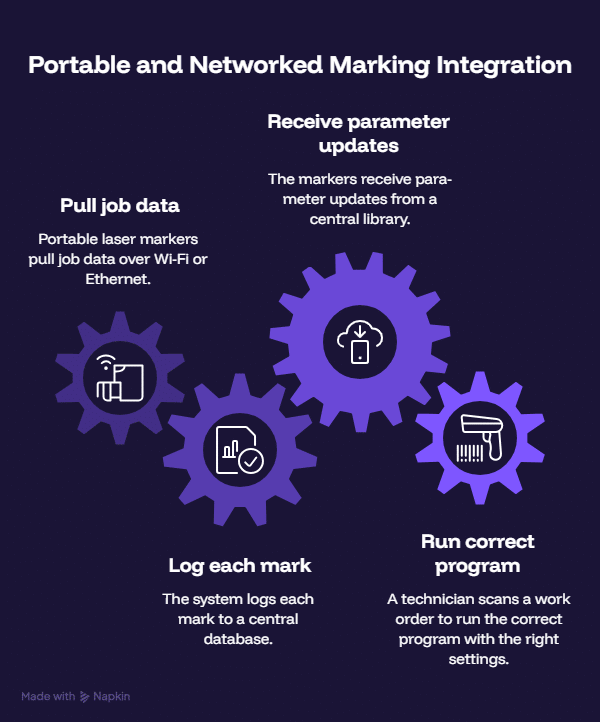
High-mix, low-volume work, large parts, or tight floor space can make portable units more practical. Smart manufacturing connects portables.
Modern portable laser markers can:
– Pull job data over Wi-Fi or Ethernet.
– Log each mark to a central database.
– Receive parameter updates from a central library.
That way, you keep flexibility without losing traceability. A technician can move a handheld unit between lines, scan a work order, and run the correct program with the right settings. The system still knows who did what and when.
Traceability Is the Default
Regulations and customer demands keep pushing traceability deeper into supply chains. Aerospace, medical, automotive, and electronics all expect item-level history. Smart manufacturing treats that as normal, not exceptional.
Marking systems now support:
– Unique identifiers on every part or package.
– 2D codes that hold more data in less space.
– Marks that survive cleaning, heat, and wear.
Add connected software, and you can trace a field failure back to the exact batch, shift, and machine settings. That speed matters during recalls or audits. It also helps you prove compliance without scrambling through paper logs.
Conclusion
Smart manufacturing is reshaping industrial marking by tying every mark to data, quality checks, and traceability systems. Fiber and other laser technologies fit this shift well because they are stable, low-maintenance, and easy to connect.
The winners will be teams that treat marking as a connected process, not a standalone task, and that choose tools based on real operational gains.