A guest arrives at your event, sees a long line, and immediately checks the time. Ten minutes later, they are still waiting to get through the door. Security may be doing its job, but the guest experience is already taking a hit.
That is the challenge event organizers face. You need strong security, but you also need people to move. Bag checks, ticket scans, ID checks, and even metal detector rentals can create delays when they are not planned around the way guests actually enter a venue.
Good event security should not feel like a wall between people and the event. It should feel like part of the event itself.
Start With the Entrance, Not the Security Check
Most problems begin before someone reaches the actual security checkpoint.
Look at the entrance from a guest’s point of view. Where do they join the line? Where do they show their ticket? Where do they wait for a bag check? What happens if they have a problem with their ticket? And where do they go after they are cleared?
These questions matter because one slow point can affect every other part of the entrance.
In order to solve this, you can use queue systems, clear signage, and trained staff who help manage how the crowd moves. Also, do everything to prevent security searches from creating risks of overcrowding.
That means your security plan needs to include the physical layout of the entrance.
Instead of sending every guest through one narrow checkpoint, create separate lanes when possible. You might have one lane for standard entry, another for guests who need extra assistance, and a separate area for resolving ticket or registration problems.
A guest whose ticket will not scan should not have to stand in the same line as hundreds of other people while staff troubleshoot the problem. Move that issue away from the main flow so that everyone else can keep moving.
Make Screening Simple and Predictable
People are more patient when they know what to expect.
Before guests reach security, tell them what they need to have ready. You can put signs that explain your bag policy, prohibited items, and ID requirements. The staff can repeat the information verbally when lines start to get busy.
This saves time because guests arrive at the checkpoint prepared.
It also helps to make the screening process consistent. When one security team member checks bags in 10 seconds, and another takes a full minute, the line quickly becomes uneven.
Train the team to follow the same process.
Do Not Let Security Become the Main Attraction
There is a difference between visible security and disruptive security.
Guests should know that trained staff are present. At the same time, security personnel should not create unnecessary tension.
This is important because security affects how comfortable people feel about attending events in the first place. According to statistics, 83% of Americans were concerned about a criminal attack at large-scale events.
People want to feel protected. They also want to enjoy themselves.
The answer is not simply adding more guards. It is putting the right people in the right places.
One team can focus on screening. Another can handle directions and guest questions. This gives security staff clear jobs instead of asking everyone to do everything.
Keep an Eye on Bottlenecks
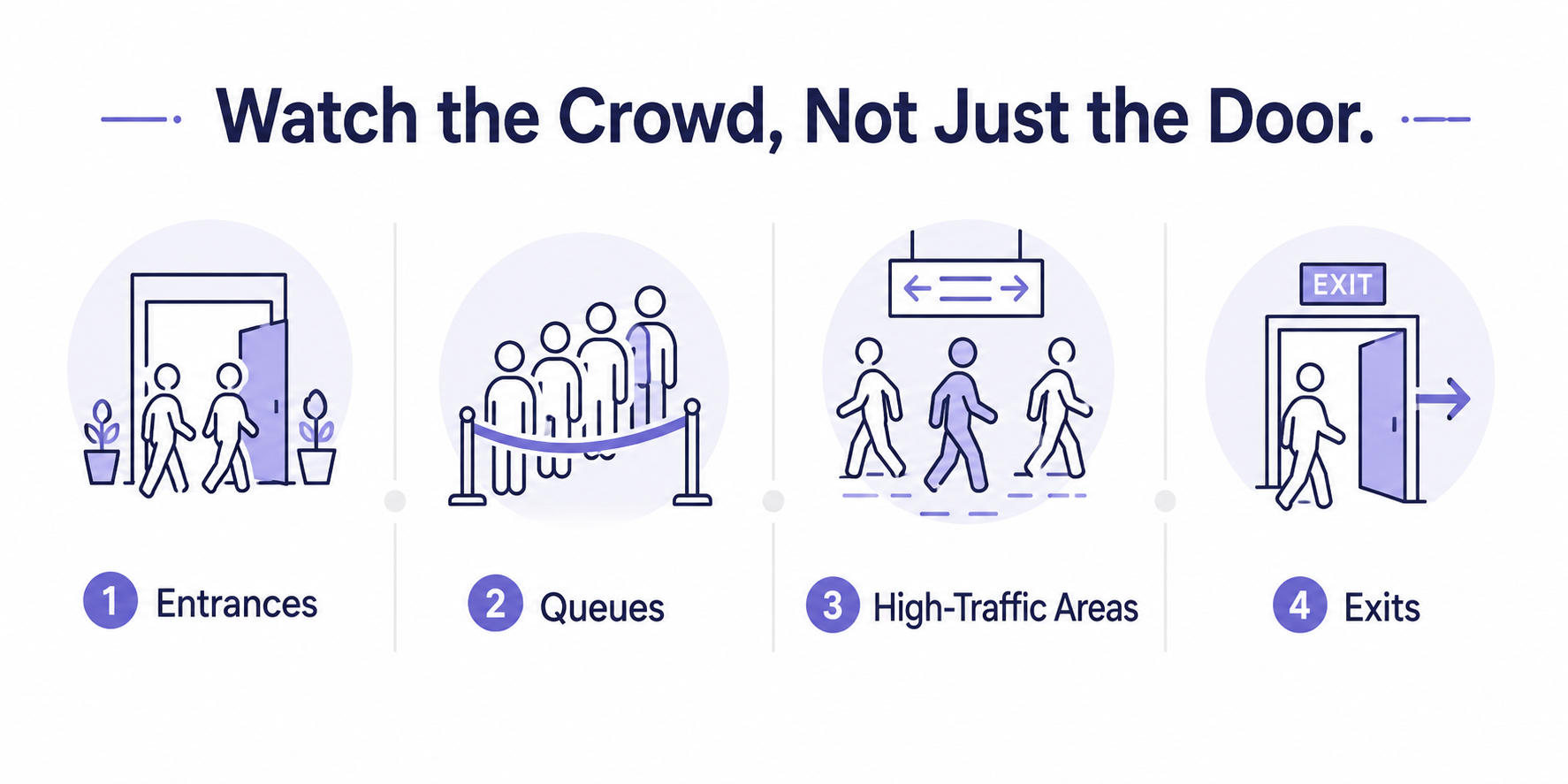
Security problems do not only happen at the front door.
A crowded hallway, narrow staircase, food stand, merchandise table, or popular attraction can create its own pressure point. You should be monitoring entrances, exits, queues, popular attractions, and other areas where people may gather too closely.
Walk through your venue before the event and ask a simple question: Where would people naturally stop?
Maybe it is the first place they see the main stage. Maybe everyone wants to take a photo beside the entrance sign. Maybe the coffee stand is positioned too close to a doorway.
Small layout changes can make a big difference.
Move furniture. Widen a walking path. Put signage before the turn instead of after it. Give people somewhere to wait that does not block people who are still moving.
Security and event design are connected.
Prepare Security Staff for the Actual Venue
A security team can be experienced and still struggle if they do not understand your venue.
Before doors open, walk the team through the site. Show them entrances, exits, emergency routes, first aid areas, staff-only rooms, VIP spaces, and likely crowding points.
Everyone should know what happens when something goes wrong.
Who closes an entrance? Who redirects guests? Who calls for medical help? Who communicates with the event manager?
These questions should be answered before the first guest arrives. That way, everyone will be prepared.
Security Should Support the Guest Experience
Strong event security is not about making guests notice security.
It is about making the entire event feel organized.
Before your next event, stand outside the entrance and watch how people move. Do not look at it like an organizer. Look at it like a guest.
Where would you hesitate? Where would you stop? Where might you feel confused?
Those answers can tell you more than a complicated security plan ever will. And they will definitely help you create your event planning checklist.
The best security setup is one that protects people while still letting the event breathe. Safety and good guest flow do not have to compete. They can go hand in hand.