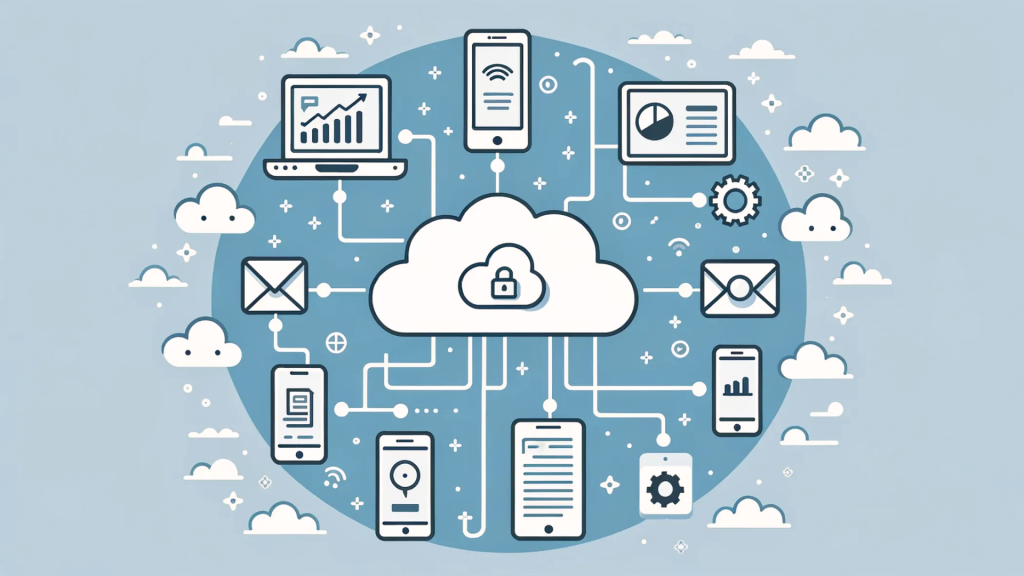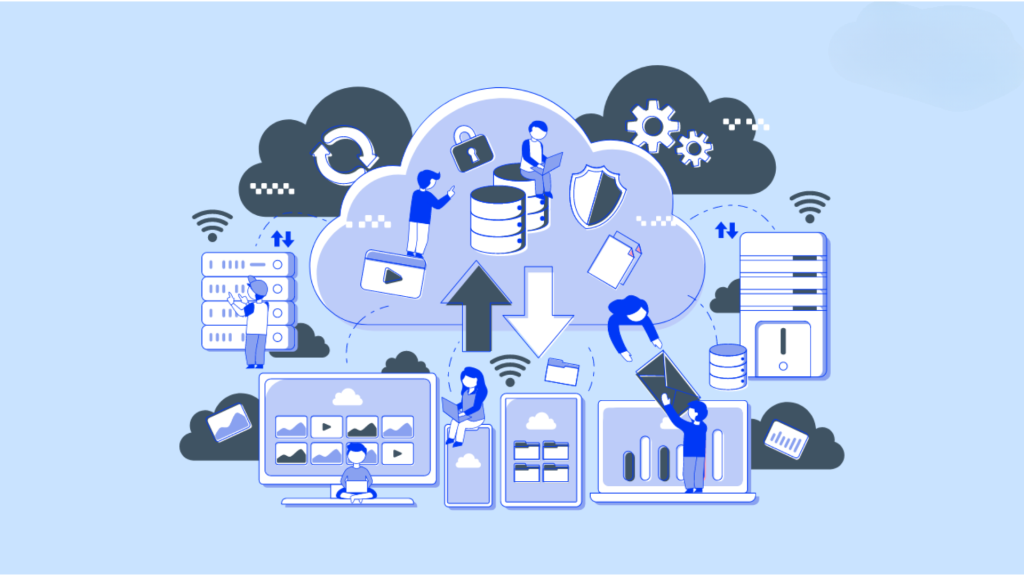
Cloud misconfigurations are behind most cloud breaches today. They happen when settings are left open, permissions are too broad, or security rules aren’t followed.
The result can be data leaks, compliance issues, and costly downtime. Staying ahead means knowing where your cloud stands and spotting weak points fast.
That’s where cloud security posture management tools come in. These tools scan your cloud setup, highlight gaps, and help keep your data safer.
In this guide, you’ll get a clear look at the top CSPM tools available, see how they compare, and find out what real users think about them.
By the end, you’ll have a better sense of which tools fit different needs and how to pick the right one for your cloud environment.
What is CSPM and Why Does it Matter?
CSPM, or cloud security posture management, is a way to keep your cloud setup safe. In simple terms, it checks your cloud for mistakes, gaps, and risky settings before they turn into problems.
It helps prevent misconfigurations, exposed storage, weak access controls, and compliance issues.
CSPM tools work by continuously scanning your cloud services, whether it’s IaaS, PaaS, or SaaS, looking for weaknesses and alerting you when something is off.
Unlike CWPP, which focuses on protecting workloads, or CNAPP, which combines security and compliance across apps, CSPM zeroes in on your cloud’s overall setup.
It’s about seeing the full picture of your cloud security, spotting trouble early, and keeping your data and operations safe without slowing down your workflow.
Key Features to Look for in Cloud Security Posture Management Tools
Choosing the right CSPM tool means knowing what features matter most for keeping your cloud secure and compliant.
- Agentless scanning: Scans cloud resources without installing software on servers or workloads, reducing complexity while still detecting security gaps effectively.
- Multi-cloud support: Works seamlessly across AWS, Azure, and GCP, providing a single view of the entire cloud environment for better management.
- Compliance frameworks: Helps meet major regulations like SOC 2, HIPAA, GDPR, PCI-DSS, and NIST, ensuring cloud setups stay compliant and audit-ready.
- Attack path analysis: Identifies potential routes hackers could take through misconfigurations, helping prioritize fixes to protect sensitive data and resources.
- Auto-remediation: Automatically fixes certain configuration issues, reducing manual work and lowering the chances of human error causing security gaps.
- DevSecOps / CI-CD integration: Integrates into development pipelines to run continuous security checks, catching issues before code or infrastructure is deployed.
- SIEM/SOAR integrations: Sends alerts, logs, and reports to your existing security platforms, enabling faster analysis, response, and threat tracking across systems.
Top CSPM Tools You Should Know
These tools help teams detect misconfigurations, manage risks, and maintain compliance across cloud environments, offering both multi-cloud and specialized security solutions.
1. Wiz
Wiz is a Cloud-Native Application Protection Platform that combines CSPM, CWPP, KSPM, vulnerability management, CIEM, DSPM, IaC security, and Cloud Detection & Response in one unified platform.
Its standout feature is the Security Graph, which reduces thousands of CVEs into a single actionable “Toxic Combination,” showing exactly what is exploitable and why.
The agentless CSPM module deploys via APIs with instant visibility into risks.
Google acquired Wiz for $32 billion in 2026, the largest cybersecurity deal ever. It also added AI-SPM to detect shadow AI deployments, but pricing is high for smaller teams.
2. Palo Alto Prisma Cloud
Prisma Cloud is a comprehensive CSPM and CNAPP platform, covering posture, runtime, compliance, CIEM, and code-to-cloud security.
It integrates tools from RedLock and Twistlock acquisitions into one platform. Compliance frameworks support EU DORA and NIS2 directives, automating reporting for financial organizations.
The platform is feature-rich but can feel complex due to multiple acquisitions stitched together. Pricing uses a credit-based model that can be hard to forecast.
Overall, it’s a full-stack solution that gives teams deep visibility and broad coverage, though onboarding and management require time and effort to navigate efficiently.
3. Orca Security
Orca Security uses agentless SideScanning to read cloud workloads’ block storage out-of-band, detecting vulnerabilities, malware, and misconfigurations without any agents.
Risk scoring factors in internet exposure, lateral movement paths, sensitive data proximity, and business criticality.
The platform delivers Wiz-level detection at roughly 30% lower cost and provides flexible contract terms.
Orca is easy to deploy and offers instant visibility across environments, making it a popular choice for teams that want comprehensive security coverage without the operational complexity of traditional agent-based tools. Detection accuracy is high, and ongoing monitoring is continuous and contextual.
4. Microsoft Defender for Cloud
Microsoft Defender for Cloud provides native CSPM for Azure and supports AWS and GCP through connectors.
It tracks posture using the Secure Score metric, which helps teams understand cloud health over time and provides executive reporting capabilities.
Basic CSPM coverage is free, and the full plan costs about $5 per billable resource per month. While its multi-cloud coverage isn’t as deep as some third-party tools, Defender has been rapidly adopted thanks to integration with Microsoft ecosystems.
Teams may notice a fragmented UX across different modules, but it remains a solid choice for organizations heavily invested in Microsoft services.
5. CrowdStrike Falcon Cloud Security
Falcon Cloud Security provides agentless monitoring for cloud workloads and detects misconfigurations, vulnerabilities, and threats.
It brings an adversary-focused approach, delivering real-time intelligence on over 230 adversary groups and 50 attack indicators.
This EDR-like model applies CrowdStrike’s endpoint detection expertise to cloud security. It monitors networks, identifies threats, and helps teams implement preventive measures proactively.
Integration with the Falcon XDR suite is seamless, and pricing is generally lower than Wiz.
Falcon Cloud Security is well-suited for teams already in the CrowdStrike ecosystem seeking consistent detection and prevention capabilities across endpoints and cloud resources.
6. Check Point CloudGuard
CloudGuard CNAPP offers a unified platform combining CSPM, CWPP, CIEM, code security, and cloud detection and response.
It provides agentless workload posture, multi-cloud coverage, compliance automation, and one-click remediation. The risk scoring engine prioritizes findings by severity, reducing alert fatigue and speeding up remediation.
While it performs well as a standalone platform, CloudGuard shines when paired with Check Point’s wider security stack.
It has a broad customer base, including Fortune 500 enterprises, and enables teams to manage security centrally, though it may not offer the same cloud-native depth as dedicated CSPM platforms.
7. Lacework (FortiCNAPP)
Lacework uses behavioral baselines to detect anomalies in cloud workloads and resources.
By understanding normal activity, it alerts teams to deviations that might indicate threats, including compromised credentials that follow legitimate patterns.
The Polygraph technology builds a complete behavioral model, detecting risks that traditional scanners may miss. It supports AWS, Azure, GCP, and OCI.
Lacework was acquired by Fortinet in 2024, and integration post-acquisition is still evolving.
Despite this, it effectively reduces false positives and prioritizes actionable alerts, providing a modern, ML-driven approach to cloud security for alert-heavy environments.
8. Sysdig Secure
Sysdig Secure focuses on containerized applications and cloud infrastructure, offering runtime security, compliance monitoring, and vulnerability management.
Built on the open-source Falco project, it detects threats in as little as five seconds. The Cloud Attack Graph correlates assets, risks, and runtime signals to prioritize findings.
Teams can uncover hidden attack paths and protect identities across cloud workloads. While documentation can be inconsistent and policy setup has a learning curve, Sysdig excels in Kubernetes-heavy environments.
Its deep runtime visibility makes it a preferred tool for teams needing fast detection and response for containerized workloads.
9. Tenable Cloud Security
Tenable Cloud Security enforces policies across multi-cloud environments using pre-built CIS benchmarks or custom frameworks.
It provides CSPM, CIEM, vulnerability management, and Kubernetes security, with automated compliance reporting and inventory visibility.
Risk scoring is based on severity, helping teams focus on the most critical issues. Its vulnerability database, inherited from Tenable.io, is extensive.
DSPM coverage is limited, and AI-powered security features are still developing. Tenable allows organizations to monitor misconfigurations and enforce security policies consistently across complex environments, providing both operational insight and compliance reporting in a single dashboard.
10. Aqua Security
Aqua Security offers automated scanning and incident response for serverless workloads, containers, and VMs. It provides compliance checks, CI/CD posture management, unified cloud protection, and SBOM generation.
Its open-source Trivy tool is widely used and free. Enterprise coverage extends to code, build, deploy, and runtime stages.
While CSPM features are not as deep as dedicated platforms, Aqua integrates well into DevSecOps pipelines.
It ensures visibility across the software lifecycle and helps teams detect and respond to misconfigurations or vulnerabilities proactively, maintaining security from development through production.
11. AWS Security Hub
AWS Security Hub aggregates findings from multiple AWS security services, including GuardDuty, Inspector, Macie, IAM Analyzer, and Config Rules.
It checks resources against AWS best practices, prioritizes risks, and triggers automated remediation through EventBridge. The setup is fast and agentless.
While it’s suitable for early-stage or single-cloud deployments, multi-cloud normalization, attack path analysis, and comprehensive compliance reporting are limited compared to third-party CSPM platforms.
Security Hub provides a strong foundation for AWS-centric environments, offering centralized visibility and risk prioritization without additional software, but it may require additional tooling for larger, multi-cloud enterprises.
12. SentinelOne Singularity Cloud Security
SentinelOne Singularity combines CSPM, CWPP, CIEM, container security, Kubernetes security, and cloud detection in one platform.
It offers agent-based and agentless deployment, context-aware risk prioritization, and real-time threat detection. On G2, it holds high ratings for ease of use, setup, and support.
It brings XDR-style detection to cloud security and allows mid-market teams to get enterprise-grade coverage without the operational overhead of larger platforms.
Singularity provides continuous monitoring, correlates risks effectively, and integrates well with existing SentinelOne deployments, offering a complete security solution across endpoints and cloud workloads.
13. Scrut Automation
Scrut Automation centralizes compliance, automates evidence collection, and simplifies audits for cloud environments.
It supports over 60 frameworks, including SOC 2, ISO 27001, GDPR, HIPAA, and PCI-DSS, and allows custom frameworks.
It scans cloud accounts across AWS, Azure, and GCP against 150+ CIS benchmarks and integrates with Jira to turn misconfigurations into actionable tickets.
Navigation may feel clunky for new users, but its automation reduces compliance efforts significantly.
Scrut provides SMBs and fast-growing teams with audit-ready reports and continuous monitoring, helping maintain security posture without overwhelming operational teams.
14. Aikido Security
Aikido Security integrates SAST, SCA, DAST, CSPM, secrets detection, and IaC checks in a single dashboard.
AI-powered triage and auto-fixes reduce noise and guide developers toward actionable security fixes in CI/CD pipelines.
It uses minimal read-only access, no agents, and supports AWS, Azure, and GCP. Checks map to SOC 2 and ISO 27001 and auto-sync with Vanta and Drata.
The free Developer plan supports 2 users, 10 repositories, 1 cloud, and basic scans. Paid plans start at $300/month. Aikido simplifies code-to-cloud security for startups and small teams with clear, actionable insights.
15. Trend Micro Cloud One Conformity
Trend Micro Cloud One Conformity monitors cloud environments in real-time and alerts on misconfigurations. It supports auto-remediation and offers visibility into risk posture across AWS, Azure, and GCP.
The platform includes 750+ built-in rules mapped to CIS, NIST, HIPAA, GDPR, and PCI-DSS. Initial setup can be complex, but day-to-day operations are straightforward.
Conformity provides multi-cloud monitoring, compliance checks, and actionable guidance to fix security gaps, making it easier for teams to maintain cloud security posture and reduce misconfiguration risks effectively without needing extensive cloud security staff.
Cloud Security Posture Management Tools: Real User Insights
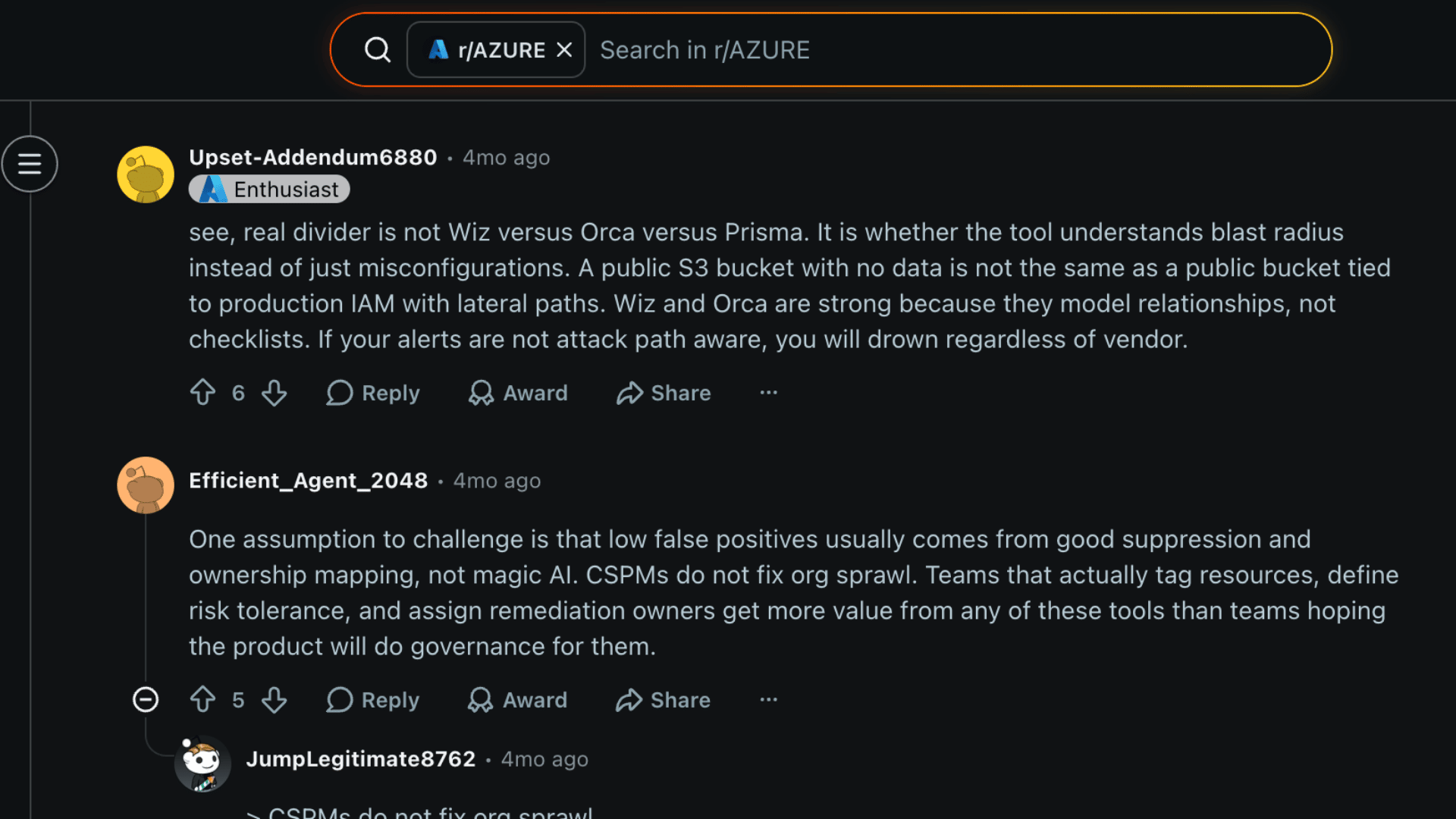
According to Reddit users, Microsoft Defender for Cloud works well if you’re deep into Azure, but cross-cloud parity with AWS and GCP is still uneven.
Teams often feel like they’re maintaining two separate security models. The real difference between tools isn’t just features like Wiz, Orca, or Prisma; it’s how well they understand blast radius.
A public bucket with no data isn’t the same as one tied to production IAM with lateral paths. Wiz and Orca excel because they model relationships, not just checklists.
In 2026, teams keep returning to these platforms for agentless multi-cloud visibility and better prioritization. Defender for Cloud is solid for Microsoft-heavy setups, while Prisma Cloud works but can feel heavy.
Context matters more than raw coverage; tools like Cyera layer data sensitivity and access paths, helping teams focus on risks that really matter.
CSPM Tools Comparison at a Glance
This table summarizes deployment, multi-cloud support, compliance coverage, and pricing for top CSPM tools, helping teams quickly evaluate options and features.
| Tool | Multi-Cloud Support | Compliance Frameworks | Pricing Model |
|---|---|---|---|
| Wiz | AWS, Azure, GCP, OCI, Kubernetes | SOC 2, ISO 27001, HIPAA, PCI-DSS, NIST, CIS, GDPR, DORA, NIS2 | Workload-based; custom quote |
| Prisma Cloud | AWS, Azure, GCP, OCI, Alibaba Cloud | SOC 2, ISO 27001, HIPAA, PCI-DSS, NIST, GDPR, DORA, NIS2, FedRAMP | Credit consumption; custom quote |
| Orca Security | AWS, Azure, GCP | SOC 2, ISO 27001, HIPAA, PCI-DSS, NIST, CIS, GDPR | Subscription; ~30% cheaper than Wiz; custom quote |
| Microsoft Defender for Cloud | AWS, Azure, GCP (Azure-native) | SOC 2, ISO 27001, NIST, PCI-DSS, HIPAA, CIS, GDPR | Free tier; ~$5/resource/month for full CSPM |
| CrowdStrike Falcon Cloud Security | AWS, Azure, GCP | SOC 2, ISO 27001, PCI-DSS, HIPAA, CIS, NIST | Module-based; bundled with Falcon; custom quote |
How to Choose the Right CSPM Tool
Picking the right CSPM tool means understanding your cloud environment, budget, compliance needs, and operational workflow to ensure effective security management.
- Cost considerations: Evaluate pricing models, subscription fees, and potential hidden costs to make sure the tool fits your budget over time.
- Cloud type compatibility: Check whether the tool supports your cloud providers (AWS, Azure, GCP, OCI) and any hybrid or multi-cloud setups.
- Compliance support: Ensure the tool covers required frameworks like SOC 2, HIPAA, GDPR, PCI-DSS, NIST, and any industry-specific regulations.
- Ease of use: Look for intuitive dashboards, automated reporting, and minimal configuration to reduce setup time and operational overhead.
- Integration capabilities: Confirm that the tool works with existing security systems, DevOps pipelines, CI/CD workflows, and alerting platforms for seamless monitoring.
- Trial access: Most enterprise CSPM platforms offer a proof-of-concept period. Run it against a representative slice of your actual cloud environment, not a sandbox; misconfiguration patterns in production differ from test accounts
Conclusion
Cloud security is only as strong as the tools and processes you use. In this guide, we explored what CSPM tools are, their key features, and the top options available today.
We also looked at practical ways to compare tools, including deployment type, multi-cloud support, compliance coverage, and pricing models.
By understanding your environment, budget, and workflow, you can pick a solution that fits your team and reduces misconfigurations, compliance gaps, and security risks.
Whether you’re managing containers, multi-cloud setups, or a single cloud provider, the right cloud security posture management tools can make a big difference in protecting your data.
Which feature matters most to you when evaluating a CSPM tool? Share your thoughts and experiences in the comments below!
Frequently Asked Questions
Can CSPM Tools Detect Insider Threats Within Cloud Environments?
Most CSPM tools focus on misconfigurations and compliance issues, but some advanced platforms can monitor unusual access patterns and privilege escalations that may indicate insider threats.
How Often Should Cloud Environments Be Scanned by CSPM Tools?
Continuous scanning is ideal, but at a minimum, organizations should schedule daily or weekly scans. This ensures new resources, configuration changes, or deployments are checked promptly.
Can CSPM Tools Integrate with DevOps Pipelines for Automated Security Checks?
Yes, many CSPM platforms offer CI/CD integration, allowing security checks during development and deployment. This helps catch misconfigurations before workloads go live.