What actually makes one portable power station worth buying over another? After riding out a few multi-day outages with different units plugged into my kitchen.
I’ve found the answer usually comes down to three numbers most shoppers skip: real usable capacity, continuous output, and how the battery ages after a few hundred cycles.
Here you’ll know about seven of the best portable power stations on the market, chosen after cross-checking manufacturer spec sheets, current pricing, and verified owner feedback rather than marketing copy.
You’ll get picks sorted by budget and use case, a plain-language sizing guide for matching wattage to your devices, and a straight comparison against gas generators so you know what you’re paying for before you buy.
How We Evaluated These Power Stations
I’ve relied on a portable power station through three separate outages in the past two years, including one that ran almost four days, so this list leans on what actually held up rather than what looked good on a spec sheet.
I checked every model below against its manufacturer’s published specifications, current pricing across multiple retailers, and hands-on owner feedback from forums and long-form reviews, and we left out or corrected any number we couldn’t verify in at least two places.
We verified continuous output and real cycle life, not a flashy “peak” wattage number a unit can only hold for a few seconds.
What Makes a Portable Power Station Worth Buying?
A good portable power station balances capacity, output, and portability instead of maximizing just one spec. Battery capacity, measured in watt-hours, determines how long it runs your gear, while continuous output in watts determines what it can power at once, and the two numbers rarely tell the same story.
Battery chemistry matters just as much. LiFePO4 (lithium iron phosphate) cells typically last 3,000 to 6,000 charge cycles before dropping to 80% capacity, handle heat and cold better, and are far less prone to thermal runaway than the older lithium-ion (NMC) cells still used in a few budget units, roughly a decade of near-daily use versus a couple of years for NMC packs.
Port variety, display clarity, and handle design affect everyday convenience, especially if you load and unload the unit often. Build quality and weather resistance help it hold up outdoors, and compact units are easier to carry but trade away runtime. Choosing based on your own use case, not the biggest number on the box, is what separates a good buy from a wasted one.
Best Portable Power Stations Reviewed by Use Case
These five models cover different budgets and priorities, ranked using tested performance and real-world value over marketing claims. Each one earned its spot by handling a specific job well, from daily charging to home backup.
1. Anker SOLIX C1000 Gen 2: Best Overall
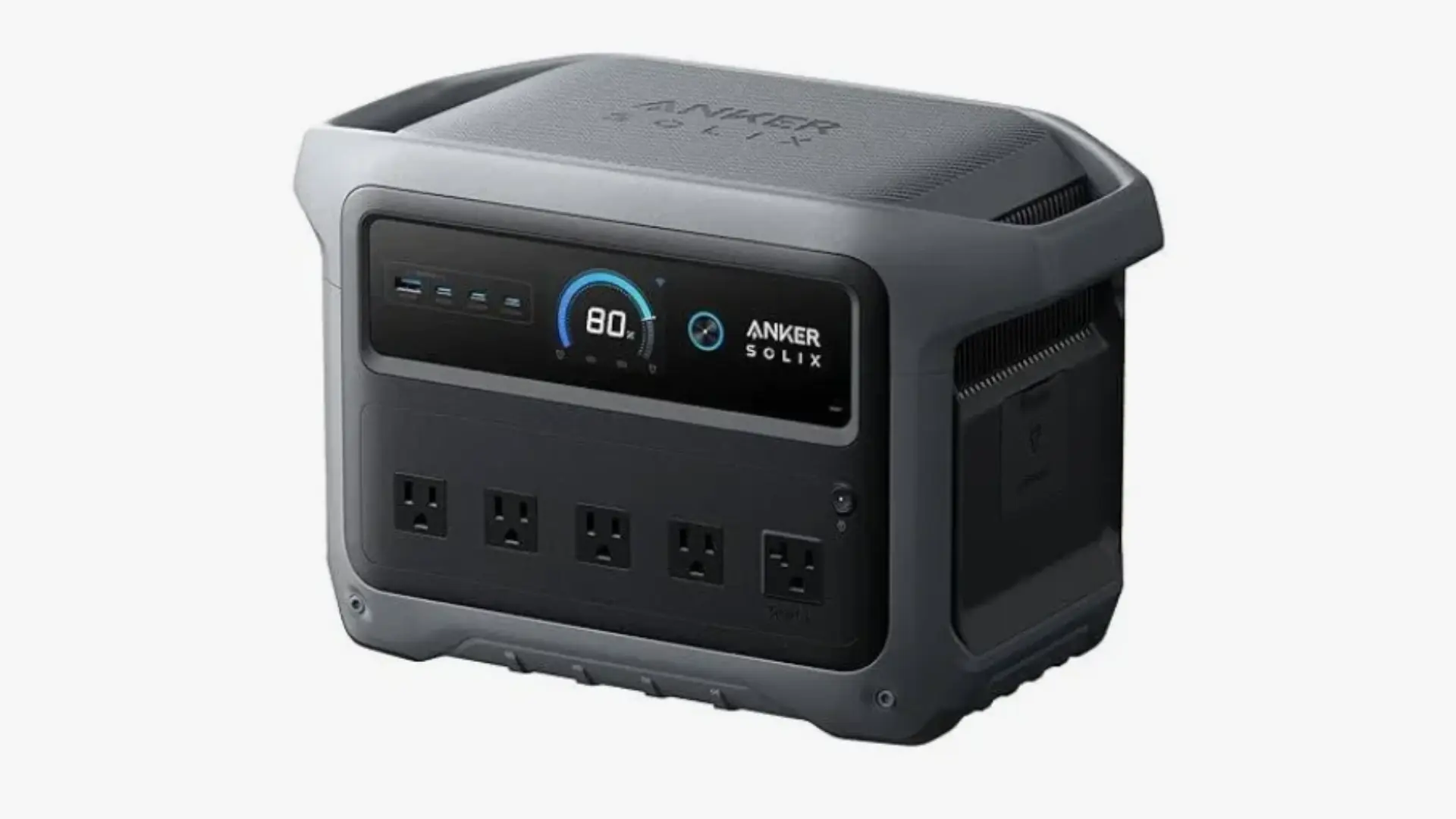
This is the unit I’d point a first-time buyer toward. Anker’s HyperFlash charging genuinely hits a full charge from empty in under 50 minutes when the battery is warm, the fastest recharge currently certified in the 1kWh class, which is why Anker holds the Guinness World Record for it.
The trade-off from the outgoing model is that this generation dropped the built-in light and lost the expansion-battery option, so if you think you’ll want to add capacity later, look at the standard C1000 (not the Gen 2) instead.
- Capacity: 1,024Wh
- Output: 2,000W continuous, 3,000W peak
- Recharge: 49 minutes (0 to 100%) with HyperFlash mode enabled
- Cycle life: 4,000 cycles to 80% capacity
- Dimensions: 15.1 x 8.2 x 9.6 inches
- Weight: 24.9 lbs
- Price: around $799 MSRP, frequently discounted to $400 to $500
2. Bluetti EB3A: Best Budget Portable Power Station
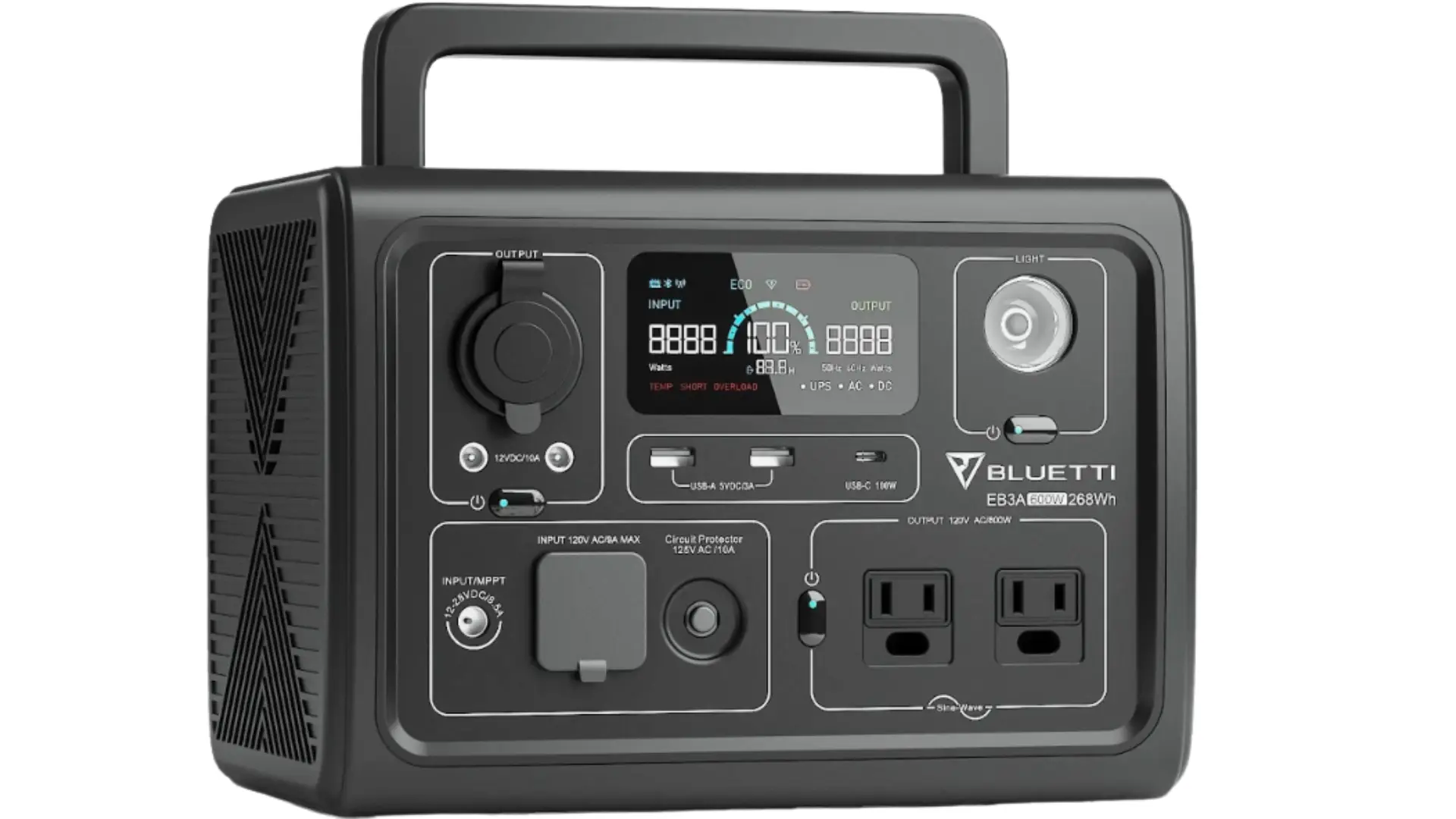
The EB3A is built for someone who just needs a phone and laptop charged through a short outage, not an entire household running on it.
It won’t handle anything with a compressor or motor, but the 45-minute recharge time, tiny footprint, and app-based monitoring make it one of the easiest entry points into LiFePO4 backup power without spending much.
- Capacity: 268Wh
- Output: 600W (1,200W surge)
- Recharge: around 45 minutes via AC
- Cycle life: 2,500+ cycles to 80%
- Weight: about 10 lbs
- Price: around $229
3. EcoFlow RIVER 3: Best for Camping and Travel
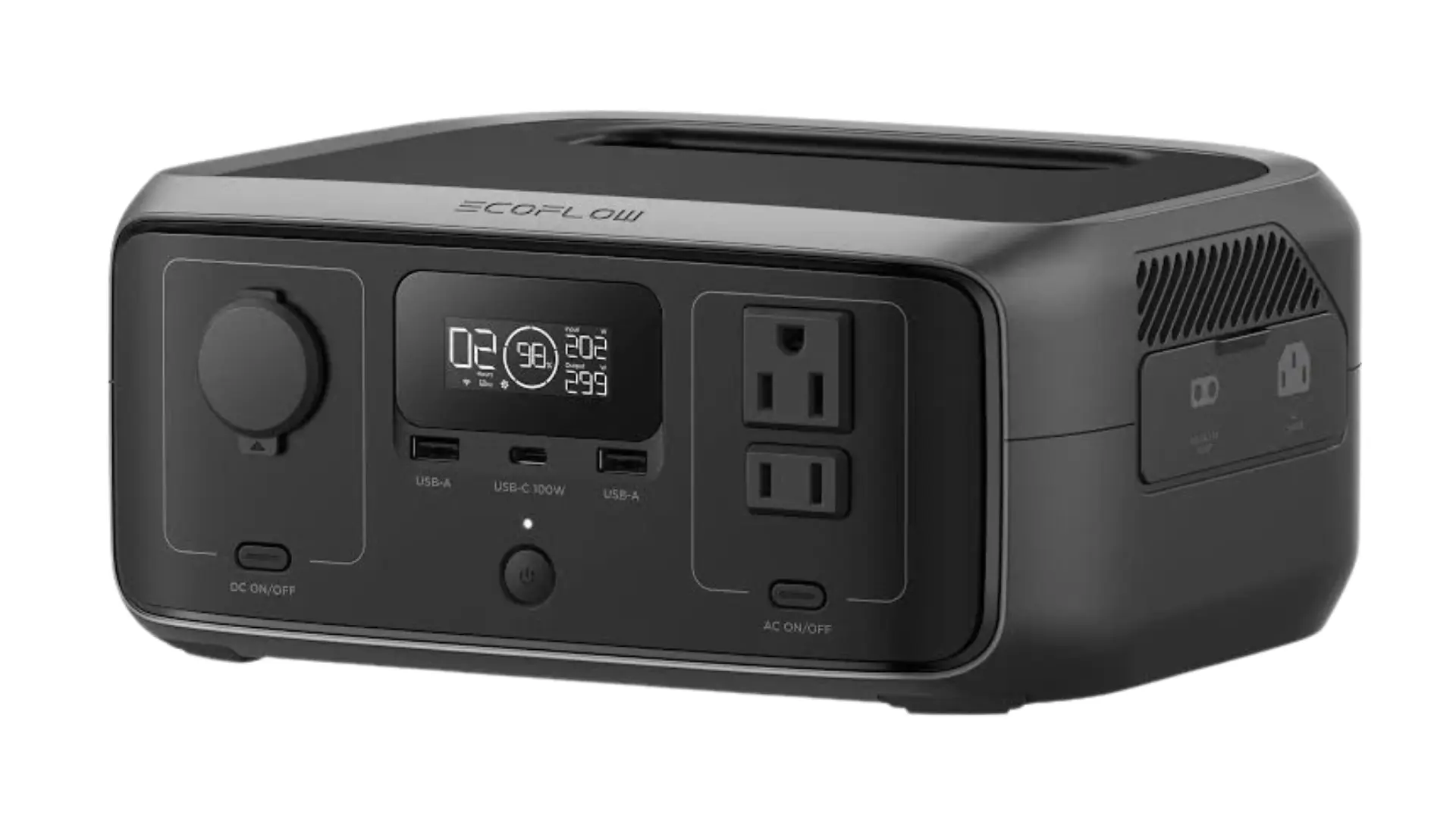
Weighing under 8 pounds, the RIVER 3 is small enough to disappear into a daypack or glovebox, making it the pick for anyone who just wants to top off a phone, camera, or headlamp on the move.
EcoFlow’s X-Boost feature claims to push higher-draw devices, but that’s really a software trick stretching a small battery, not extra stored capacity.
- Capacity: 245Wh
- Output: 300W continuous (600W with X-Boost)
- Weight: 7.8 lbs
- Extras: IP54 dust and water resistance, under 20ms UPS switchover
- Price: around $199 to $239
4. Bluetti Elite 200 V2: Best Home Backup
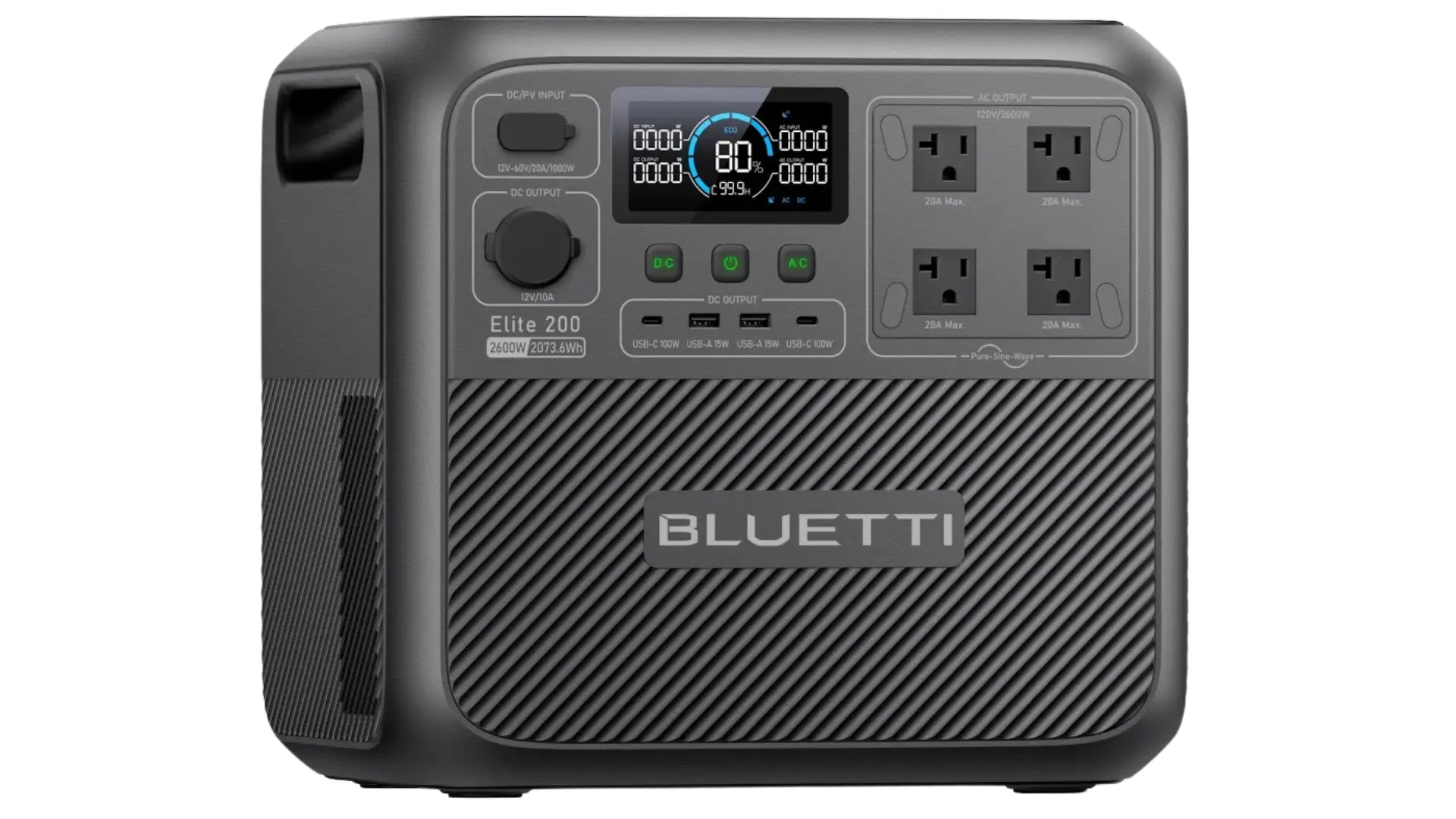
The Elite 200 V2 is meant to sit in a closet and wait, not travel with you. Its 6,000-cycle battery is nearly double what most rivals in this size class offer, and its operating range down to -4°F makes it a genuine option for winter storms, not just summer trips. At over 50 pounds, moving it around isn’t realistic.
- Capacity: 2,073.6Wh
- Output: 2,600W continuous, 3,900W surge via Power Lifting mode
- Dimensions: 13.7 x 9.8 x 12.7 inches
- Weight: 53.4 lbs
- Cycle life: 6,000 cycles to 80%
- Price: MSRP around $1,699 to $1,999, commonly on sale for $799 to $1,099
5. Anker SOLIX F3000: Best High-Capacity, Expandable Pick
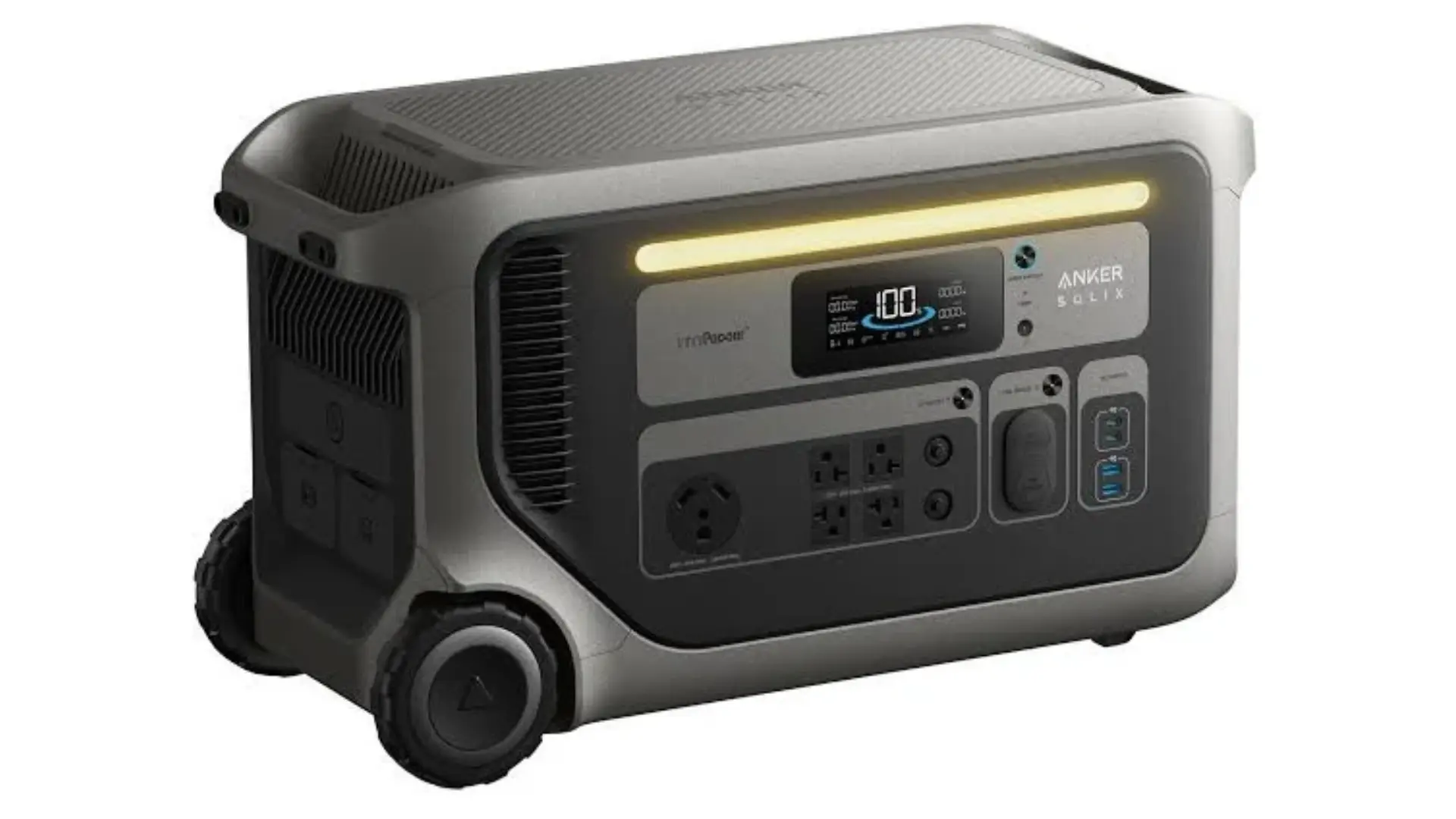
At just over 90 pounds, the F3000 rolls on wheels rather than riding in a trunk, built for buyers planning near whole-home backup instead of a grab-and-go trip.
Its BP3000 expansion batteries let households scale capacity up over time, from a single 3kWh unit to a multi-day, multi-battery system without buying a second station from scratch.
- Capacity: 3,072Wh, expandable to 12,288Wh with add-on batteries
- Output: 3,600W continuous (7,200W in 240V parallel mode)
- Dimensions: 25.6 x 11.8 x 14.8 inches
- Weight: 91.5 lbs
- Price: MSRP around $2,599, frequently discounted to $1,600 to $2,0006. Jackery Explorer 1000 V2
6. Jackery Explorer 1000 v2: Best Lightweight All-Rounder
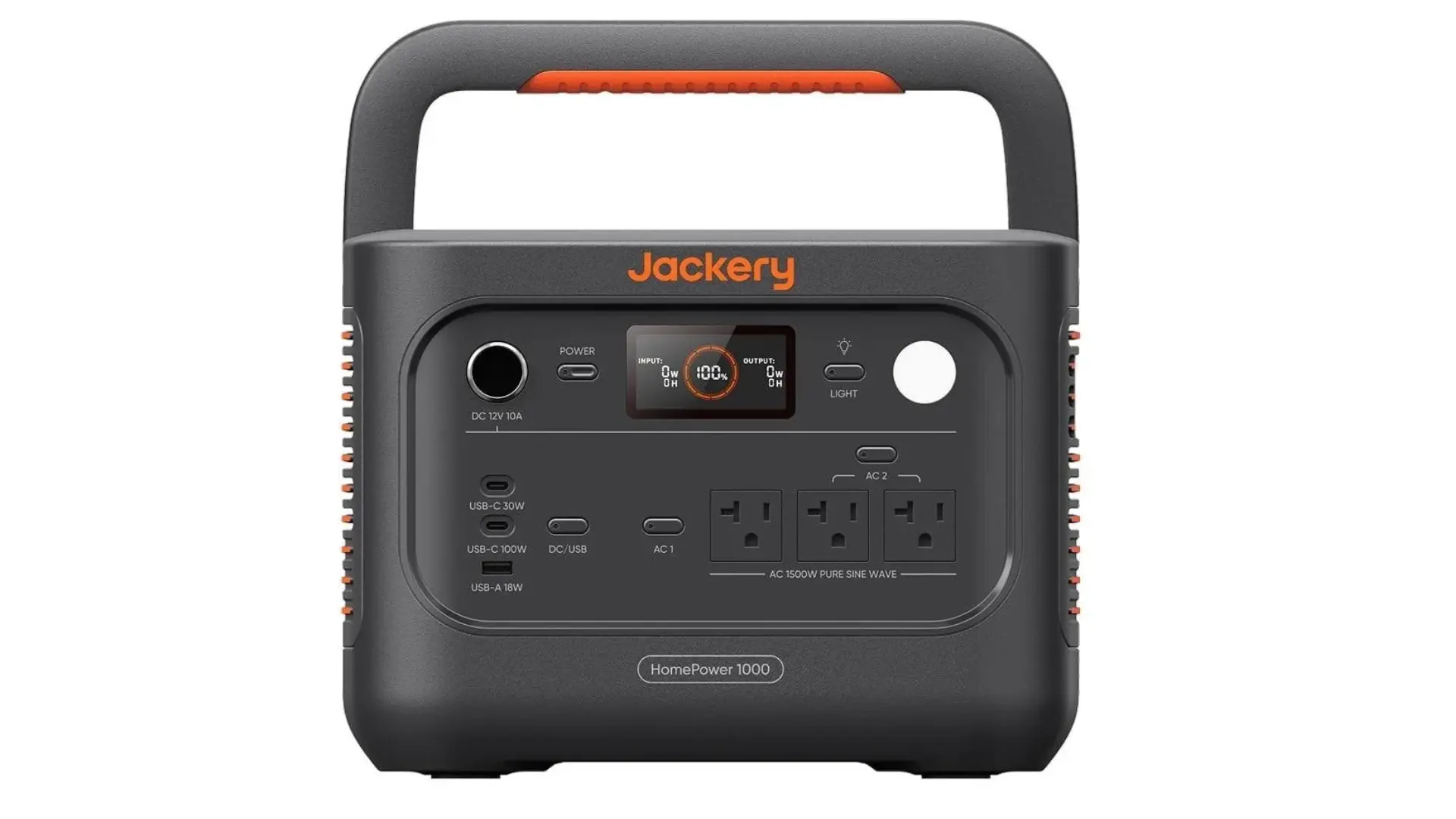
Jackery finally swapped the older Explorer’s short-lived NMC battery for LiFePO4 in this v2 refresh, which alone is reason enough to choose it over the original 1000.
Weighing under 24 pounds with a genuine one-hour wall recharge, it strikes a rare balance between weekend-camping portability and enough continuous output to run a coffee maker or small space heater without hesitation.
- Capacity: 1,070Wh (LiFePO4)
- Output: 1,500W continuous, 3,000W surge
- Weight: 23.8 lbs
- Cycle life: 4,000 cycles to 70%+ capacity
- Price: MSRP around $899, commonly discounted to $429 to $649
7. DJI Power 1000: Best for Photographers and Drone Operators
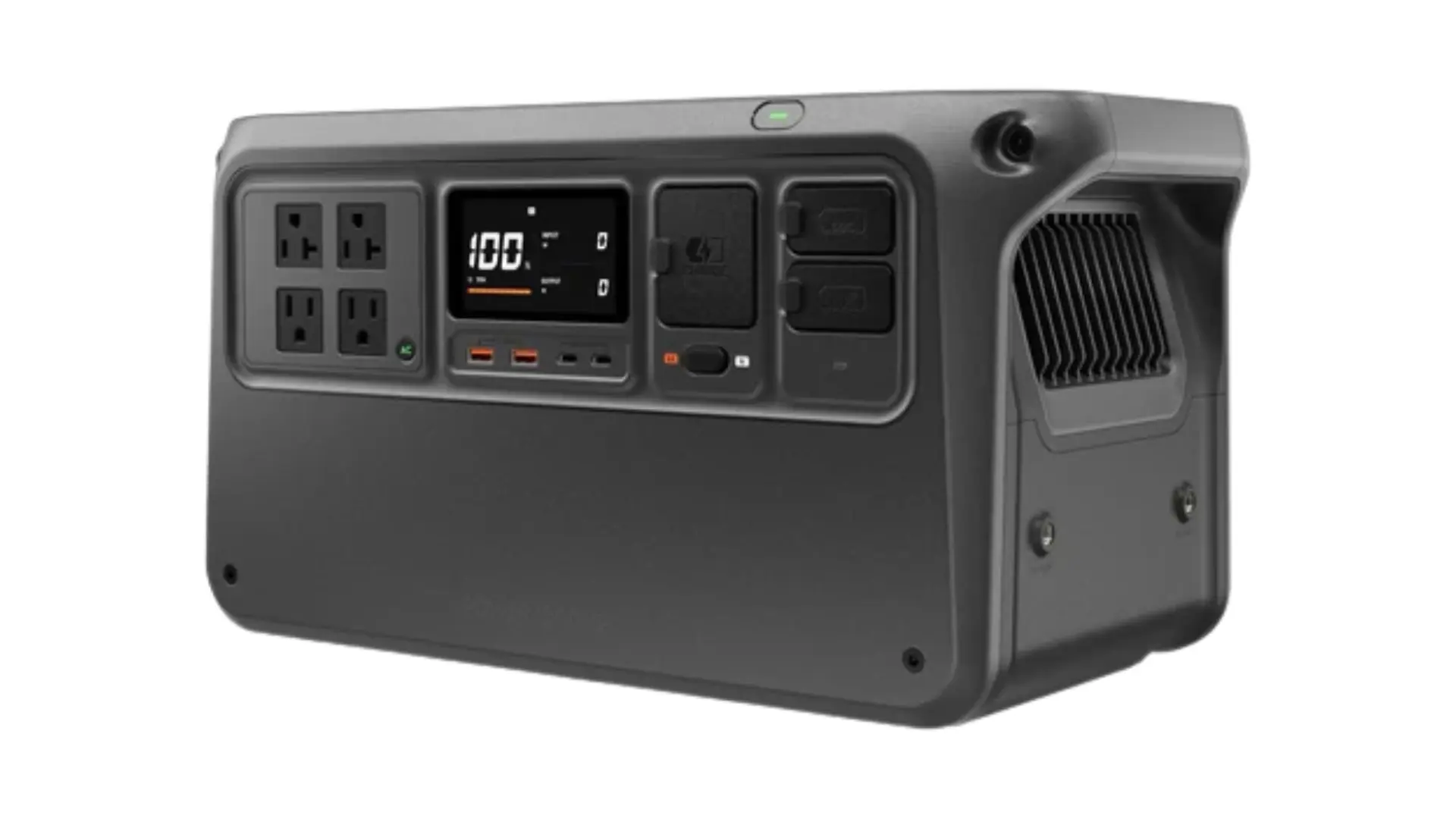
DJI built this station around its own SDC port, which fast-charges select drone batteries directly, something none of the other six units here offer.
At just 23 decibels, it’s also the quietest option in this lineup, worth knowing if you’re charging gear in a tent or hotel room overnight. It matches the Anker C1000 Gen 2 on capacity and price.
- Capacity: 1,024Wh (LiFePO4)
- Output: 2,200W continuous, 2,600W max, 4,400W peak
- Recharge: 70 minutes (0 to 100%) via AC
- Cycle life: 4,000 cycles, over 70% capacity retained
- Weight: about 28 lbs
- Price: around $999 MSRP, frequently discounted to $599 to $699
These options span casual travelers to buyers planning to back up a full refrigerator for days at a time. Match the capacity and output to what you’re actually running, not the biggest number on the shelf.
How Much Power Do You Actually Need?
Before comparing specs, it helps to know what your own devices draw. Here’s a rough guide based on typical wattage for common gear:
|
Device |
Typical running watts |
Startup surge |
Minimum station to consider |
|---|---|---|---|
|
Phone or tablet |
5 to 20W |
none |
any station |
|
Laptop |
45 to 100W |
none |
245Wh and up |
|
CPAP machine |
30 to 60W |
none |
268Wh and up, verify pass-through charging |
|
Mini fridge |
60 to 100W |
up to 600W |
500W output, 500Wh and up |
|
Full-size fridge |
150 to 400W |
up to 1,200W |
2,000W output, 1,000Wh+ for all-day use |
|
Microwave |
900 to 1,200W |
minimal |
1,500W output and up |
|
Window AC unit |
900 to 1,500W |
up to 2,500W |
2,000W output and up |
Startup surge, not running wattage, is what trips most underpowered stations. Check the surge or peak rating before you buy, not just the continuous number printed on the box.
How to Choose the Right Portable Power Station
Choosing a portable power station comes down to a handful of specs that actually affect performance, not the marketing copy on the box.
- Match capacity to your devices. List what you plan to power and add up the wattage. A higher watt-hour rating supports longer runtime, but it also adds weight and cost you may not need.
- Compare battery chemistry. As covered above, LiFePO4 cells hold up for thousands more cycles than standard lithium-ion, which is the deciding factor for anyone using the unit regularly rather than once a year.
- Check output and charging speed. Continuous output determines what appliances the unit can actually run, while charging speed affects how quickly you’re back to full power after a trip or an outage.
- Consider weight and portability. Lightweight units are easier to carry for camping, while heavier, higher-capacity models are better suited to staying in place as home backup.
Portable Power Station vs. Generator
Gas generators still make sense for some situations, but the two options solve the same problem in very different ways.
A power station runs silently, produces no fumes, and can sit safely inside a tent, RV, or living room, though its runtime is capped by battery capacity.
A generator delivers unlimited runtime as long as fuel holds out, but it comes with noise, exhaust, and regular engine maintenance.
Power stations suit buyers who want quiet, low-maintenance backup for electronics and small appliances, while generators remain better suited to running heavy equipment or covering outages that stretch beyond a couple of days.
Caution: Never run a gas generator indoors or in an enclosed space such as a garage. Carbon monoxide builds up quickly and can be fatal even with doors or windows partly open.
What Real Owners and Buyers are Saying
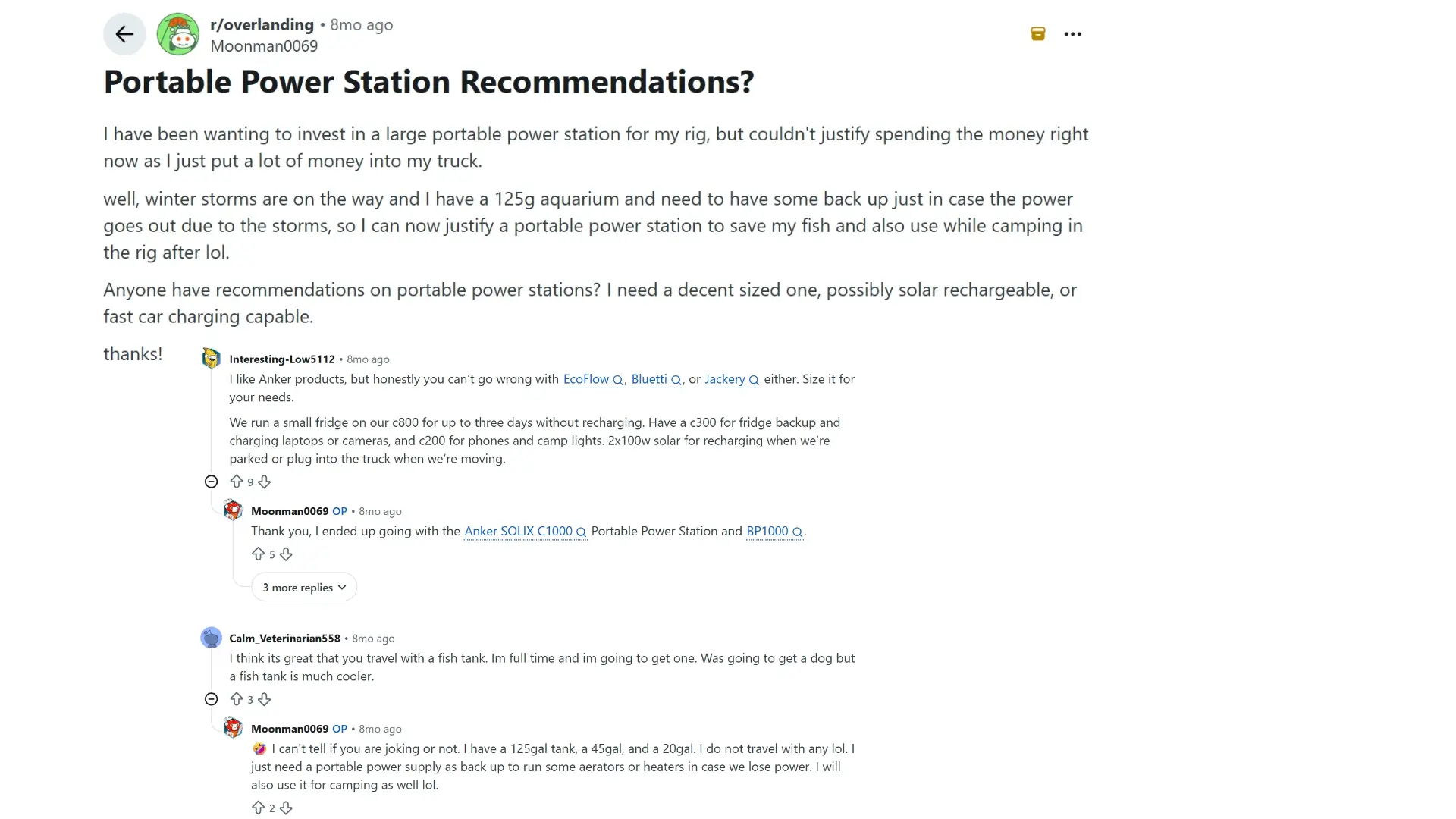
Real threads back this up. In one r/overlanding post, a user bracing for winter storms needed backup power for a 125-gallon aquarium’s aerators and heaters, plus something usable for camping in their rig.
Replies noted that Anker, EcoFlow, Bluetti, and Jackery are all safe bets, and one commenter laid out a three-unit setup: a larger station running a small fridge for up to three days without recharging, a mid-size unit for backup power and charging laptops or cameras, and a small one for phones and camp lights, all topped up through portable solar panels or a truck charger on the move.
The original poster ended up going with the Anker SOLIX C1000 plus an add-on battery, which reflects how many buyers actually shop: layering a few smaller units by priority instead of hunting for one station to cover everything at once.
It’s roughly the same conclusion I landed on after my own second outage: one big unit for the fridge, one small one for everything else.
Common Mistakes to Avoid When Buying
Before buying a portable power station, consider more than just capacity and price. Avoid these mistakes to choose a model that matches your actual needs.
- Buying based on capacity alone and ignoring output limits
- Choosing lithium-ion over LiFePO4 for long-term use
- Skipping the weight check before a camping trip
- Underestimating what appliances with motors actually draw at startup
- Forgetting to confirm solar or car-charging compatibility
- Assuming pass-through charging has no limits, running a heavy load while recharging can slow the charge rate or trip some units entirely
Note: Appliances with a compressor or motor, like fridges and power tools, often need two to three times their running wattage just to start. Check the surge rating, not just the continuous output number on the box.
Storage and Maintenance Tips to Extend Battery Life
A portable power station is only as reliable as the care it gets between uses. Store it at 40 to 60% charge rather than full or empty if it will sit for more than a month, keep it somewhere between 50°F and 80°F, and give it a top-up charge every three months even if you never touched it.
Avoid leaving it in a hot car trunk or a freezing garage, since both extremes shorten cell life faster than normal use would.
If the unit has app connectivity, check for firmware updates before storing it long-term, since manufacturers occasionally patch charging behavior.
LiFePO4 units are fairly forgiving of this kind of neglect. Older lithium-ion packs aren’t, which is another reason chemistry matters more than the spec sheet lets on.
Final Thoughts
Picking the best portable power stations really comes down to matching watt-hours and output to what you actually plan to run, not chasing the biggest battery on the shelf.
A budget pick like the RIVER 3 covers phones and lights, while something like the F3000 or Elite 200 V2 makes sense once you’re backing up a fridge or a full room.
Battery chemistry, real-world cycle life, and recharge speed matter just as much as the capacity number on the box, and they’re the specs most listings bury.
Whichever size you land on, check the surge rating against your heaviest appliance before you buy. Which one are you leaning toward? Drop a comment, and I’ll help you size it.
Frequently Asked Questions
Can You Fly with a Portable Power Station?
Most airlines cap lithium batteries at 100Wh for carry-on without approval, and up to 160Wh with airline sign-off. Anything larger typically isn’t allowed on flights, checked or carried.
Does a Power Station Lose Charge Sitting Unused?
Yes, all lithium batteries self-discharge slowly over time, usually a few percent per month. Charging it every couple of months during storage keeps it healthy and ready to use.
Can You Charge a Power Station While Using It?
Yes, most models support pass-through charging, letting you power devices while the unit charges. Check the manual first, since running both at once can slow overall charging speed.
How Long Do Portable Power Stations Actually Last?
A LiFePO4 unit rated for 4,000 to 6,000 cycles to 80% capacity works out to roughly a decade of daily charge and discharge cycles before it noticeably weakens. Units still using older lithium-ion cells typically last a few hundred cycles, closer to 2 to 3 years of regular use.
Can a Portable Power Station Really Run a Full-Size Refrigerator?
Yes, as long as the station’s output and surge rating clear the fridge’s startup spike, usually 900W to 1,200W for a moment. A 2,000Wh-class station like the Elite 200 V2 can typically keep a standard fridge running for a full day or more on a single charge.