You’ve decided you need a GPS tracker. Smart move. Whether you want to keep tabs on a teenager’s first car, protect a company vehicle, or make sure your aging parent gets home safely, GPS tracking genuinely works.
But then you hit the wall: portable or hardwired?
They both track location. They both send alerts. So what’s actually different – and does it matter for your situation? Let’s cut through the noise.
What Is a Portable GPS Tracker?

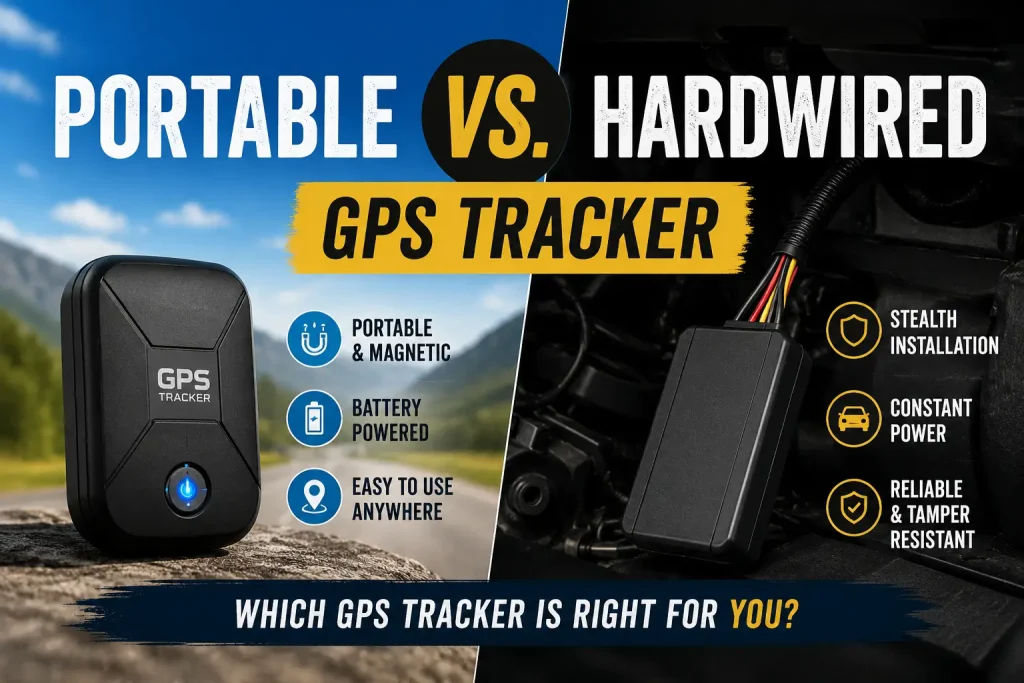
A portable GPS tracker is a self-contained device with its own internal battery. You place it wherever you need it – under a seat, in a glove box, inside a bag, or magnetically attached to a vehicle’s exterior – and it tracks location independently without any wiring.
Popular uses include tracking vehicles you don’t own (rental cars, company fleets you can’t modify), personal assets like luggage or equipment, and situations where you need to move the device between multiple vehicles.
How it works: The device uses its internal battery to power both the GPS chip and the cellular radio that transmits location data to an app or web dashboard. Battery life varies widely – anywhere from a few days to several months depending on how frequently it “pings” its location.
What Is a Hardwired GPS Tracker?
A hardwired GPS tracker connects directly to your vehicle’s electrical system, typically drawing power from the OBD-II port or from wiring behind the dashboard. Because it runs off the car’s power, it never needs a battery charge.
This is the go-to option for fleet managers, parents adding a tracker to a teen’s car, or anyone who wants a permanent, tamper-resistant solution on a vehicle they own.
How it works: The device taps into the vehicle’s 12V power supply (or OBD-II port for plug-in hardwired options). It’s always on, always connected, and – because it’s hidden inside the vehicle – significantly harder to find and remove.
Key Differences: Portable vs. Hardwired
1. Installation
Portable: Zero installation required. Charge it, place it, done. You can set it up in under two minutes.
Hardwired: Requires basic wiring knowledge or a professional installation. OBD-II plug-in versions are simpler – they take about 30 seconds – but traditional hardwired installs behind the dash take 30-60 minutes.
Winner for simplicity: Portable.
2. Power and Battery Life
This is the biggest practical difference between the two.
Portable trackers run on battery. Real-world battery life depends heavily on update frequency. A tracker pinging every 3 minutes will die in days. One set to update every 30 minutes can last weeks. Some low-power portable trackers in “sleep mode” claim months of standby – but you’ll sacrifice real-time updates to get there.
Hardwired trackers draw from the vehicle’s power supply. They never run out of battery, and they can deliver real-time updates (every 10-60 seconds) around the clock without any compromise.
Winner for always-on reliability: Hardwired.
3. Real-Time Tracking Accuracy
Both types can offer real-time tracking, but hardwired devices have a structural advantage: they don’t have to conserve power, so they can update location continuously.
With a portable tracker on power-saving mode, you might get location updates every 5-30 minutes. That’s fine for general monitoring – but if you’re trying to track a moving vehicle in real time, gaps matter.
Hardwired trackers can report location every 10-30 seconds without draining anything. For active fleet management or teen driver monitoring, that granularity is significant.
Winner for precision tracking: Hardwired.
4. Covertness and Tamper Resistance
A portable tracker hidden in a magnetic case under a bumper is discoverable. If someone sweeps the vehicle – physically or with a detector – they’ll likely find it.
For more on how vehicle security tech works together, our guide to key fobs covers another layer of protection worth understanding.
A hardwired tracker installed inside the dashboard, tucked behind panels, is far harder to locate. There are no visible wires to pull, no magnetic mount to find, and no battery that dies and gives itself away.
Winner for concealment: Hardwired.
5. Flexibility
Here’s where portable trackers shine. Need to move tracking from one vehicle to another? Pick it up and go. Want to drop it in a suitcase when you travel? Done. Monitoring multiple assets with one device on a rotating basis? Portable is the only option.
A hardwired tracker is committed to one vehicle. That’s great for permanence – not so great if your needs change.
Winner for versatility: Portable.
6. Cost
Portable trackers are generally cheaper upfront – many quality options fall in the $30-$80 range. The ongoing monthly subscription for cellular data is similar across both types, typically $15-$30/month.
Hardwired trackers can cost more upfront ($80-$150+), and if you pay for professional installation, add another $50-$100. That said, you eliminate the cost and hassle of battery replacements or recharging.
Winner for upfront cost: Portable. Winner for long-term convenience: Hardwired.
Which One Is Right for You?
Here’s a simple way to think about it:
Choose a portable GPS tracker if:
- You need to track an asset you don’t own or can’t modify (rental cars, borrowed vehicles)
- You want to monitor multiple vehicles or assets with one device
- You need to track personal items beyond vehicles (luggage, equipment, bags)
- You want a quick setup with no tools or installation
Choose a hardwired GPS tracker if:
- You own the vehicle and want a permanent, tamper-resistant solution
- You’re a parent monitoring a teen driver and need real-time, continuous updates
- You manage a small fleet and need reliable always-on tracking
- You don’t want to worry about charging or battery failure
A Note on Monthly Fees
One question that comes up often: can you get GPS tracking without a monthly subscription?
The honest answer is that most real-time GPS trackers do require a monthly data plan – the cellular network used to transmit location data isn’t free. However, some trackers offer prepaid or pay-as-you-go plans rather than locked annual contracts. If monthly fees are a concern, look for no-contract options that give you the flexibility to pause or cancel without penalty.
Bottom Line
Neither type is universally better. They solve different problems.
If you need flexibility, speed, and simplicity – go portable. If you need reliability, continuous tracking, and a solution that lives permanently in a vehicle – hardwired wins every time.
The good news: both options have matured significantly. You’re not choosing between good and bad – you’re choosing between two genuinely capable tools. Pick the one that fits how you’ll actually use it.
Looking to explore GPS tracker options? Devices like the Spark Nano (portable) and the Livewire (hardwired) from BrickHouse Security are well-regarded examples of each type, with no long-term contracts required.