DeepSeek and ChatGPT keep showing up in the same conversation, and for good reason. One built its name on cheap, efficient reasoning, and the other on being the AI assistant that can write, plan, and create for almost any task.
When you actually put DeepSeek vs. ChatGPT side by side on the same prompts, the gap between them shows up in specific, practical ways: how each one handles a messy coding bug, how naturally each one writes a client email, and how much each one costs once you move past the free tier.
That practical gap, not marketing claims, is what actually decides which tool deserves a permanent spot in your workflow.
How We Compared DeepSeek and ChatGPT
Before writing this comparison, I spent two weeks in September 2026 running the same set of prompts through both tools’ standard web versions: DeepSeek’s chat interface and ChatGPT’s default browser experience, with no paid add-ons on either side.
The test set covered twelve prompts across four categories: three coding tasks (fixing a Python indexing bug, writing a SQL query with a join, and building a small React form), three writing tasks (a product description, a cold outreach email, and a blog outline), three explain-it-to-me research tasks, and three everyday tasks like planning a weekend trip and reviewing a short resume.
I logged how each tool answered on the first try, whether it needed a follow-up prompt to produce usable output, and how the tone read to a non-technical reader, using the same standard I’d apply to any app built to cut down wasted time. Those results shape the comparisons below, not general reputation or marketing copy.
DeepSeek vs ChatGPT: Where They Actually Differ
DeepSeek and ChatGPT differ in how they are built, what tasks they prioritize, and the features available to users. Comparing these areas helps clarify where each AI platform performs best.
1. Model Architecture and Development Approach
DeepSeek builds its models to activate only part of their network for each task, which keeps running costs low and lets the company release open-weight models that developers can download and run themselves.
ChatGPT runs inside OpenAI’s wider product, where the model connects to tools like file uploads, image generation, and voice mode inside one interface.
In practice, this means DeepSeek suits people who want a lean, inspectable tool or plan to build something on top of it, while ChatGPT suits people who want everything working together out of the box.
2. Coding and Technical Reasoning
In our coding tests, DeepSeek solved the Python indexing bug and the SQL join correctly on the first attempt and explained the fix in fewer words. ChatGPT also solved both correctly but added more context and alternative approaches, which helped when the bug was slightly ambiguous.
For the React form, both tools produced working code, though ChatGPT’s version handled form validation without being asked, while DeepSeek’s needed a follow-up prompt to add it.
Neither tool is unreliable here. The difference shows up in how much hand-holding each one needs, not whether it can code at all, and that gap matters even more when choosing a first language for a new project.
3. Writing and Everyday Assistance
ChatGPT’s writing came out more natural to read on the first pass, especially for the cold outreach email and the blog outline, where it adjusted tone without being told to.
DeepSeek’s writing was accurate and well organized but occasionally read a little stiff until we asked it to loosen the tone.
For research-style prompts, both explained concepts clearly, though ChatGPT tended to structure longer answers with better signposting for a reader who is skimming.
4. Tools, Files, and Everyday Features
ChatGPT’s interface supports file uploads, image generation, voice input, and browsing within one app, which matters if you switch between tasks often.
DeepSeek keeps its interface centered on text and reasoning, and while developers can wire its open models into custom tools, the hosted chat app stays simpler.
If your day involves juggling documents, images, and text in the same conversation, that gap is worth weighing, particularly for anyone already leaning on other apps for remote work organized.
Pricing, Privacy, and Security Comparison
Cost, privacy, and security are key factors when selecting an AI tool. DeepSeek and ChatGPT differ in pricing models, API costs, and data protection features, and organizations weighing either one can use a federal AI risk framework to decide how much sensitive data to run through any chatbot.
|
Category |
DeepSeek |
ChatGPT |
|---|---|---|
|
Pricing |
Free access with API costs around $0.14 input and $0.28 output per 1M tokens |
Free plan available; Plus plan costs $20/month |
|
API Costs |
Lower pricing makes it suitable for developers and large-scale use |
Higher cost but includes advanced models and tools |
|
Privacy |
Users should review data handling and hosting practices |
Offers privacy controls and enterprise security options |
|
Best Value For |
Developers and cost-focused users |
Professionals and businesses needing advanced features |
DeepSeek offers better affordability and flexibility, while ChatGPT provides more features, security options, and professional capabilities.
Common Mistakes People Make when Comparing These Two Tools
Comparing AI tools sounds simple until you actually do it. Most people fall into the same few traps, and those traps usually explain why the “wrong” tool gets picked.
- Assuming last year’s benchmark scores still apply. Both companies release new model versions multiple times a year, so a comparison from even six months ago may already be outdated.
- Testing only the free tier and assuming it reflects the paid experience.
- Picking a tool based on general reputation instead of the task at hand, such as choosing ChatGPT for cost-sensitive, high-volume API work where DeepSeek’s pricing usually wins.
- Ignoring where the data goes. Cost and quality matter, but for regulated industries, where a model is hosted and how data is retained can matter more- a concern serious enough that lawmakers urged device bans on state-issued hardware.
- Judging creativity or accuracy from a single prompt. One test rarely tells you how a tool performs across a full week of real work.
Avoiding these mistakes will not tell you which tool wins outright, but it will make sure whatever conclusion you reach actually holds up under real use.
What Reddit Users Say About DeepSeek and ChatGPT
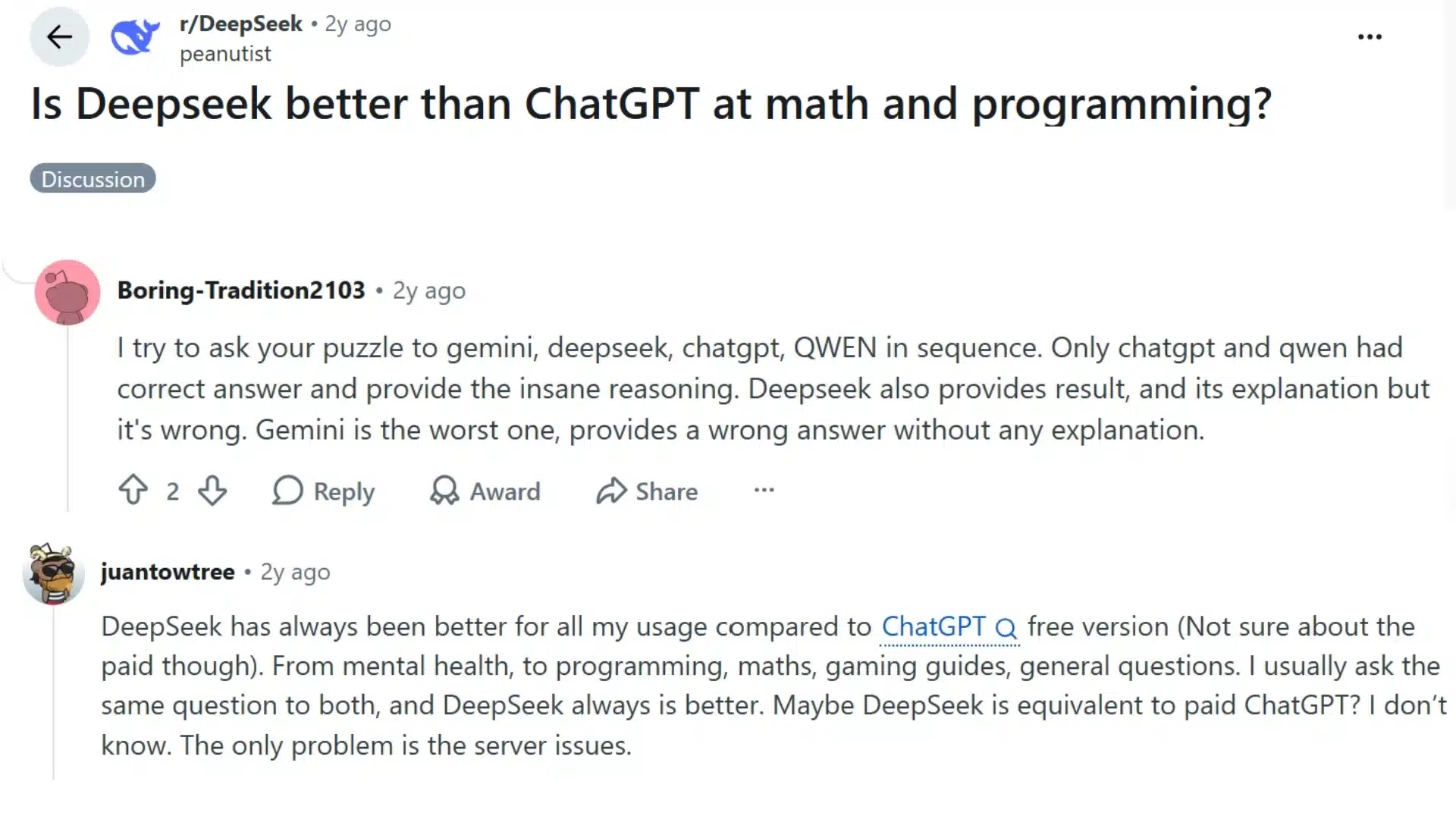
Reddit discussions suggest that users choose DeepSeek or ChatGPT based more on the task than on one platform being universally better.
Many developers favor DeepSeek for coding, mathematical reasoning, debugging, and lower-cost technical experimentation, particularly when efficiency matters.
In r/DeepSeek discussions, users often highlight its technical capabilities. ChatGPT, however, is frequently preferred for writing, research, brainstorming, explanations, and everyday productivity because users find its responses more conversational and its feature set broader.
Some r/ChatGPT users also recommend using both tools, choosing DeepSeek for certain coding or reasoning tasks and ChatGPT for creative or general work.
These opinions reflect individual experiences rather than controlled benchmarks, so performance can vary by prompt, model, updates, and workflow.
Which AI Should You Choose?
That’s what settles the DeepSeek vs. ChatGPT question for most people: match the tool to the task in front of you, not the hype around it.
|
Task |
Better Fit |
Why |
|---|---|---|
|
Coding and debugging |
Both (lean DeepSeek for cost) |
DeepSeek is cheaper at scale; ChatGPT explains fixes in more depth |
|
Everyday writing and editing |
ChatGPT |
More natural tone without extra prompting |
|
Research and learning |
ChatGPT |
Clearer structure for skimming |
|
Brainstorming |
ChatGPT |
Wider range of angles per idea |
|
High-volume API workloads |
DeepSeek |
Lower per-token cost |
|
Working with files, images, or voice |
ChatGPT |
Broader built-in tools |
|
Custom or self-hosted AI projects |
DeepSeek |
Open-weight models |
|
Handling sensitive company data |
Depends on policy |
Check each provider’s current data handling terms |
When It Makes Sense to Use Both
Plenty of people who work with AI daily don’t pick one tool and stop there, and that is not indecision; it’s a practical workflow.
A common pattern among developers is running everyday, high-volume tasks like generating boilerplate code, cleaning data, or drafting quick scripts through DeepSeek, since the cost stays low even at scale.
Then, when a task shifts toward polished client-facing writing, image input, voice notes, or a longer back-and-forth conversation that needs to hold context, they switch over to ChatGPT.
Some people go further and run the same important prompt, like a legal summary or a production code fix, through both tools side by side, simply to catch a wrong or incomplete answer before acting on it. Used this way, the two tools complement each other rather than compete.
Final Verdict
Testing both tools side by side over two weeks made the choice clearer than reading spec sheets ever could. DeepSeek earns its reputation on cost and coding efficiency, especially for developers running high-volume tasks or building on open models.
ChatGPT earns its reputation on everyday usability, handling writing, files, and follow-up questions with less friction. Neither tool wins every category, and both keep changing their pricing and capabilities throughout the year, so today’s answer may shift by next quarter.
For most people weighing DeepSeek vs. ChatGPT right now, the safest approach is to run your most common task through both before committing. Which one matched your workflow better? Share your results in the comments.
Frequently Asked Questions
Does DeepSeek Store or Train on My Conversations?
DeepSeek’s hosted chat app can use conversations to improve its models unless you opt out in settings, and its data is processed under Chinese data regulations, so sensitive business data deserves a closer read of its current privacy terms before use.
Can I Self-Host Deepseek’s Models Instead of Using the Hosted App?
Yes. DeepSeek releases open-weight versions of its models that developers can download and run on their own infrastructure, which gives more control over data handling than the hosted chat app.
Is ChatGPT’s Free Plan Enough for Daily Use, or Do I Need Plus?
The free plan covers light, everyday use, but heavy users often hit message limits or want access to the latest model and faster response times, which is when the $20-a-month Plus plan becomes worth it.
Which Tool Handles Longer Conversations or Big Documents Better?
Both support large context windows, but ChatGPT’s file upload tools make it easier to work through long documents in a single conversation, while DeepSeek is better suited to shorter, focused technical exchanges.
How Often Do These Tools Change, and Does that Affect Which One I Choose?
Both companies update models and pricing several times a year, sometimes with little notice, so it is worth rechecking official pricing and model pages every few months rather than treating any comparison, including this one, as permanent.