Key Takeaways
|
Every month brings another “best noise cancelling earbuds” roundup. Most just rank sound, ANC depth, and battery life. Few mention premium ANC earbuds or what new trends 2026 actually bring.
The real question is not which pair tops a lab chart. It is whether new premium features are actually worth paying for. This guide breaks down five trends shaping ANC earbuds in 2026, flags what is marketing filler, and gives you a framework to decide if an upgrade makes sense.
Prices and availability as of June 2026; check manufacturer sites for current MSRP.
Adaptive ANC 4.0: Environment-Aware Noise Cancellation
Adaptive ANC 4.0 is the 2026 marketing label several brands use for their latest generation: faster scene detection, finer wind-noise handling, and tighter coupling between feed-forward and feed-back mics. Adaptive ANC continuously reads your environment: engine rumble, human chatter, wind. It adjusts intensity and filter profiles in real time. Adaptive tuning targets the spikes that make cheap buds feel inconsistent: sudden announcements, gusts at a crosswalk, or the HVAC cycle kicking on mid-call.
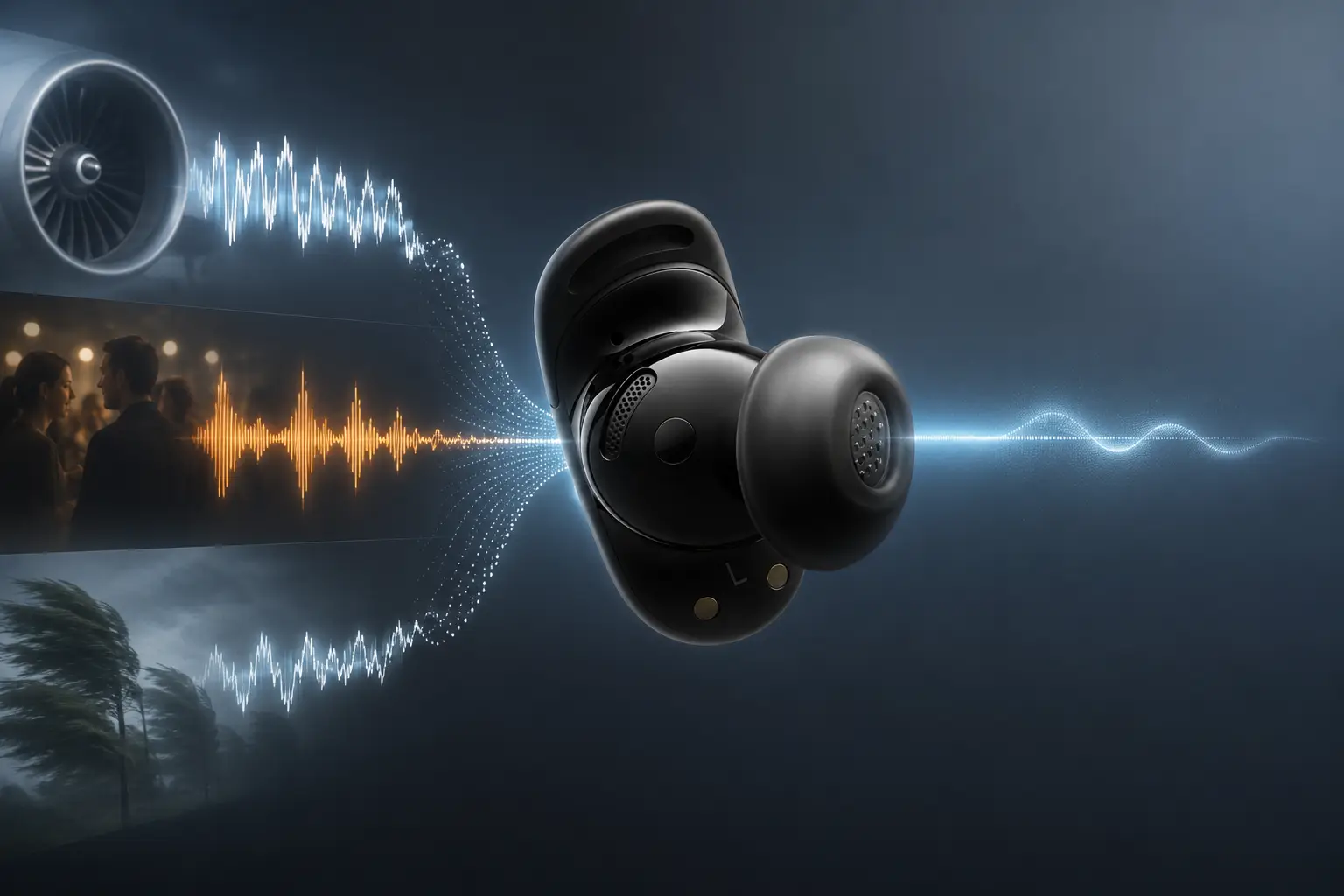
In the 2026 premium tier, soundcore Liberty 5 Pro (about $169.99) and Liberty 5 Pro Max (about $229.99) both list Adaptive ANC 4.0 on their specs pages, with identical earbud features across both SKUs. The same price band also includes adaptive ANC flagships from Sony WF-1000XM6 and Bose QuietComfort Ultra Earbuds 2. Naming differs by brand, but the direction is the same: dynamic noise cancellation tuned to your environment.
The benefit is simple: fewer manual ANC mode taps. In practice, adaptive systems vary widely. For example, Sony WF-1000XM6 and Bose QuietComfort Ultra Earbuds 2 remain go-to references for deep cancellation on flights and in offices. soundcore Liberty 5 Pro and Liberty 5 Pro Max both ship the same Adaptive ANC 4.0 and ANKER Thus™ Chip processing on the earbud side.
AI-Powered Call Clarity: Can They Hear You Clearly?
If you take calls from cafés, open offices, or windy sidewalks, premium 2026 buds aim for one outcome: the person on the other end hears you, not the background.
- Sony WF-1000XM6 and AirPods Pro 3 are common benchmarks—the former leans on a multi-mic array with AI wind-noise reduction; the latter uses Voice Isolation and bone-conduction call detection. Both help your voice come through clearly in noisy or windy settings.
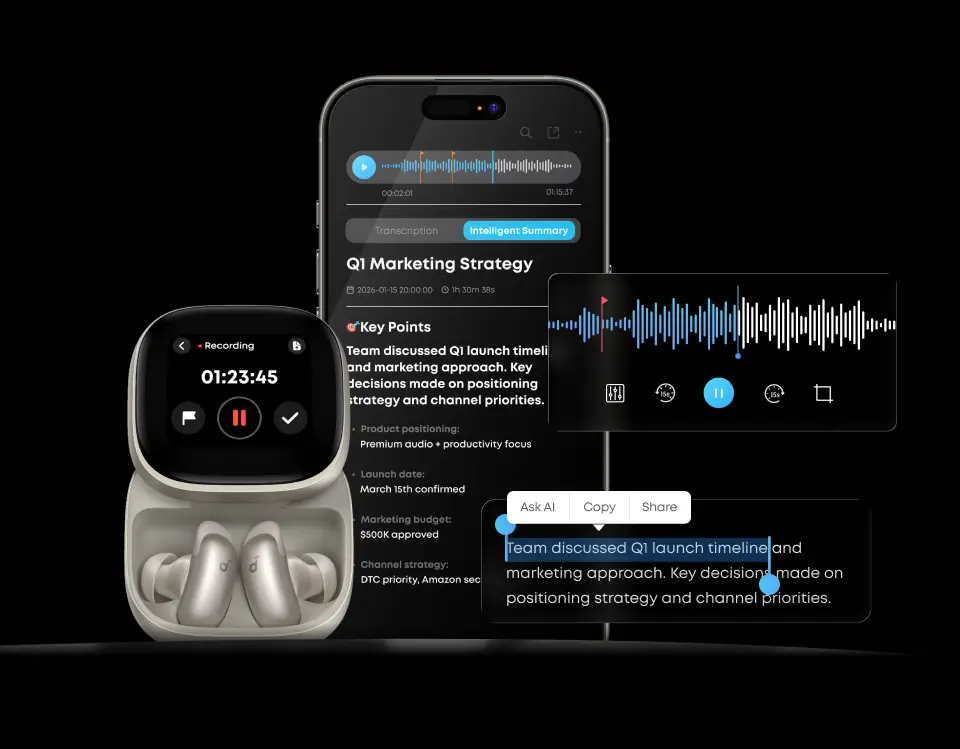
- soundcore Liberty 5 Pro and Liberty 5 Pro Max stack eight voice mics, two bone-conduction sensors, and Thus™ on-device processing on both earbuds, keeping everyday commute and open-office calls easier for the person on the other end to follow. Liberty 5 Pro Max case goes further with a 1.78-inch AMOLED touch display—you can capture meetings right from the case. Transcription sits behind a subscription, but for professionals who need call and meeting records, it is a practical time-saver.
- soundcore Liberty 5 Pro and Liberty 5 Pro Max are both certified as the World’s Clearest Earbuds for Calls, a Guinness World Record title, one of the few earbuds in this guide with a third-party benchmark behind the call quality claim.
|
Basic recording (via the case mic) is free. Eligible purchasers include 120 minutes of AI transcription per month for 24 months. Beyond the included 120 minutes, transcription and summaries require a paid subscription (and an internet connection). — soundcore |
Spatial Audio With Head Tracking: Immersive, but Niche
Spatial audio widens the soundstage so instruments and dialogue feel positioned around you. Head tracking adjusts that image as you turn your head. It is most compelling for video, not a Spotify playlist on a walk.
Head-tracked spatial audio works best when your head stays relatively still and your eyes stay on a screen—movies, games, or video at home. On a commute, the picture is different: walking with ANC and spatial enabled can feel disorienting, and it often drains battery faster than standard stereo.
That does not make spatial audio a gimmick. If you already chase a wider, more immersive listen—movies on Apple TV+ or Netflix mobile, supported games—head-tracked spatial audio is a genuine upgrade, not just ad copy. It is not the main reason to upgrade if your library is mostly music and podcasts, but for buyers who care about sound quality and presence, it remains a choice worth weighing.
Multipoint Bluetooth 6.1: Seamless Device Switching
Multipoint lets one earbud pair stay connected to two devices, such as a laptop and phone. It switches audio without full re-pairing. Bluetooth 6.0/6.1 (2026 flagships are adopting it) improves connection stability, lower latency in supported stacks, and better coexistence with wearables on crowded radio bands.
If you have missed a phone call because your buds were still connected to a laptop—or interrupted a meeting while audio was tied to the wrong device—multipoint targets exactly that pain. One pair stays linked to two devices, and when a call or new source starts, audio can switch without digging through Bluetooth settings to disconnect and re-pair. For anyone on a laptop-and-phone workflow, that is why multipoint ranks among the emerging trends shaping premium ANC earbuds in 2026.
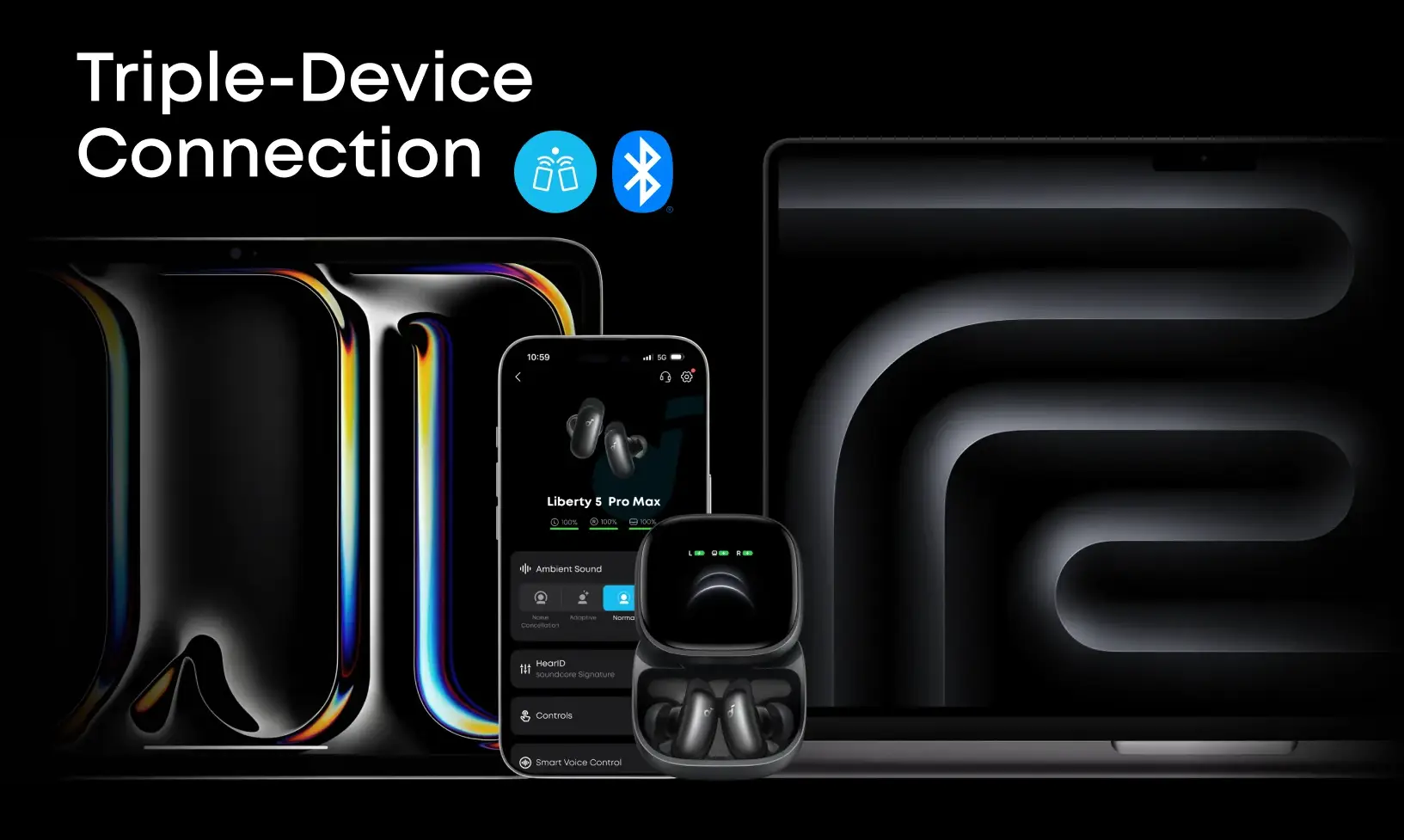
Sony WF-1000XM6 (Bluetooth 5.3) and Jabra Elite 10 (Bluetooth 5.3) often lead with multipoint—join a Teams call on your laptop, then answer your phone without reopening Bluetooth settings. soundcore Liberty 5 Pro and Liberty 5 Pro Max run Bluetooth 6.1 with the same dual-device workflow on both models.
Battery Life and Fast Charging: Less Anxiety, More Trade-offs
Premium ANC earbuds in 2026 also put a spotlight on two practical questions: how long the buds last, and how long charging takes. In real use, many flagship pairs still land around 6–8 hours with ANC on—enough to meet most everyday needs.
Fast charging is the more visible upgrade in 2026. soundcore Liberty 5 Pro and Liberty 5 Pro Max, for example, deliver about four hours of playback from five minutes on the charger. A brief stop before your commute can cover a typical workday. AirPods Pro 3 offers a similar single-charge ceiling at up to eight hours with ANC enabled, though its fast charging is more modest: Apple lists around one hour of listening time from five minutes in the case.
Buyer Framework: 5 Questions Before You Upgrade
Before you click buy on any premium ANC earbuds or best anc earbuds 2026 list, run these five checks:
- Does your current ANC fail in a specific place? (Subway, open office, airplane.)
- Are calls a daily pain? If yes, weight mic count and ENC over incremental ANC gains.
- Do you use two devices daily? Multipoint alone can justify a step up from 2022-era buds.
- Will you use spatial audio weekly? If not, do not pay flagship prices for it.
- Have you checked third-party ANC tests? Manufacturer claims need independent verification.
If your answers point to an upgrade, you may still want a ranked starting list. See best noise cancelling earbuds for soundcore’s roundup picks. Read those lists through the lens of this framework, not as a substitute for it.
Who Should Upgrade in 2026?
Match your daily routine to one of four upgrade personas:

How to Evaluate Premium ANC Without Overpaying
Do not start with spec sheets. Ask yourself which two features you actually rely on this week—commute ANC, clear calls on Zoom, or switching between laptop and phone? Compare models in the same price band only after that. If you will not use a feature more than once a week, do not pay extra for it.
Once your priorities are clear, browse the anc earbuds collection to see what is available in the premium range. Going in with a short list beats opening another “best of” roundup with no plan.
Conclusion
In 2026, premium ANC is about system integration, not single specifications. What actually changes your day is smarter cancellation, clearer calls, smoother device switching, and case-level tools working together. Use the personas in this guide to lock your priorities. To explore further, browse the ANC earbuds collection.
If your current buds only struggle in one narrow scenario, a full premium jump may be overkill. If three or more rows in the tables above say worth it, 2026 is a reasonable year to upgrade—provided you verify ANC through independent reviews, not brand slides alone.
FAQ
What Is the Difference Between ANC and Adaptive ANC?
ANC uses a fixed noise-cancellation profile: the same intensity and filter curve whether you are at a quiet desk, on a subway platform, or outdoors in the wind. When the environment shifts—sudden announcements, HVAC cycles, or gusts—ANC can feel too weak one moment and too muffled the next. Adaptive ANC uses feed-forward and feed-back microphones to read ambient noise in real time and dynamically adjust intensity and filtering. The core benefit is fewer manual mode switches and more stable quiet across changing scenes.
What’s the Difference Between ANC and ENC?
ANC reduces ambient noise during music playback—subway rumble, office chatter, and plane hum reach your ears at lower volume. ENC (Environmental Noise Cancellation) filters background noise from your microphone during calls so the other person hears you, not café clatter, keyboard taps, or wind. Premium 2026 earbuds increasingly include both, since most buyers listen and take calls in the same week.
Do Premium ANC Earbuds Damage Hearing Over Time?
No. ANC does not blast extra noise into your ears—it blocks outside sound so you can turn the volume down. The real risk is still listening too loud, too long, especially if the fit is poor and you crank the slider to compensate. At sensible volumes, ANC often helps more than it hurts compared to fighting background noise without it.
Which Premium ANC Specs Matter Most in 2026?
Look for ANC results you can verify—third-party tests beat marketing slides alone. Match battery life (many 2026 flagships offer about 6–8 hours with ANC on) and everyday perks like multipoint and fast charging to your routine. Call quality and wind handling matter if you phone or Zoom daily. Skip flagship extras like spatial audio or case screens unless you will actually use them.