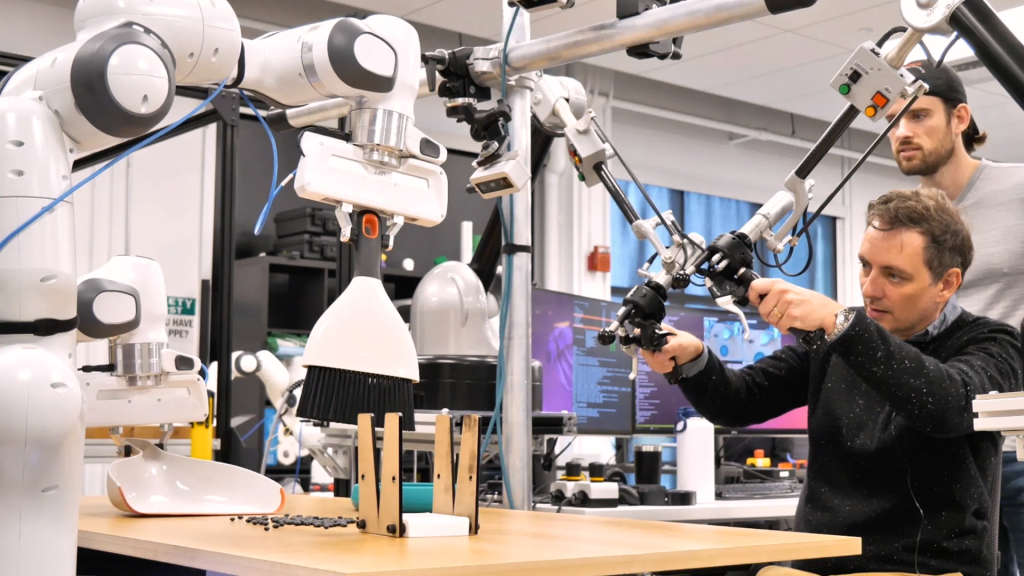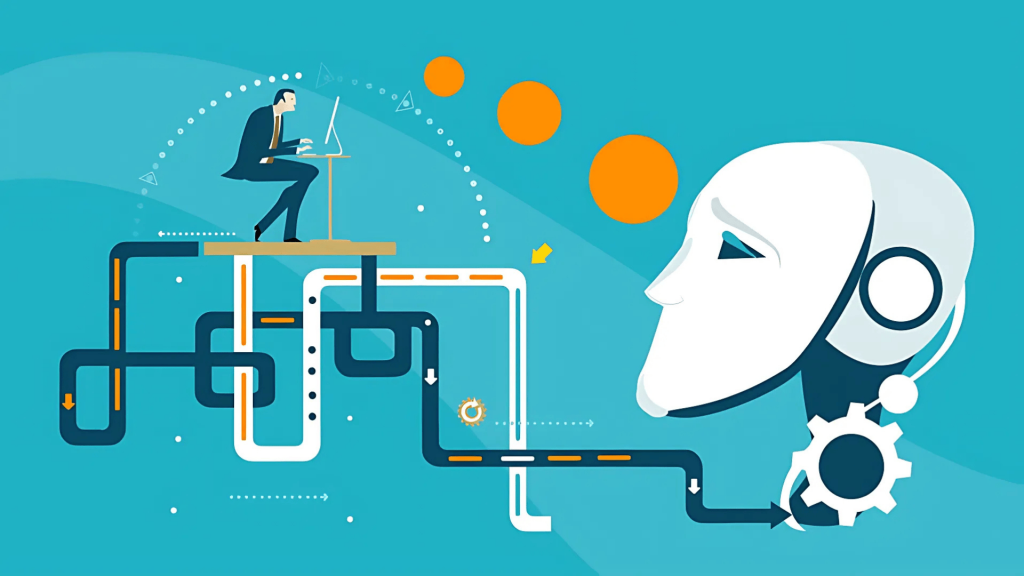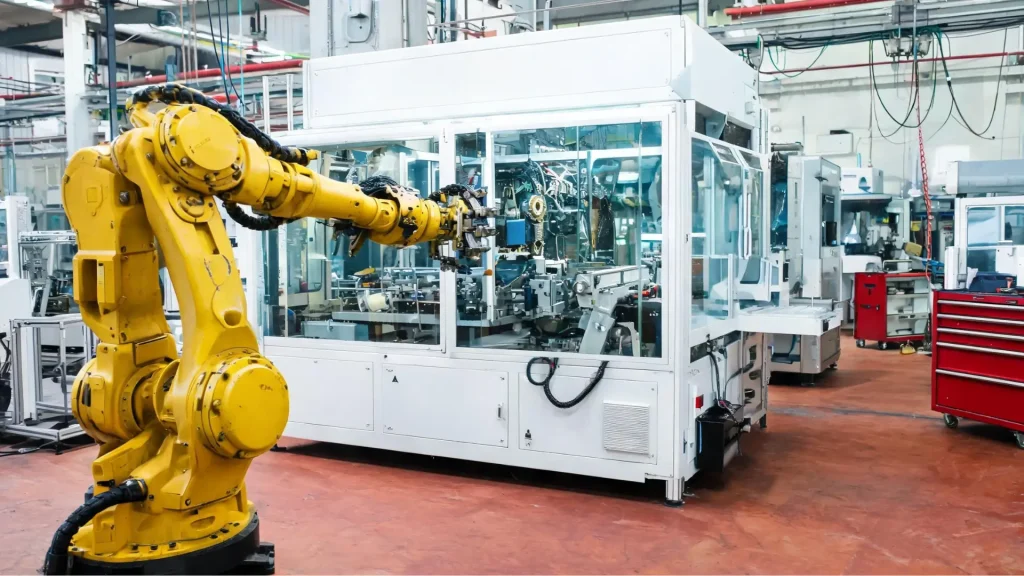
Walk into a modern car plant, and you might expect noise, fumes, and a hundred workers on the line. What you actually find is quieter than you’d think.
Robotic arms weld door panels. Cameras inspect paint finishes at speeds no human eye can match. A small crew watches dashboards from a glass-enclosed control room.
This is what industrial automation and robotics look like in practice, and it is happening across far more industries than just automotive.
The factories building your phone, the warehouses shipping your orders, the plants packaging your medicine, they are all running on these systems.
This guide breaks down exactly how it works, what the different types are, and why so many businesses are betting billions on it.
What is Industrial Automation?
Industrial automation is the use of technology and control systems to run industrial processes with minimal human input.
It covers everything from a single automated conveyor belt to a fully connected smart factory where every machine communicates with every other in real time.
The goal is consistent: produce more output, faster, with fewer errors and lower operating costs.
Automation is not the same as robotics, though people often use the terms interchangeably. Think of automation as the system, and robotics as one type of tool within that system.
A factory can automate its inventory tracking through software alone, with no robots at all. Industrial automation and robotics work best in combination, but they are distinct concepts.
The field has been evolving since the first assembly lines of the early 20th century.
What changed in the past decade is the arrival of AI and machine learning, which transformed robots from fixed task-executors into systems that can learn, adapt, and make real-time decisions.
Having tracked this shift for over a decade, the practical gap between a 2010-era industrial robot and a 2025 system is roughly the same as the gap between a calculator and a smartphone.
Types of Industrial Automation
Industrial automation generally falls into four categories. Each one suits a different kind of production, different volumes, different levels of flexibility, and different costs. Here is how they compare:
| Type | How it works | Best for | Example |
|---|---|---|---|
| Fixed (hard) automation | Equipment is set up to perform one specific task and cannot be easily changed | High-volume, low-variety production | Bottling lines, conveyor systems |
| Programmable automation | Machines are reprogrammed between production runs via software | Batch production with moderate variety | CNC machines, programmable industrial robots |
| Flexible automation | Systems can switch between tasks without stopping production | Mixed production, fast changeovers | Flexible manufacturing cells, robotic assembly lines |
| Integrated automation | All systems in a facility are connected and coordinated by software | Smart factories, large-scale operations | Computer-integrated manufacturing (CIM), smart factories |
Fixed automation delivers the lowest cost per unit when you are making millions of the same thing. Integrated automation is where the real power lies, when robots, sensors, software, and logistics all operate as a single system.
The architecture behind each of these categories matters as much as the robots themselves.
If you want a deeper breakdown of the hardware and software layers involved, the guide to types of industrial automation systems covers the infrastructure side in detail.
What is Industrial Robotics Automation?
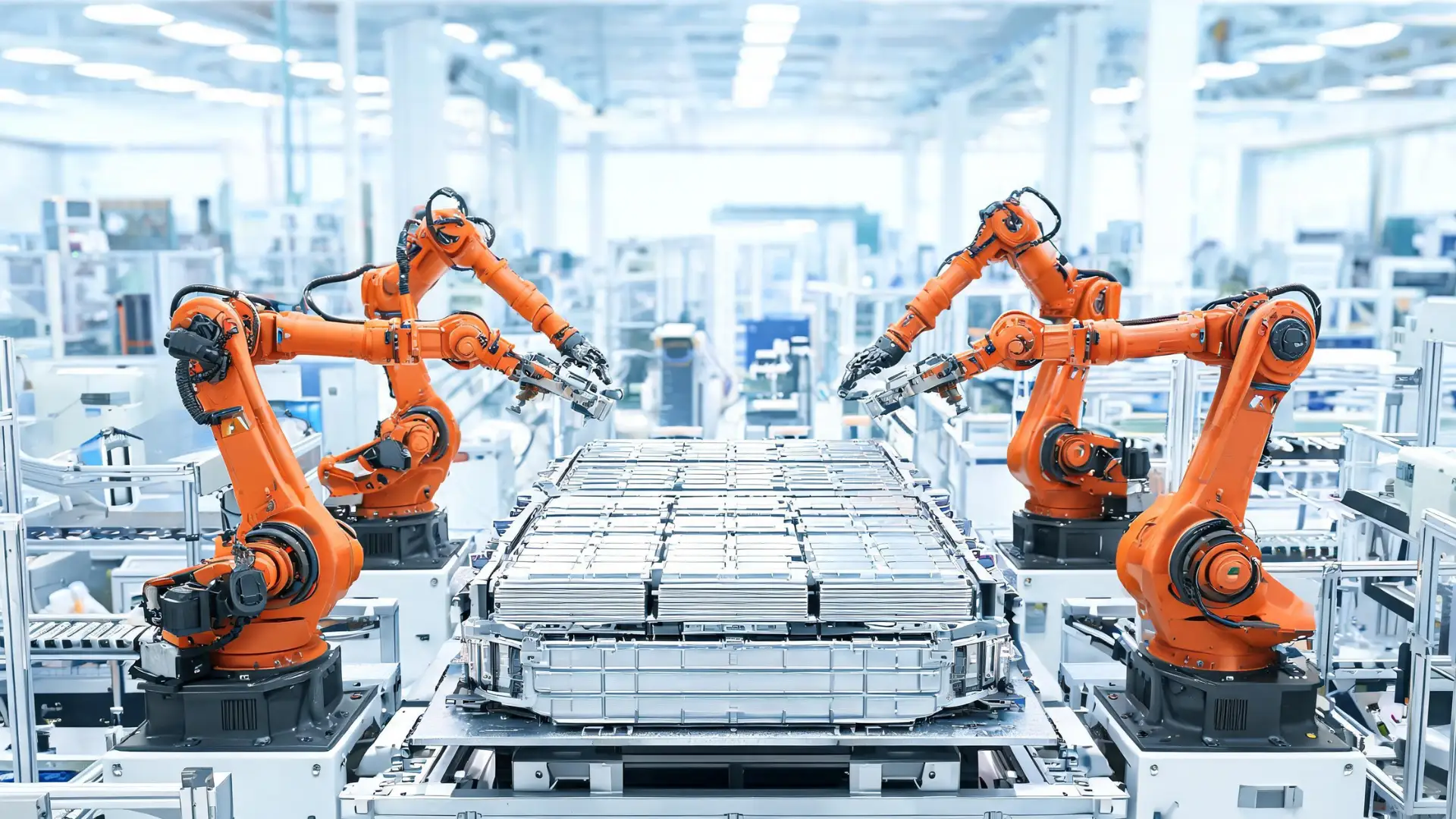
Industrial robotics automation is the use of programmable machines to carry out physical tasks in a manufacturing or production environment.
These machines can weld, assemble, paint, package, inspect, and move materials, often with greater precision and speed than any human worker.
A robot in this context is not a humanoid walking on a factory floor. Most industrial robots are stationary or rail-mounted arms with multiple rotary joints.
They are reprogrammable, which means one robot can handle welding today and switch to part assembly next week after a software update and a toolhead change.
That flexibility is the core of their value proposition.
The broader context around robotics and automation fundamentals makes this clearer: AI improves at interpreting sensor data and making real-time decisions, and industrial robots can now handle tasks that once required human judgment.
Quality inspection is one example. A camera-equipped robot can detect a hairline crack in a component at thousands of units per hour. No human inspector consistently matches that rate over an eight-hour shift.
Major Types of Industrial Robots
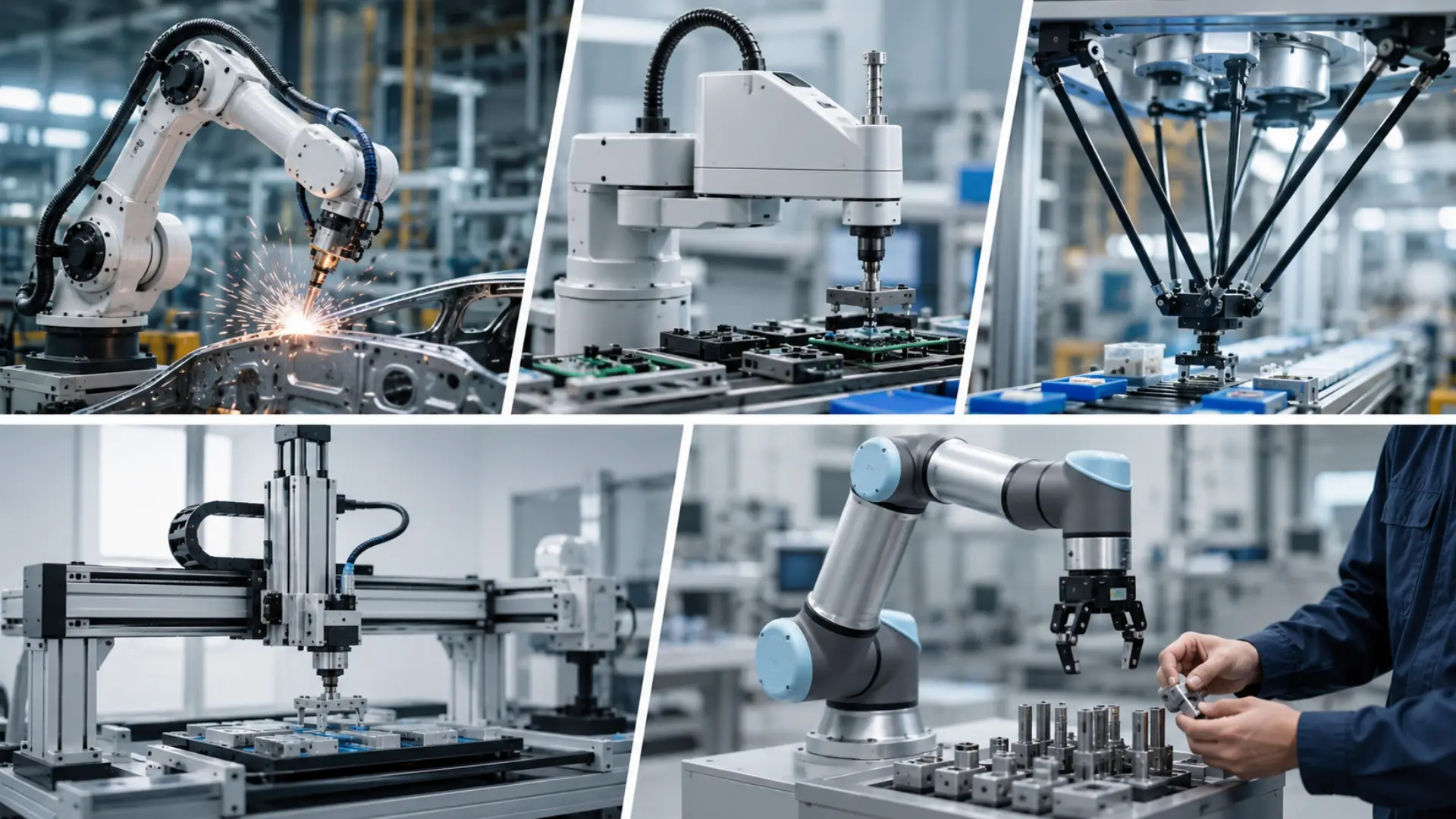
Industrial robots are designed for different manufacturing tasks, and each type serves a specific purpose based on movement, precision, speed, and workload requirements.
- Articulated robots: These are the most common type. They have rotary joints (usually six) that make them move like a human arm. They handle welding, painting, assembly, and machine tending across almost every industry. Their biggest strength is the range of motion; they can reach into tight spaces and work at almost any angle.
- SCARA robots (Selective Compliance Articulated Robot Arm): Smaller and faster than articulated models, SCARA robots work on flat, horizontal surfaces. They are widely used for pick-and-place, assembly, and packaging tasks where speed matters more than range of motion.
- Delta robots: Sometimes called spider robots, these have three parallel arms connected to a single point below. Their motors sit in the base rather than the joints, which makes the arms very light and extremely fast. They are a common sight in food, pharmaceutical, and electronics packaging lines.
- Cartesian robots: These move along three straight axes (X, Y, Z) inside a fixed frame. They are very precise and handle heavy loads well, which makes them a good fit for CNC machine loading, 3D printing, and warehouse pick operations.
- Collaborative robots (cobots): Cobots are designed to work safely next to human workers without safety cages. They use sensors to detect contact and stop before causing injury.
Industries Using Industrial Automation and Robotics
Industrial automation is no longer limited to car plants and assembly lines. The technology has spread across sectors, and some of the fastest growth is happening in industries most people would not immediately associate with factory robots.
| Industry | Primary use cases | Market position (2025 data) |
|---|---|---|
| Automotive | Welding, painting, assembly, and quality inspection | 35.86% of global industrial robotics demand (Mordor Intelligence) |
| Electronics | PCB assembly, component placement, micro-soldering | Record installations in 2025, Asia driving growth (IFR) |
| Pharmaceuticals & healthcare | Drug packaging, lab automation, and surgical assistance | Fastest-growing sector at 13.52% CAGR through 2031 (Mordor Intelligence) |
| Food & beverage | Sorting, packaging, palletizing, and contamination detection | Strong adoption of delta robots and vision systems |
| Logistics & warehousing | Order picking, inventory management, AGV transport | AGV market projected to reach $35 billion by 2026 (Technavio) |
| Aerospace | Precision drilling, composite assembly, surface treatment | Emerging growth area alongside healthcare (IFR) |
Key Benefits of Industrial Automation and Robotics
The case for industrial automation and robotics comes down to six measurable advantages. These are not theoretical gains; manufacturers across automotive, electronics, and food processing have tracked them directly.
- Higher productivity: Automated systems operate 24/7 without breaks, increasing overall output. This helps manufacturers meet high production demands with faster turnaround times.
- Lower costs: Automation reduces repetitive labor expenses and improves long-term operational efficiency. Businesses also save money by reducing errors, waste, and production downtime.
- Improved safety: Robots handle dangerous tasks such as heavy lifting, extreme heat, and hazardous materials, reducing workplace injuries. Safer work environments also improve employee satisfaction and retention.
- Consistent quality: Robots perform tasks with precision and repeatability, minimizing defects and product inconsistencies. This is especially important in industries that require strict quality standards.
- Scalable production: Manufacturers can increase capacity faster by adding robotic systems instead of expanding large workforces. Production lines can adapt more easily to changing market demands.
- Better workforce utilization: Employees can focus on monitoring, problem-solving, and higher-value responsibilities instead of repetitive manual tasks. This allows companies to make better use of skilled workers and improve overall efficiency.
Technologies Powering Modern Industrial Robotics Automation
Industrial automation is no longer confined to car plants and assembly lines. The technology has expanded across sectors, and some of the fastest growth is in industries most people would not immediately associate with factory robots.
- Artificial intelligence and machine learning: AI helps robots analyze data, predict equipment failures, and improve performance without constant manual programming. You can also explore how AI trends are shaping smart systems across multiple industries beyond manufacturing.
- Industrial Internet of Things (IIoT): It connects machines, sensors, and production lines into one connected system for real-time monitoring. Manufacturers can track performance, energy usage, and maintenance needs from anywhere.
- Digital twins: Digital twins create virtual models of machines or factory systems to test workflows before making physical changes. This helps reduce downtime, improve efficiency, and identify production bottlenecks early.
- Computer vision: AI-powered cameras allow robots to inspect products, detect defects, and improve quality control processes. Computer vision also helps robots navigate complex factory environments more accurately.
- Automated Guided Vehicles (AGVs) and Autonomous Mobile Robots (AMRs): Automated Guided Vehicles and Autonomous Mobile Robots move materials across warehouses and production floors. Unlike fixed conveyor systems, they can automatically change routes and avoid obstacles.
Where Industrial Automation and Robotics are Heading?
Industrial automation and robotics are entering a new phase driven by AI, flexible robotics, and affordable deployment models.
The global industrial robotics market, valued at $55.1 billion in 2025, is expected to reach $291.1 billion by 2035 as more industries adopt smart manufacturing technologies.
Companies like BMW, Mercedes-Benz, and Tesla are already testing humanoid robots on factory floors for tasks that require human-like movement and adaptability.
At the same time, Robotics-as-a-Service (RaaS) is making automation more accessible for small and mid-sized businesses by reducing large upfront equipment costs.
Artificial intelligence is also pushing robotics beyond simple programmed tasks.
Modern systems can now analyze data, identify production issues, and adjust operations with minimal human input.
This shift from basic automation to intelligent autonomy will shape the future of industrial manufacturing over the next decade.
Conclusion
Industrial automation and robotics started as a way to speed up production lines and cut labor costs.
It has become something bigger, a complete rethinking of how factories, warehouses, and production facilities are designed and operated.
The companies investing in this technology now are not just trying to speed up their current processes.
The market data is clear on where this is going. The adoption curve is steep; the technology is improving faster than most people expect, and the gap between early adopters and everyone else is widening.
Whether you are just starting to evaluate automation options or already deep into an implementation, staying informed is the first step to getting it right.
Which part of industrial automation or robotics is most relevant to your work right now? Drop in the comment section below.
Frequently Asked Questions
Can Small Businesses Realistically Use Industrial Automation?
Yes, small businesses can realistically use industrial automation through affordable cobots that are flexible, easy to program, and designed for smaller manufacturing operations.
What Certifications or Standards Govern Industrial Robotics?
Industrial robotics follows standards like ANSI/A3 R15.06 in the US and ISO 10218 internationally to ensure safe robot design, integration, and workplace operation.
How Does Industrial Automation Affect Jobs?
Industrial automation changes jobs by reducing repetitive manual work while increasing demand for skilled roles like technicians, programmers, and robotics system operators.
Is RPA Considered AI?
RPA is not the same as AI, but advanced RPA systems can use AI technologies like machine learning and natural language processing to automate more complex and decision-based tasks.