Key Takeaways
- AI-driven tools help teams accelerate design tasks and unlock greater creativity.
- Digital twins merge virtual prototypes with real-world data for improved design outcomes.
- Remote collaboration platforms are essential for distributed teams to remain productive and aligned.
- Generative AI integration can automate complex processes, providing measurable productivity gains.
In today’s dynamic technology landscape, collaborative design is a pillar of both innovation and efficiency. As organizations expand globally and projects become increasingly complex, leveraging cutting-edge collaborative design techniques is crucial for staying ahead of the competition. From digital platforms that connect designers across continents to advanced AI design generator solutions that streamline workflows, modern teams now have more tools than ever to work smarter, not just harder.
The evolution of collaborative practices has accelerated with AI, cloud systems, and virtual modeling, enabling distributed teams to ideate, iterate, and execute concepts more effectively across UI design, engineering, and architecture. These tools boost productivity and creativity. As remote and hybrid work grow, technology-fueled collaboration bridges distances, fosters communication, reduces friction, and drives innovation. Industry leaders and startups invest heavily in these solutions to gain benefits. Staying updated helps teams adapt to changing needs, gain competitive advantages, improve morale, and achieve better project outcomes through streamlined collaboration.
AI-Driven Design Tools
Artificial intelligence is rapidly becoming indispensable for modern design teams. AI-driven tools automate repetitive design tasks, provide intelligent recommendations, and facilitate enhanced creativity. Take Google’s vibe design tool, Stitch, for example. This platform enables users to generate high-fidelity user interfaces using natural language prompts, fundamentally changing how user experience and product teams brainstorm and execute their ideas.
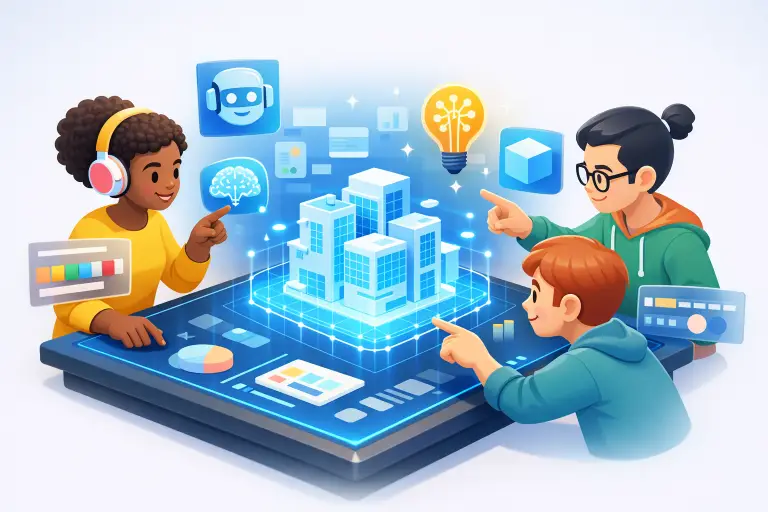
By leveraging AI’s computational capabilities, teams can allocate more time to solving complex design challenges while machines handle routine or labor-intensive work. As a result, organizations benefit from faster project delivery and greater creativity across the board.
Digital Twin Technology
Digital twins, virtual replicas that simulate the performance and behavior of real-world systems, are revolutionizing collaborative design. By integrating these with AI, companies can run real-time simulations, optimize performance, and predict how a proposed product will operate under various conditions before a physical prototype is built. Leading innovators such as Nvidia and Dassault Systèmes have set a new benchmark with their AI-enhanced industry-wide models, empowering distributed teams to collaborate with unprecedented accuracy and insight. This proactive approach reduces costly revisions and speeds product development cycles.
The application of digital twins is also expanding beyond manufacturing and product design; fields such as urban planning, environmental monitoring, and healthcare are now leveraging digital twins for simulation and forecasting. For instance, city planners can create digital twins of urban environments to test infrastructure changes before implementation, while hospitals are beginning to model patient care processes to optimize outcomes and manage resources. This wide-ranging adaptability underscores digital twins’ importance as a versatile solution that transcends traditional sector boundaries, making real-time collaborative innovation accessible across diverse industries.
Remote Collaboration Tools
The need for robust remote collaboration platforms has grown. As teams disperse, technology like Siemens’ Digital Twin Composer becomes essential, enabling real-time communication, data-driven decisions with AI, simulations, and live data from machines. Such tools eliminate remote work barriers and maintain workflow regardless of location. Remote collaboration fosters inclusion, giving all voices a chance to be heard, no matter the time zone. Features like video, shared whiteboards, instant feedback, and project management keep work on track and tasks visible. This mix of synchronous and asynchronous work allows global teams to innovate around the clock, using worldwide talent and knowledge.
Generative AI in Design Workflows
Generative AI is poised to further transform collaborative design workflows. By automating complex aspects of the design process, such as layout generation and code synthesis, these intelligent systems help organizations operate faster and with greater adaptability. Apple’s initiative to introduce generative AI into its electronic design automation tools demonstrates the scale of the potential benefits, particularly in highly technical fields like chip development. According to Tom’s Hardware, such advances can yield huge productivity gains and help streamline intricate design chains.
Moreover, generative AI acts as a powerful creative partner, proposing novel solutions and iterations that human designers might not otherwise imagine. By generating dozens or even hundreds of prototypes in minutes, these AI systems amplify the scope and diversity of design exploration, empowering teams to move rapidly from concept to solution. As these tools continue to evolve, we can expect them to increasingly support every phase of the design lifecycle, from ideation and brainstorming to detailed execution and testing, thereby embedding collaborative intelligence deeply into the way products and systems are created.
Conclusion
Innovative approaches like AI-driven platforms, digital twins, and advanced remote tools are transforming collaboration in the tech industry. Adopting these techs boosts efficiency, creativity, and competitiveness. Investing in such solutions enhances productivity and enables teams to exceed traditional limits. Looking ahead, AI, cloud computing, and collaboration tools will bring even more benefits, helping teams work faster, gain insights, and create breakthrough products. Organizations that adopt, upskill, and foster adaptable cultures will lead the next wave of digital transformation and design excellence.