You finally have a product people want, and the launch date is locked in. The first packaging quote looks friendly, until tooling deposits, sample rounds, and rush freight appear. Suddenly the unit price feels like only half the story.
Here’s the truth: the unit price pays for the box that ships; how much a brand should budget for packaging development on a new product beyond the unit price covers the engineering, prototypes, dies, tests, and compliance work that make that box possible. Plan a separate development budget and treat it as an investment, not an unwelcome surprise.
Start with two budgets: the launch batch and mass production
Budget envelope one: the launch or event batch
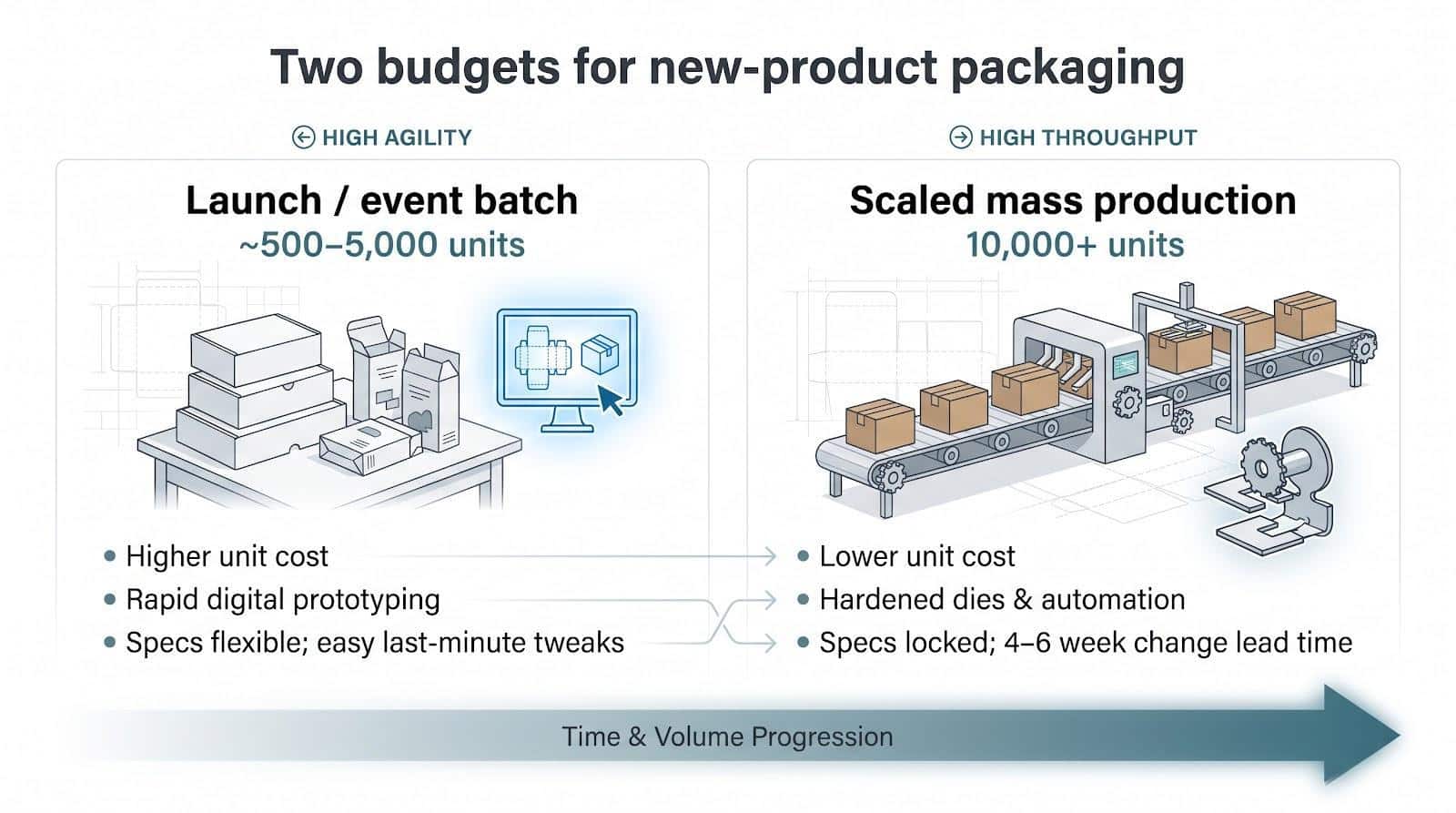
Treat your first order like a dress rehearsal. A pilot run of about 500 to 5,000 units covers PR kits, buyer meetings, or pop-ups without tying up cash in pallets of untested inventory.
Zenpack cuts prototypes in-house on an ESKO Kongsberg X22 table, giving teams a tangible sample before the pilot run is committed. Digital presses then skip plates altogether; Century Label, for example, lists no plate charges and lead times of 7 to 14 business days for digitally printed roll film. The launch roadmap at https://www.zenpack.us/packaging-for-new-product-launch/ explains how that prototype fits into a backward-planned sequence of discovery, structural design, validation, and mass production so the pilot flows straight into the first large-volume order. Zenpack projects start at a $10,000 overall budget, and its FAQ puts expedited PR boxes and swag kits at 4 to 8 weeks, against 15 to 24 weeks for standard design-to-production. A launch smaller than that fits the stock-box route in Scenario A.
CAD-driven cutters read the dieline directly, so a last-minute one-millimeter tweak costs a file upload, not a rebuilt die that can take three to six weeks.
Yes, each box costs more at this stage, but that premium buys agility: overnight colour proofs, hand assembly where automation would waste setup time, and the freedom to pivot if a label fails legal review. Every extra dollar acts as an insurance policy that the product stays on-brand, on-spec, and on time.
Budget envelope two: the scaled production system
After the pilot proves fit and demand, we trade agility for throughput. Hardened steel-rule or rotary dies that last 100,000 to 300,000 impressions replace digital cutters, and automated carton erectors fold 15 to 25 cartons per minute, roughly triple the pace of a manual station. Because every press stroke now spreads across tens of thousands of blanks, the unit cost drops sharply.
That efficiency comes with commitment. Once the die is cut and the golden sample signed, changing product height by even a millimetre can require a new tool and another four-to-six-week lead time. We freeze specifications, document colour tolerances, and run factory-acceptance tests before issuing the production purchase order.
The package structure determines the fixed cost before the artwork does
Compare structural paths and their built-in price tags
Before we debate Pantone chips or foil, we must lock the structure. One choice (stock mailer, folding carton, or rigid box) sets the baseline for every die, plate, and test that follows.
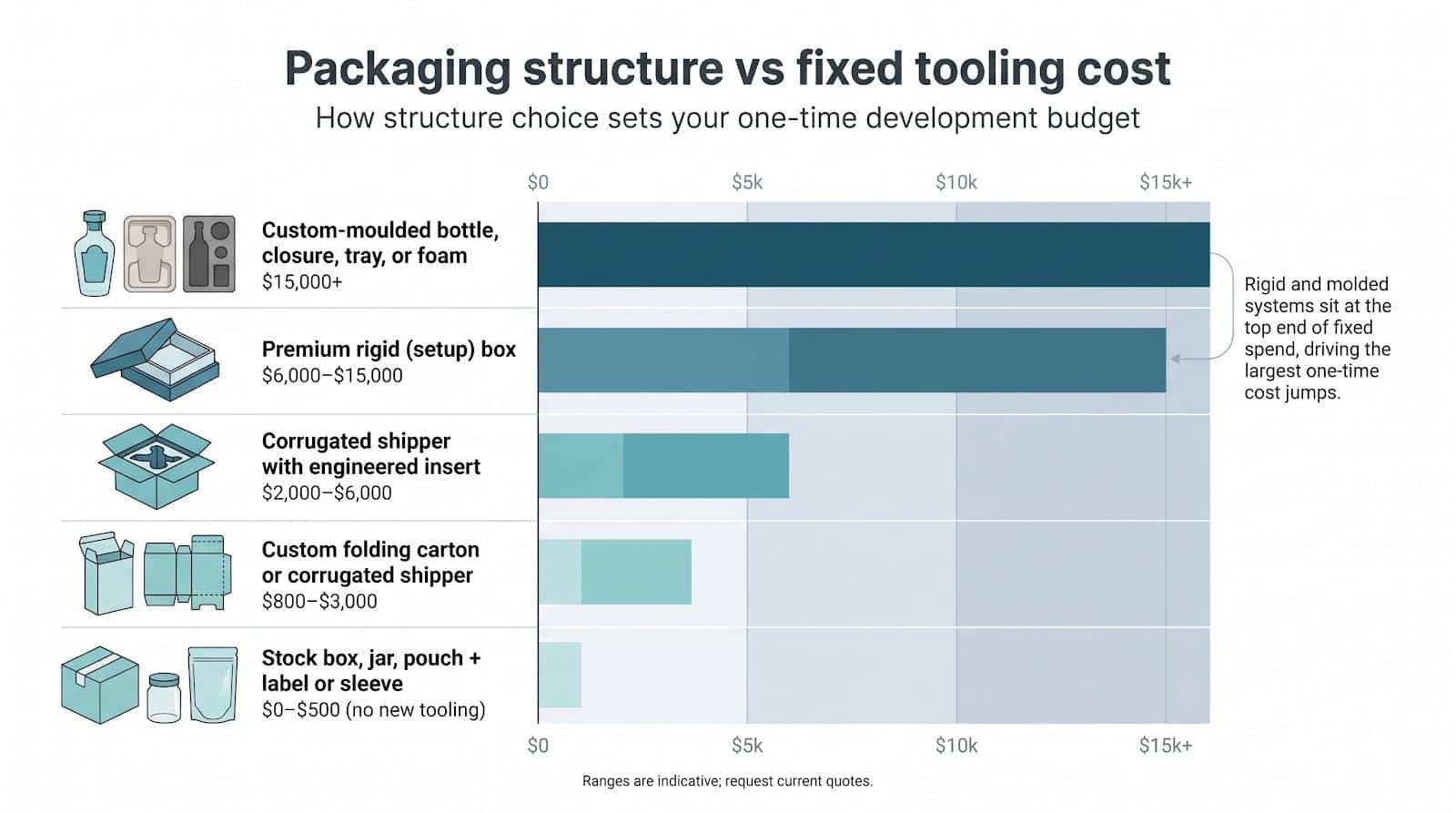
| Structure | Typical one-time cost range* | Why it stacks up | First-launch sweet spot |
| Stock box, jar, pouch + label or sleeve | $0 to $500 (no new tooling) | Existing cutters and plates already amortised | Validation runs, PR drops |
| Custom folding carton or corrugated shipper | $800 to $3,000 | One cutting die + one print plate often suffice | Retail shelf, ecommerce |
| Corrugated shipper with engineered insert | $2,000 to $6,000 | Die for box, die for insert, ISTA transit test | Electronics or fragile items |
| Premium rigid (setup) box | $6,000 to $15,000 | Separate wrap and board dies, forming fixtures, hand assembly | Luxury or giftable launches |
| Custom-moulded bottle, closure, tray, or foam | $15,000+ | Aluminium or steel moulds, line trials, compatibility tests | Proven volume or “pack-as-product” concepts |
*Planning ranges only; request current quotes.
Moving from a stock mailer to a rigid setup box can lift the fixed budget by a full order of magnitude. Freeze the structure early; a late pivot means fresh tools, fresh money, and fresh delays.
What belongs in the development budget beyond the unit price?
A reliable packaging budget has two columns: one-time investments and recurring run costs. Here are the line items most teams miss when they focus only on the per-box quote.
| Cost bucket | Typical one-time range* | What triggers the spend |
| Structural discovery & CAD | $1,000 to $3,000 | Channel, pallet, drop-test, and material decisions |
| Brand design & pre-press | $5,000 to $20,000 | Master artwork, variant roll-outs, colour separations |
| Physical prototypes & comps | $3,000 to $6,000 | Three rounds: concept → correction → approval |
| Tooling & set-up (dies, plates, moulds) | $800 to $15,000+ | Depends on structure; rigid boxes and moulded parts sit at the top end |
| Transit & compliance testing | From $675 per test for ISTA 3-Series (Sealed Air list price) | Drop, vibration, climate, Amazon SIPP, food-contact review |
| Data and identifiers | $30 per GS1 US GTIN, $250+ for a 10-code prefix | Each size or flavour needs its own code |
| Kitting, pack-out & QC fixtures | From about $0.20 per pick | Labour, scanners, assembly jigs |
| Contingency reserve | 10 to 15 percent of the above | Rush freight, extra proof, re-plate, or retest |
*Planning ranges only, except the GS1 US fees, which come from its published price list. Always request current quotes.
Why list these separately? Tooling, testing, and data fees are cash-up-front. They do not disappear if you cancel the order, and they grow if specs change. Build them into your first spreadsheet and the surprise line items vanish.
Discovery, requirements, and structural engineering
First, you pay to answer a blunt question: what must the package do? A discovery sprint can cost $1,000 to $3,000 per new SKU and maps sales channels, retailer mandates, pallet patterns, and drop-test limits. You weigh the product, check its centre of gravity, and decide whether each unit ships solo or in a master case. Those choices lock board grade, flute, coating, and every downstream tolerance.
Structural engineers translate the brief into a CAD dieline (the 2-D cut pattern) and run digital crush-strength simulations. They iterate until fit and cost align; skipping a $2,000 engineering step can lead to a $15,000 emergency reprint if seals break on the dock. This invisible work is inexpensive compared with one missed launch window.
Brand design, artwork, and pre-press
Once the structure is set, we move to story. DesignRush’s 2026 cost guide puts agency packaging design at $100 to $200 per hour, with simple packaging projects at $5,000 to $20,000. That buy-in covers colour strategy, typography, iconography, and the visual hierarchy that wins a shopper’s eye in three seconds or less.
After the look is approved, pre-press teams convert creative intent into press-ready reality. They separate colours, set trapping (the micro-overlap that prevents white slivers), and flag knockout text that can disappear on uncoated board. Missing one layer means re-engraving plates and losing a week on the schedule.
Because every SKU multiplies the art, we lock a master template early. Swap only flavour names or accent colours and you control cost; let each variant roam free and every file demands another round of proofs and another invoice.
Physical prototypes, comps, and sample rounds
A CAD file is theory; a comp is reality. Budget $3,000 to $6,000 for a three-round cycle on one SKU, the range 3D Color quotes for baseline, correction, and approval rounds at $300 to $400 per unit.
Plan those rounds from week one:
- Concept fit check.
- Colour and finish correction.
- Final approval sample for buyers and photography.
Courier fees, rush surcharges, and the occasional hand-carried sample belong in the spreadsheet now, not in a last-minute apology email. Skipping a $4,000 comp cycle can trigger a $40,000 reprint if the dieline is wrong under studio lights.
Tooling and setup
Tooling is where the chequebook meets steel. Expect $800 to $1,500 for a folding-carton cutting die and $300 to $600 per print plate or foil die as a planning range. Suppliers ask for deposits because each die is machined, heat-treated, and proofed before the press ever turns.
Treat tooling like capex: raise a separate PO, amortise the cost over planned volume, and put ownership terms in writing. Record where each die is stored, who pays for sharpening, and its rated life (often 100,000 to 300,000 impressions for steel-rule dies). Clarity today prevents “who owns the tool?” arguments tomorrow.
Every decoration layer needs its own setup:
- Foil logo → brass die
- Emboss or deboss → male + female counterplates
- Spot UV → dedicated screen
Each flourish can lift perceived value yet widens the gap between quoted unit price and real launch spend. Budget them line by line and the surprises disappear.
Testing, compliance, and data
- Performance testing. Budget from $675 per test for an ISTA 3-Series drop, vibration, and compression sequence on one packaged SKU, based on Sealed Air’s list price. Fail a single drop and you may need to re-engineer inserts and rerun plates.
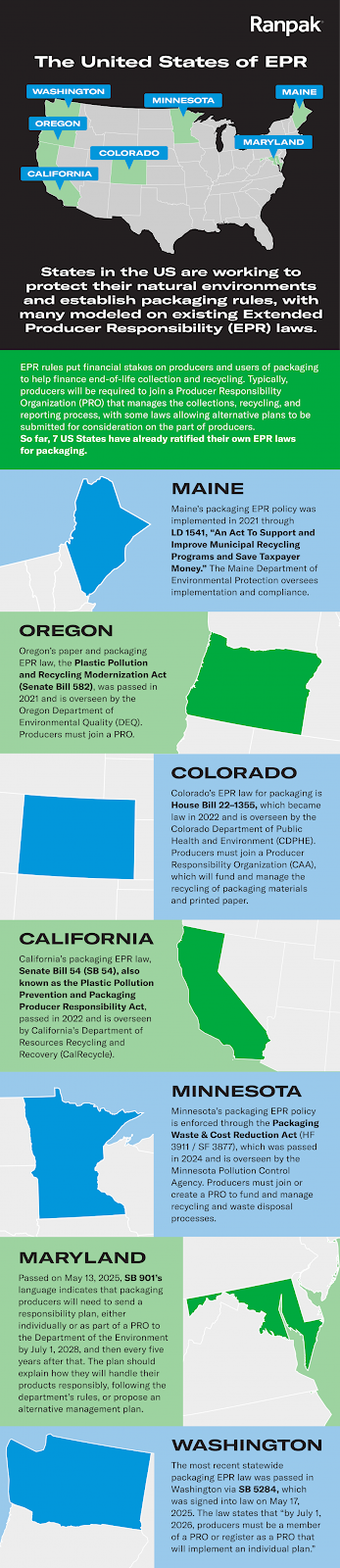
- Regulatory and EPR compliance. As of November 2026, Maine, Oregon, Colorado, California, Minnesota, Maryland, and Washington have packaging extended-producer-responsibility laws. Oregon and Colorado already charge producer fees, and the others phase in over the next few years. The EU’s Packaging and Packaging Waste Regulation (EU 2025/40) also applies to goods sold overseas. Each market wants forms and certificates, and the invoice falls in the packaging column, not R&D.
- Identifiers and data. A single GS1 US GTIN costs $30, while a 10-code company prefix starts at $250 plus renewal. Add artwork space for the forthcoming 2D barcode and the back-end database that ties each lot to recalls.
Kitting, pack-out, freight, and the all-important risk reserve
- Kitting and pack-out. Third-party fulfilment providers charge from about $0.20 per pick or “touch” when they fold, insert, label, or bundle components. More inserts mean more touches, so budget accordingly.
- Freight choices. Ocean spot rates move week to week, so check a current index before you quote, and expect air for the same volume to cost several times more once fuel and surcharges land. Decide Incoterms early; quoting ex-factory while finance budgets DDP can erase margin faster than a misprinted barcode.
- Risk reserve. Packaging veterans keep 10 to 15 percent of the development budget in reserve for a second print pass, an extra ISTA drop test, or a FedEx First Overnight sample that misses the truck.
Plan for the touches, plan for the miles, and plan for the unknown. The package, and your margin, will arrive on time and intact.
Why brands often pay for tooling twice, and sometimes a third time
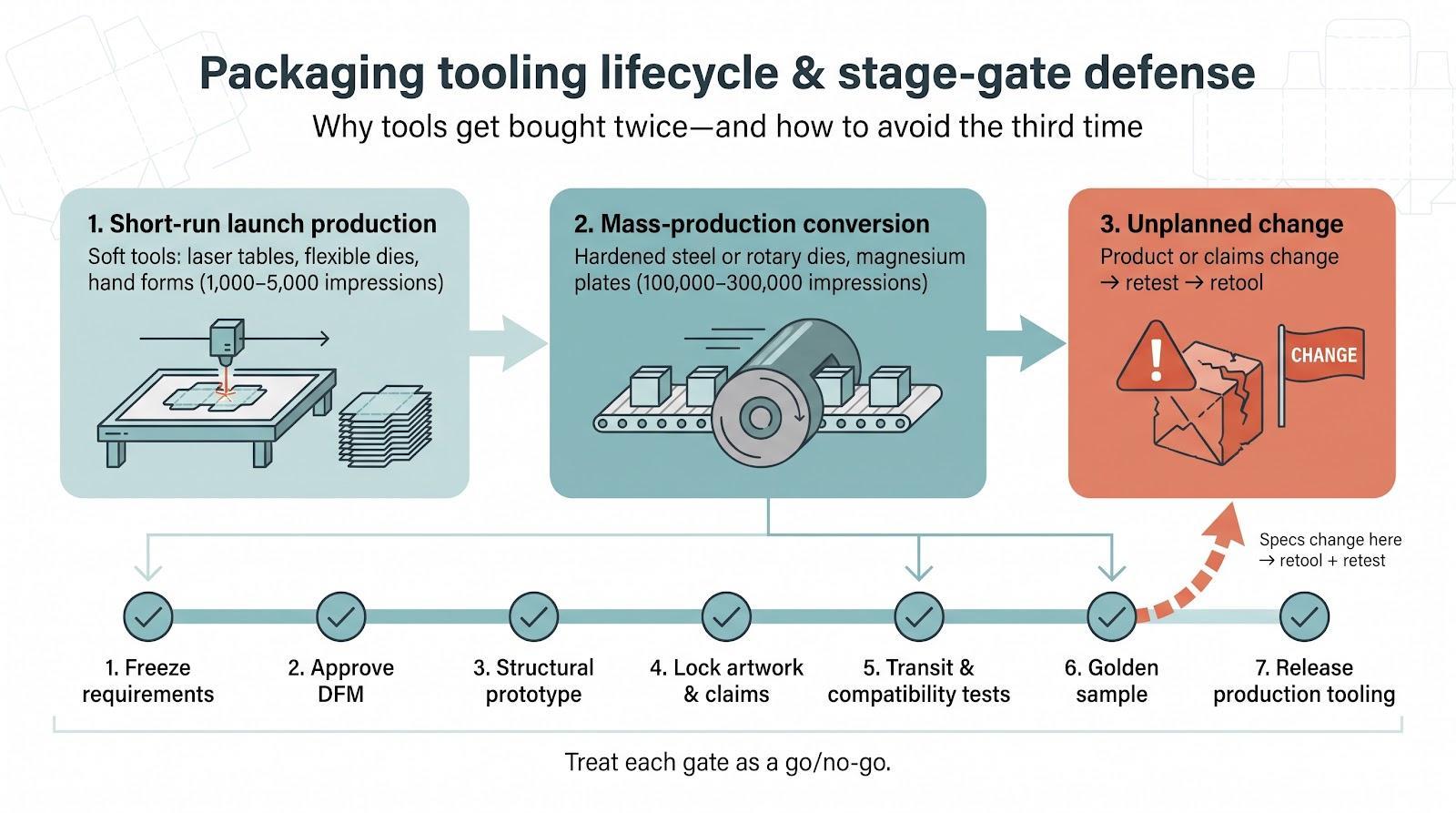
Tooling event one: short-run launch production
You start with speed tools: laser tables, flexible steel-rule dies, even hand-built forms. They run 1,000 to 5,000 impressions before tolerances drift, which is fine for photo shoots, buyer samples, and proof-of-concept sales.
Tooling event two: mass-production conversion
When forecasts top 10,000 units, we trade agility for longevity. Hardened steel or rotary dies rated for 100,000 to 300,000 impressions replace soft tools, and long-life magnesium plates take over from photopolymer. The capex lands once, but it slashes unit cost and holds registration tighter than ±0.2 mm.
Lock specs and run a factory-acceptance test before approving the die; a one-millimetre height change after cut-steel can mean re-machining and four lost weeks.
Tooling event three: unplanned change
If the product gains a gram or a retailer demands new warnings, the “perfect” die may become scrap. ISTA’s guidance treats a change in product, package, or material as a reason to retest, and a failed retest can mean re-tooling.
Stage-gate defence
- Freeze requirements.
- Approve design-for-manufacture.
- Sign off structural prototype.
- Lock artwork and claims.
- Pass transit and compatibility tests.
- Approve golden sample.
- Release production tooling.
Treat each gate as a go/no-go. One missed gate can cost more than an overnight air-freight bill.
Build three budget scenarios backward from the hard launch date
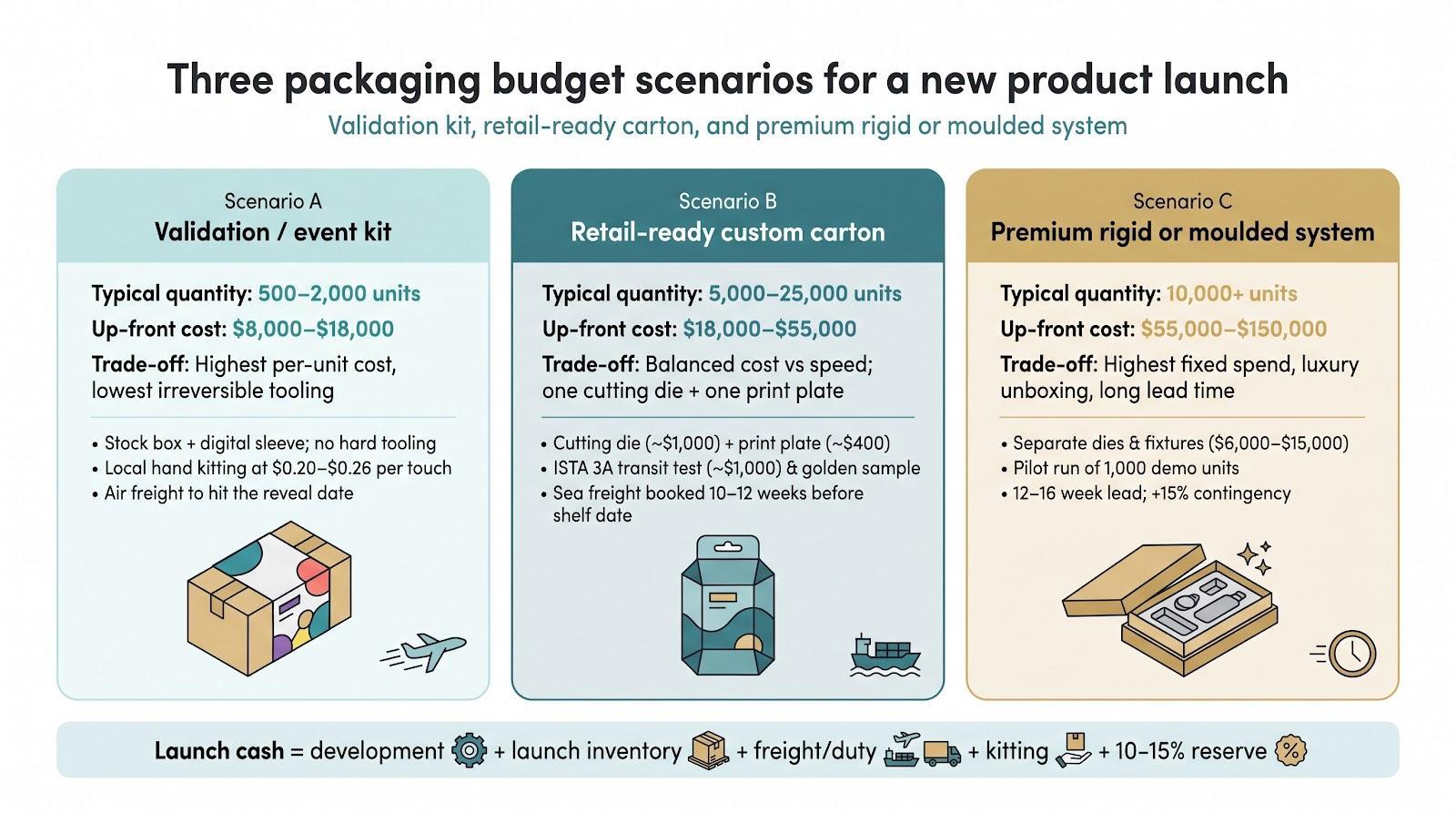
Use your fixed in-store or event date as the anchor, then choose one of three common launch paths:
| Scenario | Typical quantity | Up-front cost range* | Main trade-off |
| A. Validation / event kit | 500 to 2,000 units | $8,000 to $18,000 | Highest per-unit cost, lowest irreversible tooling |
| B. Retail-ready custom carton | 5,000 to 25,000 units | $18,000 to $55,000 | Balanced cost vs. speed; one cutting die + one print plate |
| C. Premium rigid or moulded | 10,000+ units | $55,000 to $150,000 | Highest fixed spend, luxury unboxing, long lead time |
*Planning ranges for tooling, design, prototypes, ISTA testing, and a 10 to 15 percent risk reserve. Request current quotes.
Calculate launch cash like this:
development + launch inventory + freight/duty + kitting + 10 to 15 % reserve
Listing every line early removes the “surprise” PO that can cut margin the week before launch.
Scenario A: validation, PR, pop-up, or event launch
Think postcard budget, not billboard. Brands typically order 500 to 2,000 units of stock mailers, jars, or pouches and dress them with digitally printed sleeves or labels. A 1,000-piece run of folding cartons with digital CMYK print often lands between $0.40 and $0.80 per box FOB, roughly 40 to 60 percent higher than the same carton at 10,000 pieces but still inside a low-five-figure cash cap.
Why pay the premium?
- Zero hard tooling. No cutting dies or print plates means a file tweak costs minutes, not $1,000 in steel.
- Speed. Digital short-run printers commonly quote turnarounds of days to about two weeks for plain CMYK art at these volumes.
- Hand kitting. Local 3PLs charge from about $0.20 per touch, fine for a few hundred kits, painful for 50,000.
- Air freight. Small, light batches can fly without wrecking margin, protecting a fixed reveal date.
Treat the spend as tuition. The feedback you gather (fit photos, unboxing videos, buyer reactions) pays back multiples when you scale.
Scenario B: retail-ready launch with a custom carton or corrugated system
Now you are shipping to thousands of stores, not just influencers. A bespoke dieline plus one cutting die ($1,000) and one print plate ($400) gets you on-shelf; add from $675 for an ISTA 3-Series transit test. Fixed spend usually lands between $18,000 and $55,000 for a 5,000 to 25,000-unit first run.
Key budget lines:
- Structural engineering + transit test
- Cutting die + print plate per SKU size
- Colour-accurate press proofs and golden sample
- Insert prototype (corrugated, pulp, or foam)
- First production run + ten percent overage
- Sea freight booked 10 to 12 weeks before shelf date
Scenario C: premium rigid or moulded custom system
Expect champagne pricing. A two-piece rigid setup box with foil logo and EVA insert runs $4.80 to $6.20 per unit at 500 pieces and drops to $3.50 at 5,000, still three to four times a folding carton of the same size. Fixed spend climbs to $55,000 to $150,000 once you add:
- Separate dies for top wrap, bottom wrap, board, and insert
- Forming fixtures and hand-wrap stations (labour is $0.25 to $0.60 per unit in U.S. assembly)
- Surface-finishing tools (foil, emboss, spot-UV) at $300 to $600 each
- Pilot tools for 1,000 demo units, then hardened tools for 50,000+
Lead time stretches 12 to 16 weeks door to door. A two-week shave can add $8,000 to $12,000 in air freight. Freeze dimensions, lock claims, and sign the golden sample before cutting the master die; one late tweak can cost five figures and a month.
Cost guardrails:
- White + full-finish structural prototypes
- All dies and fixtures quoted line by line
- Pilot run to verify fulfilment fit
- Mass-production tool set + QC jigs
- Fifteen percent contingency for post-sample tweaks or air freight
Luxury goods live or die on the unboxing. Invest with eyes open and with every tool fully specified.
Adjust the budget for the product category and sales channel
| Category / channel | Cost drivers that widen the budget* | Typical premium vs. a plain folding carton |
| Food & beverage | Barrier films, oxygen scavengers, heat-seal trials, nutrition-panel reviews | +15 to 35 percent |
| Beauty & cosmetics | Compatibility tests, pump or closure tooling, soft-touch or foil finishes, influencer minis | +25 to 60 percent |
| Electronics & hardware | Shock-absorbing inserts, anti-static liners, thick manuals, ISTA 6A testing | +20 to 40 percent |
| Health & supplements | Tamper bands, lot or expiry coding, multi-language labels, legal review | +10 to 25 percent |
| Ecommerce parcel | Right-sizing for DIM weight, Amazon SIPP test, dual 1D and 2D codes | +10 to 20 percent |
| Retail pallet | Shelf-ready cases, case-pack drop tests, pallet pattern optimisation | +5 to 15 percent |
| Event / pop-up | Hand kitting, airline-safe foam, rush freight | Variable |
*Premium bands are planning estimates; confirm them with your converter.
Dial your development budget up or down with these levers before requesting quotes. Saving a few cents on a beauty sleeve can backfire if an “Instagram box” costs more to ship than the gadget inside.
Compare quotes on total cost and risk, not just piece price
RFQ inputs every supplier should receive
Give every vendor the same data set:
- Product dimensions, weight, fragility, and 3-D file
- Sales channel (parcel, pallet, or both) and destination markets
- Forecast volume per SKU, plus launch quantity and 12-month projection
- Hard delivery date tied to your marketing reveal
- Required tests and compliance (ISTA, Amazon SIPP, food-contact, EPR)
Required quote line items
- Structural design / DFM hours
- Graphic and pre-press services
- Prototype rounds (quantities listed)
- Cutting dies, print plates, foil or emboss dies
- Forming fixtures, moulds, jigs
- Line set-up / make-ready per run
- Unit price at 500, 1,000, 5,000, 10,000, 25,000
- QC inspection fees
- Kitting or assembly labour
- Freight, duty, and the Incoterm offered
- Tool storage or maintenance over tool life
- Change-order rates and rush surcharges
Questions that expose future costs
- Who owns each tool, and where is it stored?
- How many paid sample rounds are included?
- What are the acceptance criteria (± mm, ΔE, adhesive strength)?
- When does the quote expire, and which material index does it use? The U.S. producer-price index for corrugated shipping containers reached 388.939 in September 2026, up from 364.933 in May (FRED series WPU09150301).
- What is the price curve at higher breaks?
Supplier resilience: why two sources beat one
L.E.K. Consulting’s 2026 study found 91 percent of brand owners use multiple suppliers for each packaging format. Keep every vendor on the same written spec, approve samples from at least two, and split early orders. The first port backlog will prove why.
Frequently asked questions about new-product packaging budgets
What percentage of product price should packaging cost?
Industry guides put packaging anywhere from 2 percent (mass-market FMCG) to 25 percent (premium or luxury goods) of product price. Treat these percentages as a sense-check, not a plan: first total your one-time development spend ÷ launch units, then be sure the combined COGS still delivers margin.
Is packaging design normally included in the unit price?
No. Visual design, structural engineering, pre-press, tooling, samples, and compliance each need their own PO. Bundle pricing hides the real drivers and makes change orders costly; ask vendors to break every service into a separate line.
How many sample rounds should you budget?
Baseline, correction, and approval make three. Complex geometry, foil, or ISTA 6A drop tests may push you to four. Budget the extra round up front, because the rush reprint will cost more.
When does fully custom tooling make financial sense?
After demand is proven, specs are frozen, and forecast volume can amortise the tool inside its rated life. Until then, stock structures or soft tools keep cash flexible.
Can stock packaging still look custom?
Absolutely. A sleeve, belly band, digitally printed label, or insert can turn an off-the-shelf blank into an unboxing hero: fast, low-risk, and pivot-ready.