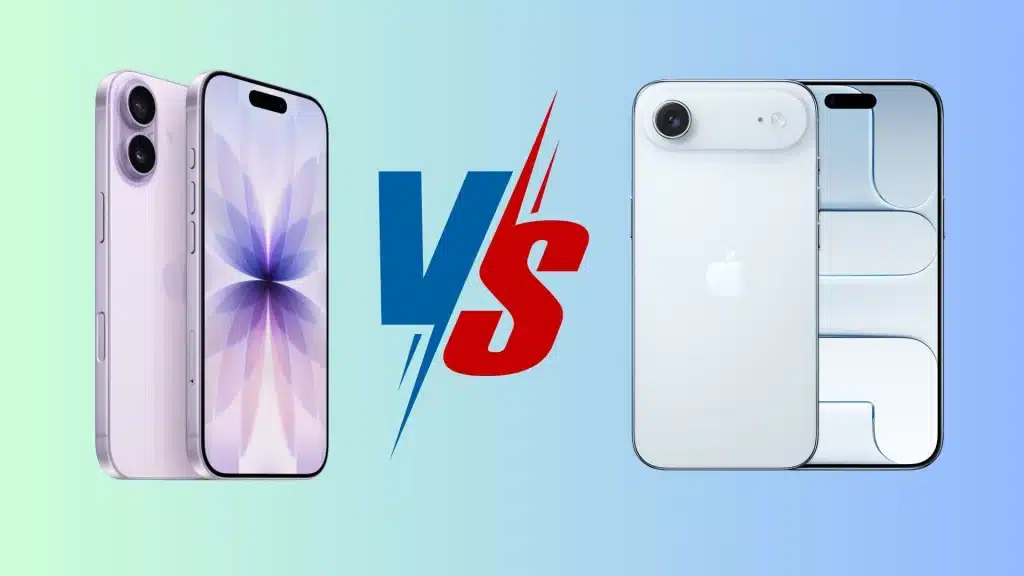
Apple changed things in a way that feels different from the usual updates. The Plus model is gone, and in its place comes the iPhone Air, an iPhone no one expected.
It is a fresh take on how a phone should look and feel, and that alone has made people pause before buying. Because of that shift, many are unsure where each model stands.
The choice between iPhone Air vs iPhone 17 is not as straightforward as before. Both sit close, but they are built with slightly different ideas in mind.
If you have been stuck trying to figure out which one makes more sense, this guide is here to help.
It breaks down design, display, performance, camera, battery, and overall value. The goal is simple. By the end, you should have a clear answer, not just a list of specs.
iPhone Air and iPhone 17 Overview
Apple has clearly split its lineup this time, and it shows in how these two phones are positioned. The iPhone Air is built around a slimmer and lighter design, aiming to feel different the moment you pick it up.
It focuses more on comfort and a fresh look rather than packing everything into one device. On the other hand, the iPhone 17 stays closer to what most people expect from a flagship iPhone.
It keeps a balanced approach, offering solid performance, a familiar design, and features that work well for everyday use without any major shifts.
This is why the comparison between iPhone Air vs iPhone 17 feels tricky. They are not direct upgrades over each other, but two slightly different ideas.
One leans toward style and feel, while the other focuses on consistency and all-around use, which makes the final choice depend more on preference than specs.
iPhone Air vs iPhone 17: Design and Build Quality

The iPhone Air stands out the moment you see it. It is just 5.6mm thick and weighs around 165 grams, making it the thinnest iPhone so far and lighter than most phones people are used to.
The frame uses polished titanium alloy, paired with Ceramic Shield glass on both sides, which gives it a very premium finish that almost feels like a piece of jewelry.
Our full iPhone Air review goes deeper into how that build holds up over time.
The thin profile is so noticeable that it can feel unreal at first touch. In contrast, the iPhone 17 follows a more familiar path.
It comes with an aluminum frame and a glass back, with a standard thickness that most users already know.
It may not grab attention instantly like the Air, but it feels solid and reliable in hand, offering a sense of durability that many users still prefer in daily use.
For users who care about building materials, titanium is generally harder to scratch and lighter than aluminum at equivalent strength.
The Air also runs roughly 20 to 30 grams lighter than a typical iPhone, which sounds small but adds up across a full day of carrying and holding.
iPhone Air vs iPhone 17: Display Comparison

Both phones get ProMotion 120Hz for the first time outside the Pro lineup, which is a meaningful upgrade for anyone coming from an older iPhone.
The iPhone Air has a 6.5-inch Super Retina XDR OLED display. The iPhone 17 comes in a smaller size. Both reach up to 3,000 nits of peak brightness, so outdoor visibility is strong on either model.
The size difference is more meaningful than the numbers suggest.
On the Air, reading long articles and watching videos feels genuinely comfortable in a way that a smaller screen does not quite match.
That said, one-handed use on the iPhone 17 is noticeably easier, which matters more than people admit until they drop something on a busy commute.
The 120Hz ProMotion scrolling is something most users will notice right away, particularly if they’re coming from an iPhone 12 or 13. Both phones deliver it equally well, and neither has an advantage here.
iPhone Air vs iPhone 17: Performance and Chipset Differences
Here is where the spec sheet throws a curveball. The iPhone Air runs the A19 Pro chip, the same processor found in the more expensive iPhone 17 Pro models. The standard iPhone 17 uses the A19.
On paper, the Air clearly has more power. In daily use like browsing, messaging, streaming, or social media, both phones feel equally fast and smooth, and there is no real gap in regular tasks.
The difference shows up under heavy use. Because of its ultra-thin design, the Air does not include a vapor chamber cooling system like the Pro models.
During long gaming sessions or 4K video editing, it can slow down sooner due to heat.
The Air also features 12GB of RAM, compared to 8GB in the iPhone 17, and ships with the C1X modem, which Apple says improves cellular battery efficiency during calls and data use.
Both phones are expected to receive software support for 5 to 6 years.
Camera Differences Between the iPhone Air and iPhone 17

The camera setup is where the difference becomes very clear. The iPhone Air comes with a single 48MP rear camera that supports 2x optical zoom.
It sticks to a single lens and a single viewing angle. The iPhone 17, on the other hand, features a 48MP main camera and a 48MP ultrawide lens.
This adds support for macro shots, Spatial Photos, and Cinematic Mode video. For everyday use like portraits, food, or travel shots, the Air performs very well and delivers sharp results.
In normal lighting, photos from both phones can look almost the same.
The gap appears when flexibility matters. The iPhone 17 allows wide-angle shots and close detail photography that the Air simply cannot match.
Users who take photos casually will be satisfied with the Air, but those who shoot more often or want creative control will find the iPhone 17 more useful overall.
iPhone Air vs iPhone 17: Battery Life and Charging Details

Battery life is another key factor that can affect the final choice. The iPhone Air is rated for up to 27 hours of video playback, which puts it close to the previous Pro models.
The iPhone 17, with its slightly thicker body, features a larger battery and offers around 3 extra hours of real-world usage, according to multiple reports.
In daily use, moderate users can get through a full day on the Air without much concern. Heavy users who rely on navigation, video calls, or gaming may need to charge it before the end of the day.
A few small habits can help you extend your smartphone’s battery life on either model
Charging speed is also slightly better on the iPhone 17. The Air charges a bit slower, which can matter in quick top-up situations.
Both phones support MagSafe wireless charging and USB-C wired charging.
Connectivity, SIM Support, and Audio
The iPhone Air is eSIM-only, so there is no physical SIM slot. That works well in markets with strong eSIM support, but frequent travelers or users on limited-carrier plans may find the iPhone 17 easier to use.
It supports both eSIM and a physical SIM slot, offering greater carrier flexibility. Audio is another clear difference.
The iPhone 17 has stereo speakers, while the Air uses a mono speaker because of its slim design. It is not bad, but it can feel like a step back if you often watch videos or listen without headphones.
The slim profile makes stereo placement impractical, so this is a genuine trade-off rather than an oversight. Both phones support Apple Intelligence, MagSafe, and USB-C accessories.
The mono speaker on the Air was the 1 thing that visibly bothered people I spoke with after switching from an older iPhone.
iPhone Air vs iPhone 17: Real User Opinions

Reddit user feedback on iPhone Air vs iPhone 17 shows a clear split between logic and feel. On paper, many agree the iPhone 17 makes more sense with better camera options, speakers, and overall value.
But the iPhone Air stands out for reasons that are harder to measure. Users highlight its 12GB RAM, A19 Pro chip, faster storage, and the efficient C1X modem, which improves cellular battery performance.
More than specs, the slim design and lighter feel make it more enjoyable to use daily. Some say the single speaker and lack of ultrawide camera do not affect them much.
Others feel those features matter a lot. In the end, both phones are solid, but the choice often comes down to whether you prefer better features or a better in-hand experience.
iPhone Air vs iPhone 17 Key Differences at a Glance
This quick table highlights the core differences in design, performance, camera, and battery so you can compare both models at a glance.
| Feature | iPhone Air | iPhone 17 |
|---|---|---|
| Design | 5.6mm thin,165g, Titanium frame, Ceramic Shield | ~7.8mm, Aluminum frame, Glass back, Traditional build |
| Display | 6.5 inch OLED,120Hz ProMotion,3000 nits | 6.1 inch OLED,120Hz ProMotion,3000 nits |
| Chip | A19 Pro without vapor cooling | A19 standard chip |
| RAM | 12GB | 8GB |
| Rear Camera | Single 48MP, 2x zoom only | 48MP main + 48MP Ultrawide,Macro, Cinematic Mode |
| Battery | 27 hours video, Slower charging | Around 30 hours ,Faster charging |
| Speakers | Mono speaker | Stereo speakers |
| SIM | eSIM only | eSIM + Physical SIM |
iPhone Air vs iPhone 17: Price and Value Breakdown
The iPhone 17 starts at $799, while the iPhone Air starts at $999. That 200-dollar gap puts the Air closer to the Pro model than the standard one.
What you are paying extra for is mostly the design. You get a much thinner body, lighter weight, a titanium frame, and a slightly larger display.
What you do not get is better cameras, longer battery life, stereo speakers, or the option for a physical SIM. In fact, the Air falls behind in these areas compared to the iPhone 17.
From a value point of view, the iPhone 17 clearly gives more for the price. It covers more features without cutting back on essentials.
The Air makes sense only if design is a top priority. If features and overall value matter more, the iPhone 17 is the easier choice.
Who Should Buy the iPhone Air vs. the iPhone 17?
This quick breakdown makes it easier to decide which model fits your needs based on daily use, features, and what matters most in a phone.
| Choose iPhone Air if | Choose iPhone 17 if |
|---|---|
| Design and slim form factor matter most | Camera flexibility is important |
| You want a very light phone for daily use | You want ultrawide, macro, and Cinematic Mode |
| A single strong camera is enough | You rely on better battery life all day |
| Your usage is moderate with nightly charging | You travel often or use a physical SIM |
| You are okay with eSIM only and mono audio | Stereo speakers matter for media |
| You prefer a new design direction from Apple | You want more features for a lower price |
| You care more about feel than features | You are upgrading from an older iPhone model |
Conclusion
This is one of those rare comparisons where the higher-priced phone is not the more complete one. Looking at iPhone Air vs iPhone 17, the difference comes down to priorities rather than upgrades.
The iPhone 17 clearly does better in areas like camera flexibility, battery life, audio, SIM support, and overall value.
The iPhone Air, on the other hand, stands out for its thin design, lighter feel, bigger display, and the A19 Pro chip. The choice is not about which one is better overall.
It is about what fits your daily use. If design and comfort matter more, the Air makes sense. If you want a more balanced phone that covers everything well, the iPhone 17 is the safer pick.
Now it comes down to you. Which feature is making your decision easier, design or practicality? Let me know what you would pick and why.
Frequently Asked Questions
Does iPhone Air Support ProRAW or Advanced Photo Formats?
No, the iPhone Air focuses on a simpler camera setup. Advanced formats like ProRAW are typically limited to higher-end Pro models.
Is there Any Difference in Build Durability Between the two?
Yes, the iPhone Air uses a titanium frame, which is generally stronger and lighter than the aluminum used in the iPhone 17.
Do Both Phones Support the Same Accessories?
Mostly yes. Both support MagSafe and USB-C accessories, but some ultra-slim cases may be designed specifically for the Air’s thinner body.
Is Heat Management Noticeably Different During Normal Use?
In normal tasks like browsing or streaming, there is no noticeable difference. Heat differences only show up during long, heavy tasks.
Which Phone is Better for Long-Term Resale Value?
Historically, models with better overall features, like cameras and battery, tend to hold value better, which may give the iPhone 17 a slight edge.