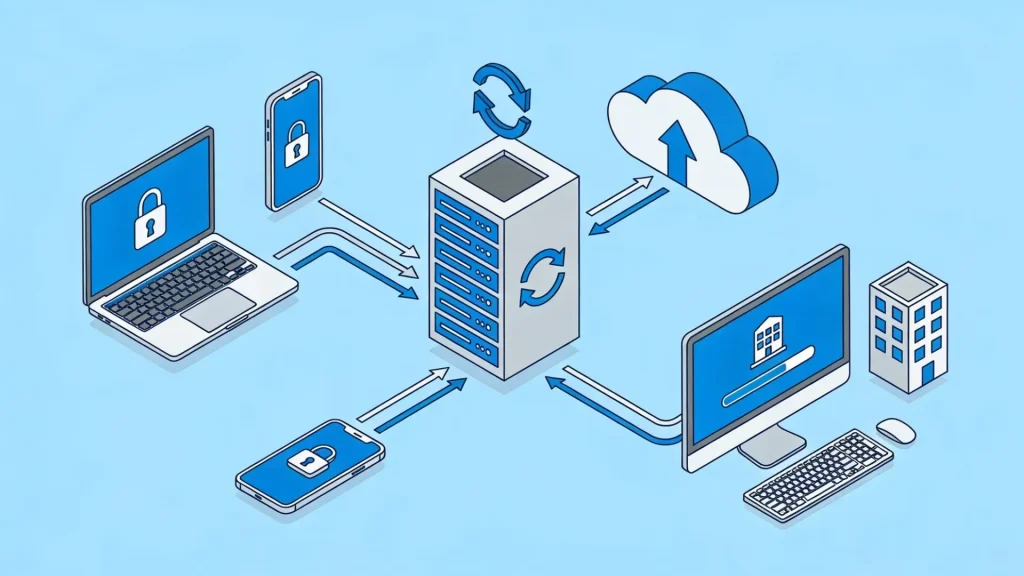
A burned proxy pool rarely announces itself. There’s no error at 2 AM, no alert, no obvious failure. What happens instead is quieter: success rates drift from 97% down to 80%, then 65%, and the team starts debugging the scraper, the parser, the target site — everything except the infrastructure that actually degraded.
Understanding how pool burnout happens, and what recovery actually looks like, is useful both for diagnosing current problems and for making better infrastructure decisions upfront. Teams that rely on a residential proxy server with a sufficiently large, well-distributed pool encounter this problem far less often — but it’s worth knowing the mechanics regardless of your setup.
How a Pool Gets Burned
Pool burnout isn’t usually caused by a single aggressive scraping session. It’s an accumulation, and it happens faster than most teams expect.
The Reputation Decay Cycle
Every IP carries a behavioral history. Anti-bot systems — Cloudflare, PerimeterX, DataDome, and similar tools — score incoming requests based on signals like request frequency, header patterns, TLS fingerprints, and the prior activity of the sending IP. When an IP starts accumulating negative signals, its fraud score rises. Sites begin serving it CAPTCHAs, throttled responses, or silent blocks instead of data.
The compounding problem is shared pool contamination. When your rotation logic cycles onto a contaminated IP, you absorb its reputation damage regardless of how carefully your own traffic was structured — a pattern Google’s Threat Intelligence Group confirmed in January 2026 when they found significant infrastructure overlap across major residential proxy providers, with the same exit nodes accessible through multiple competing networks simultaneously.
What Actually Triggers Burnout
A few behaviors accelerate the process:
- Aggressive concurrency: Sending hundreds of requests per minute from a small IP set compresses behavioral history quickly: what would take weeks of normal traffic to accumulate can happen in hours.
- Retry storms: Poor error handling that retries 403s and CAPTCHAs immediately, rather than backing off, signals automation patterns that raise fraud scores across the active IPs.
- Thin pool geography: Routing all traffic through IPs in a single city or subnet concentrates risk. When that subnet gets flagged, the problem spreads across IPs because rotating through a small pool increases damage instead of containing it.
All three tend to appear together in pipelines that weren’t designed with pool health in mind from the start.
What Recovery Actually Looks Like
This is where teams are often surprised. Recovery from pool burnout isn’t fast, and it’s not passive.
IP-Level Recovery
A January 2026 analysis by an IP intelligence firm found that the average residential proxy IP is visible for just 4.56 days. Most burned IPs cycle out of rotation before accumulating enough clean history to recover — they disappear rather than rehabilitate.
For static datacenter and ISP IPs, the problem is different: blocklist removal requires active delisting requests or replacement, with no predictable timeline.
Pool-Level Recovery
Recovering a burned pool at the infrastructure level means one of three things:
- Switching providers or pools: The fastest option, but only works if the replacement pool isn’t drawing from the same underlying IP ranges. Some IPs appear across up to 98 different provider networks simultaneously, so provider-switching doesn’t always mean IP-switching.
- Traffic pattern correction: If the burnout was caused by aggressive behavior rather than inherited reputation, fixing the behavior is necessary before adding new IPs — otherwise new IPs burn on the same timeline.
- Pool expansion: Distributing the same request volume across a larger IP set reduces per-IP exposure. The math is simple: the same 10,000 daily requests spread across 500 IPs versus 50 IPs produces very different behavioral profiles per address.
None of these is fast. Teams that have worked through a pool burnout incident typically report days to weeks of degraded pipeline performance before stabilization.
Monitor and Act Before It Gets Critical
The most effective approach is to treat pool health as a pipeline metric, not an incident response problem. A minimal monitoring setup tracks three signals:
- Success rate per target domain: A per-domain drop that doesn’t appear globally usually indicates a domain-specific block rather than infrastructure degradation — and separating the two matters for the fix.
- CAPTCHA rate over time: Rising CAPTCHA frequency on previously clean targets is the earliest signal of IP reputation erosion, well before outright blocks appear.
- Response time variance: Inconsistent latency from previously stable IPs can indicate throttling that precedes blocking.
According to the State of Web Scraping Report 2026, 43.1% of scraping professionals now use two to three proxy providers simultaneously — a direct response to the operational risk of relying on a single pool.
Final Word on the Architecture Decision
Pool burnout is ultimately a sizing and sourcing problem. A large, ethically sourced pool with genuine IP diversity across ASNs and geographies (instead of a cluster of addresses drawn from a handful of subnets) is the structural protection. Recovery from burnout is possible, but it’s always slower and more disruptive than avoiding the conditions that cause it.