I have spent years planning events where engagement is everything, and somewhere along the way, I started noticing that gaming and event attendance share a surprisingly uncomfortable truth: most people leave before the finale.
A game sits on your console, half-played, and you fully intended to go back, but you did not.
There are very specific reasons why this keeps happening, and most of them have nothing to do with how busy you are or how much you care about gaming.
The causes go deeper than time; they are woven into how games are built, how our habits have shifted, and how the industry itself has quietly changed the rules.
Below, I break down what is actually going on, and some of it may surprise you.
What the Numbers Actually Show About Game Completion?
A 2019 peer-reviewed study, Entertainment Computing, analyzed 725 Steam titles and found that only 14% of players completed them, with a median completion rate of just 10%, meaning that for half of all games studied, nine out of ten players never saw the ending.
The supply side makes this worse. Steam released approximately 19,000 games in 2024 alone, a 32% jump over 2023 and the platform’s largest single-year increase ever.
Even at a generous average of 18 hours per title, working through that one year of releases would take over 340,000 hours, roughly 39 years of uninterrupted play.
The backlog problem runs equally deep on the ownership side.
A March 2024 GameDiscoverCo analysis, drawing on hundreds of thousands of public Steam profiles via GamingAnalytics.info, found that 32.7% of the average user’s library sits completely unplayed, with the median player leaving over half their library untouched entirely.
Why Most Gamers Never Finish Video Games?
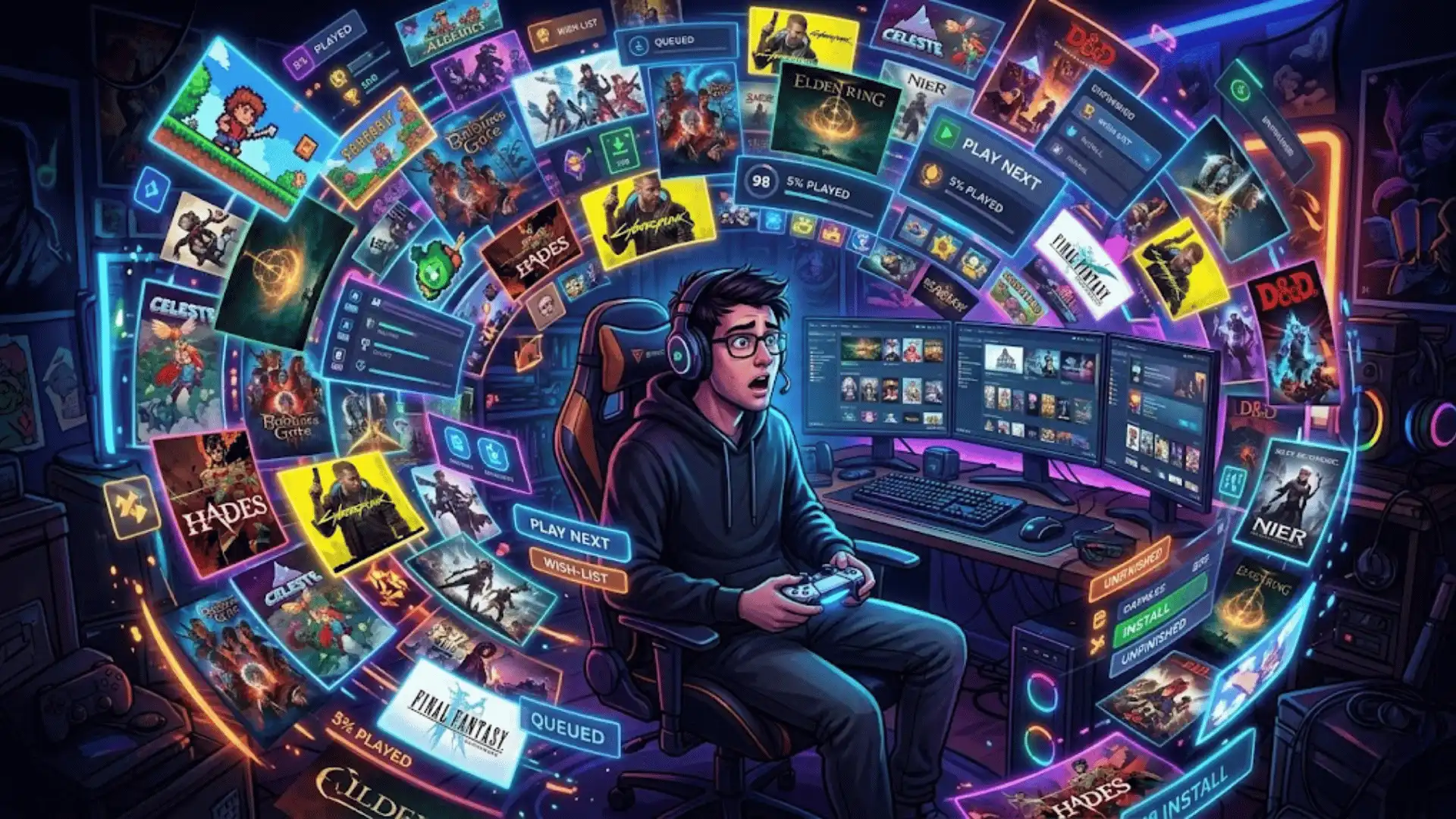
Most players start games with excitement but rarely reach the end. From overwhelming backlogs to shifting player habits, helping you understand why finishing a game has become less common today.
1. The Backlog Problem is Bigger Than it Looks
Most players now own more games than they can realistically finish. Sales, subscriptions, and bundles make it easy to build a library faster than anyone can play through it.
What I have noticed while talking to regular players is this: the moment a game feels slightly slow, another one is always waiting. That choice kills commitment.
This is one of the biggest reasons why 90% of gamers never finish video games: causes tied to abundance, not lack.
2. Modern Games are Designed to Be Longer, Not Tighter
Modern games are no longer built around tight, focused experiences. Instead, they are designed to keep players engaged for longer periods through constant updates, added mechanics, and expanding content.
This shift has changed how players interact with games, often turning what used to be a clear journey into something that feels endless.
A closer look at these changes can be seen in recent breakdowns in modern games like UndergrowthGameLine, where evolving systems are reshaping how long players stay invested before eventually moving on.
3. Early Game Excitement Fades Fast
The first few hours of any game are carefully designed to hook attention. New mechanics, story setup, and quick rewards keep players engaged.
After that phase, the pace slows, and rewards are spread out so the novelty drops.
This drop-off point explains a large part of why 90% of gamers never finish video games, linked to how motivation works, not just interest.
4. Time is Fragmented, Not Just Limited
It is easy to say “people are busy,” but the real issue is fragmented time.
Short sessions do not work well for long narrative games. If a player forgets controls, story details, or objectives, restarting feels easier than continuing.
The average gamer today is 37 years old, not a teenager with a free weekend. They are fitting gaming into commutes, lunch breaks, and the 45 minutes before bed.
Understanding the fundamentals behind what makes game design effective, like the 3 C’s in games: camera, character, and control, helps explain why some titles keep players engaged for 60 hours while others lose them within the first few hours
5. Constant New Releases Reset Attention
There is always something new launching. Big titles, updates, seasonal content.
Even committed players get pulled away mid-progress. That shift breaks momentum, which is critical for finishing a game.
This is another clear layer in understanding why 90% of gamers never finish video games: causes tied to industry pace, not player discipline.
6. Multiplayer and Live Games Take Priority
Many players now spend most of their time in multiplayer or live-service games.
These games reward daily engagement, social interaction, and quick sessions. Compared to that, finishing a single-player story feels less urgent.
Once habits shift toward ongoing games, completing story-driven titles becomes rare.
7. Players Chase Progress, Not Endings
Achievements, levels, and upgrades often matter more than finishing the story.
Many players feel satisfied once they understand the game mechanics or reach a certain point, even if the ending is still far away.
This behavior explains why 90% of gamers never finish video games: it stems from how satisfaction is measured today.
8. Difficulty Spikes Push Players Away
Some games introduce sudden difficulty jumps that break the flow.
Instead of adapting, many players choose to leave. With so many alternatives available, pushing through frustration feels unnecessary.
This subtle factor adds another layer to why gamers never finish video games.
9. Finishing a Game No Longer Feels Essential
Finishing a game used to be the goal, but that mindset has shifted. Players now focus more on moments and overall experience than reaching the end.
Burnout builds quietly. Interest fades over time, and without strong engagement points, players simply stop returning.
What Does This Mean for Gamers Today?
Understanding these causes rooted in behavior, game design, and the realities of adult time helps remove the guilt that often surrounds unfinished titles.
Not finishing a game does not mean wasted time. It often means the experience delivered what it needed to, even without reaching the end.
Still, for players who want to finish more games, small shifts help. Pick one game at a time and commit to it before buying the next.
Prioritize shorter experiences in the six-to-ten-hour range, which statistically have completion rates two to three times higher than 30-hour open-world titles.
Set a reminder or note when you last played so re-entry is easier after a break.
Conclusion
The unfinished game is not a failure; it is the norm, and now you know exactly why. The causes run deeper than a packed schedule or a wandering attention span.
They are baked into design decisions, industry habits, and the way modern life collides with long-form storytelling.
Recognizing these patterns is the first step toward changing them, whether that means being more selective about what you start or simply letting go of the guilt around what you didn’t finish.
Which reason on this list hits closest to home, and is there a game sitting unfinished on your shelf right now? Drop it in the comments below.
Frequently Asked Questions
Do Games With Higher Review Scores Get Finished More Often?
Not always. High review scores attract more players, but completion depends on engagement, pacing, and personal preference. Many highly rated games still see low completion rates due to time commitment.
What Type Of Game Has The Highest Completion Rate?
Short, story-driven games with clear objectives tend to have higher completion rates. Linear gameplay and shorter playtime make it easier for players to stay engaged and finish the experience.
Should Developers Make Shorter Games To Improve Completion Rates?
Not necessarily, while shorter games may improve completion, quality, pacing, and player engagement matter more. A well-designed, longer game can still achieve high completion if it maintains consistent interest.