You start planning with energy and big ideas. The venue is booked. The guest list is growing. Then, the night before the event, you are staring at invoices you did not fully account for.
Extra service fees. Last-minute rentals. Overtime charges. What began as excitement turns into financial chaos fast.
According to Knowland’s 2023 State of the Meetings Industry, 46.3% of event professionals say rising costs are their single biggest obstacle.
The truth is, managing an event budget is not complicated once you have the right system. You do not need accounting skills. You need structure.
By the end of this guide, you will have a practical event budget template, detailed worksheets, a tracker,
A clear step-by-step process to manage your event budget confidently, no matter if you are planning a corporate event, wedding, fundraiser, birthday, or virtual gathering.
Why You Need an Event Budget Template?
An event budget template gives you financial clarity before money starts moving. It also helps you make smarter decisions.
Instead of relying on rough estimates or scattered notes, you see every projected cost and revenue source in one structured place.
When you can compare estimated versus actual expenses, you know immediately where adjustments are needed.
That visibility alone prevents overspending. Without a clear event budget, small upgrades and overlooked fees add up fast. Most importantly, an event budget template reduces stress.
It minimizes vendor disputes, protects cash flow, supports stakeholder approval, and keeps your event aligned with its financial goals. Planning becomes controlled, not reactive.
Key Elements to Include in an Event Budget Template
A strong event budget template only works when you organize costs with intention. Splitting your event budget into clear financial sections helps you forecast accurately:
- Fixed Costs: Expenses that stay constant regardless of attendance, including venue rental, permits, insurance, speaker fees, audiovisual packages, and base marketing retainers.
- Variable Costs: Costs that increase with attendance, such as catering per person, beverage packages, seating rentals, printed materials, swag, and hourly event staff.
- Revenue Streams: Income sources including ticket sales, sponsorships, exhibitor booths, merchandise, grants, and digital placements, tracked using conservative and expected revenue projections.
- Contingency and Emergency Funds: Reserve fund of 10-20% of projected costs to cover unexpected expenses like overtime charges, extra rentals, penalties, or technical upgrades.
- Insurance and Risk Protection: Event insurance covering cancellations, liability, vendor issues, property damage, or disruptions, protecting the budget from significant financial loss.
How to Build Your Event Budget Template?
Building an event budget template is not complicated when you break it into clear phases. Follow these five structured steps to create control and clarity.
- Define Goals and Budget Ceiling: Clarify event objectives first, set a maximum spending limit, and identify income sources so your budget template aligns with financial boundaries.
- Create Three Budget Scenarios: Build conservative, expected, and optimistic projections based on attendance estimates to protect your event budget from revenue shortfalls.
- List and Research Expenses: Outline every expense category, gather two or three vendor quotes each, and enter real data instead of guesses into your event budget template.
- Allocate and Draft Smartly: Prioritize fixed, non-negotiable costs, distribute the remaining funds strategically, and immediately compare the totals against your spending ceiling.
- Track and Audit Continuously: Add an actual spend column from day one, review variances weekly, and conduct a post-event audit to refine future event budget planning.
Types of Event Budget Templates
Not all events are built the same, and your event budget template should reflect that. Different formats demand different priorities:
1. Event Fundraising Budget Template
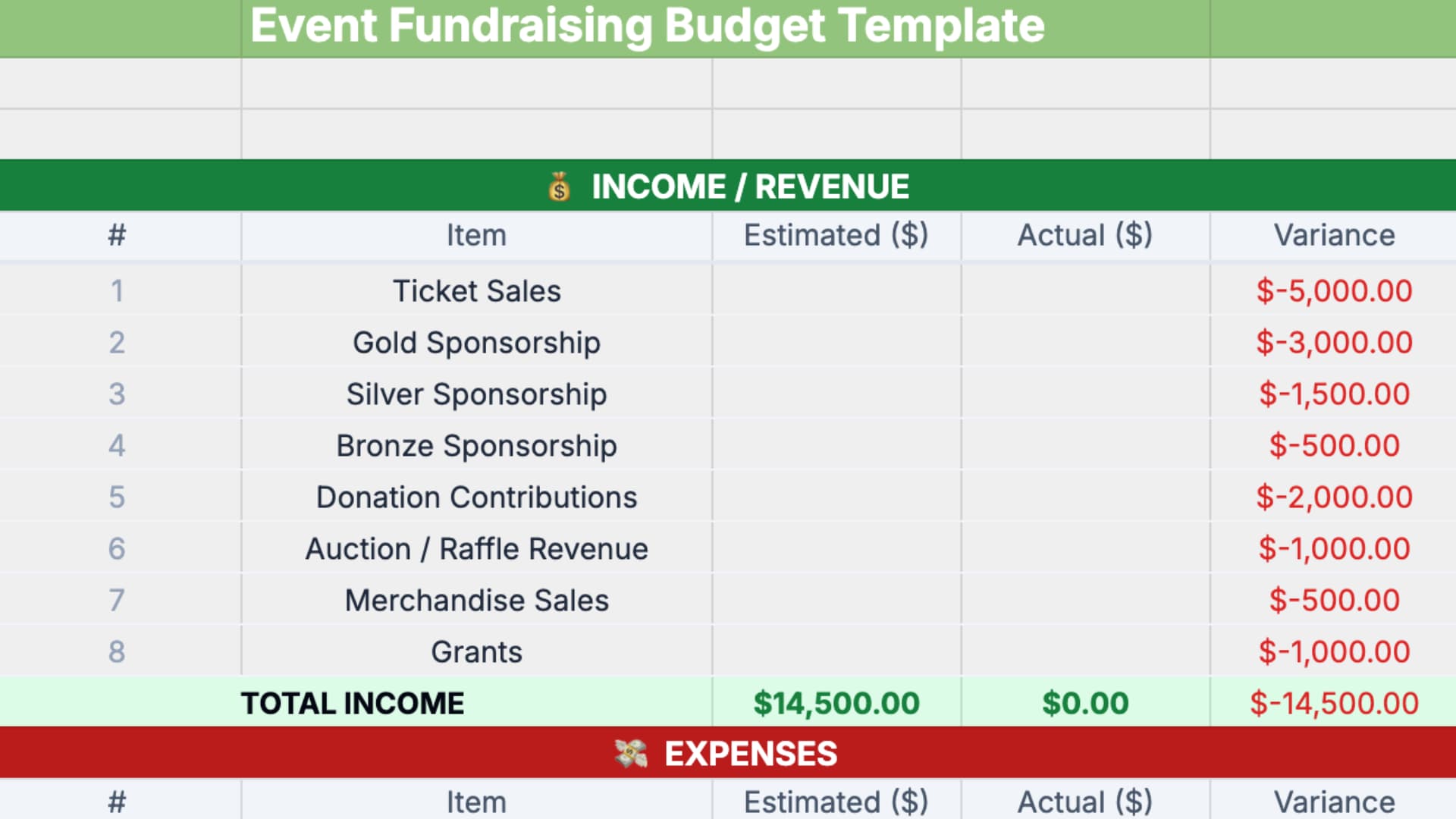
An event fundraising budget template helps nonprofit organizations plan, track, and manage fundraising events from initial outreach to final reconciliation.
It typically includes sections for donation tracking, sponsorship tiers, ticket sales, auction items, volunteer coordination, expense management, and net proceeds calculation.
This template ensures transparency, improves donor reporting, and helps maximize the amount raised after expenses are deducted.
Best for: Nonprofit galas, charity auctions, fundraising dinners, walkathons, benefit concerts, and community fundraising events where tracking donations and sponsor commitments is essential.
2. Party Budget Template
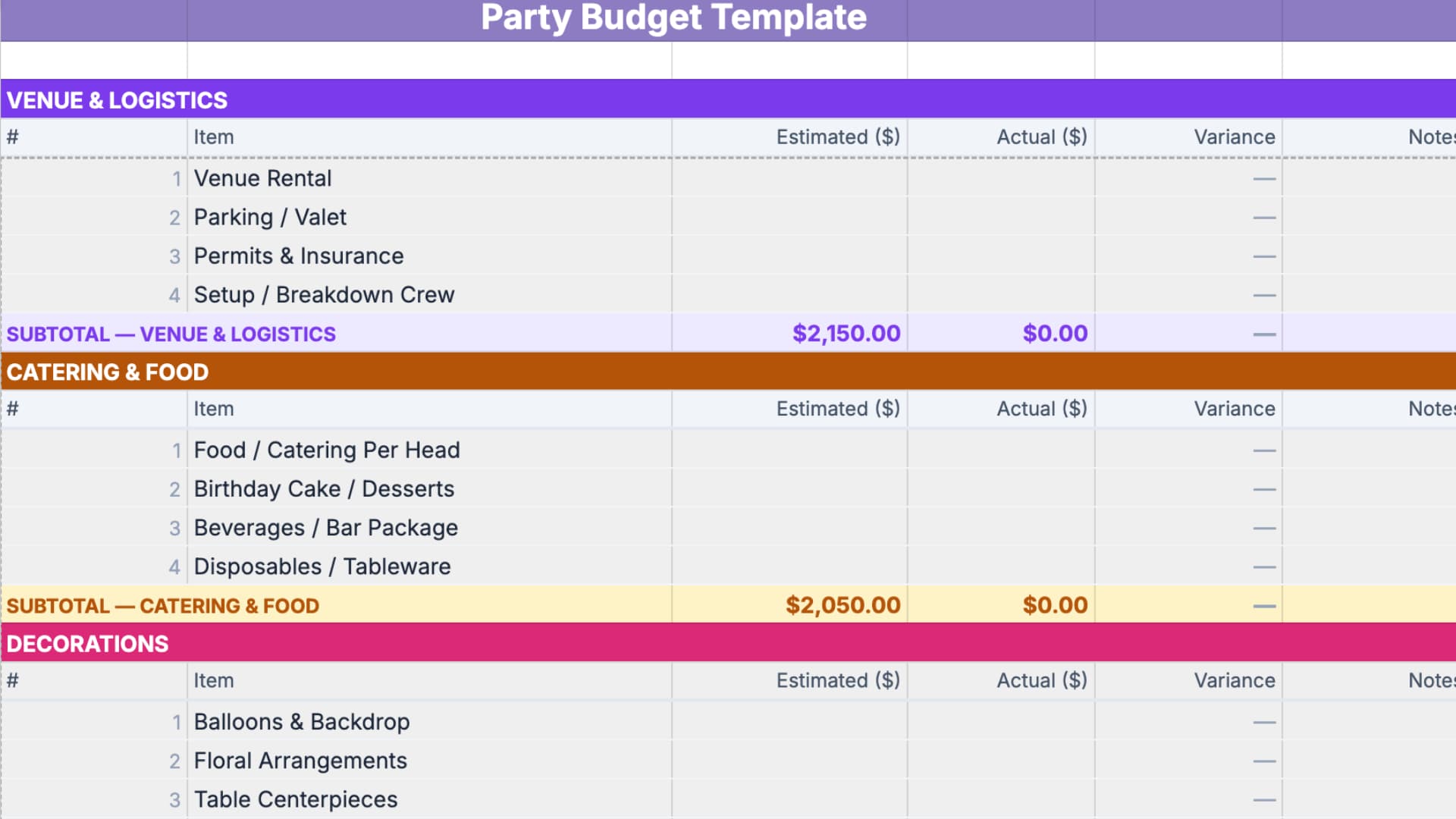
A party budget template is a structured planning tool that organizes all expenses related to hosting a celebration.
It breaks down costs into categories such as venue, catering, decorations, entertainment, invitations, photography, and rentals.
By comparing estimated and actual spending, this template helps prevent overspending while keeping your celebration organized and financially controlled from start to finish.
Best for: Birthday parties, anniversary celebrations, holiday gatherings, graduation parties, retirement events, and personal milestone celebrations.
3. Event Marketing Budget Template
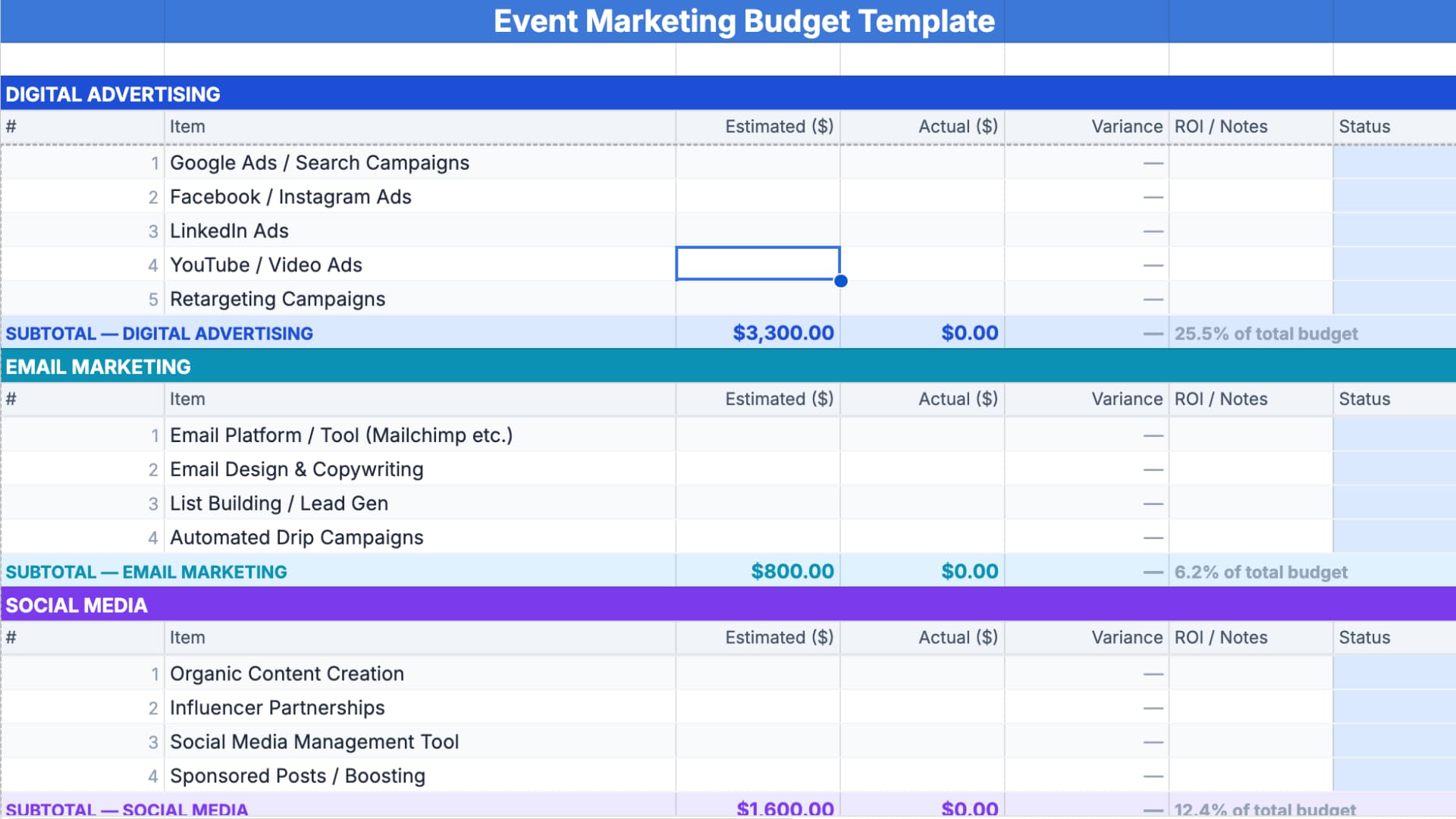
An event marketing budget template focuses specifically on promotional expenses.
It categorizes spending into digital ads, email campaigns, print materials, website development, public relations, influencer partnerships, promotional merchandise, and content creation.
This template helps you allocate funds strategically across channels, monitor campaign performance, and measure return on investment while keeping promotional costs within limits.
Best for: Product launches, conferences, trade shows, festivals, and events where driving attendance and brand awareness through multi-channel marketing is critical.
4. Virtual Event Budget Template
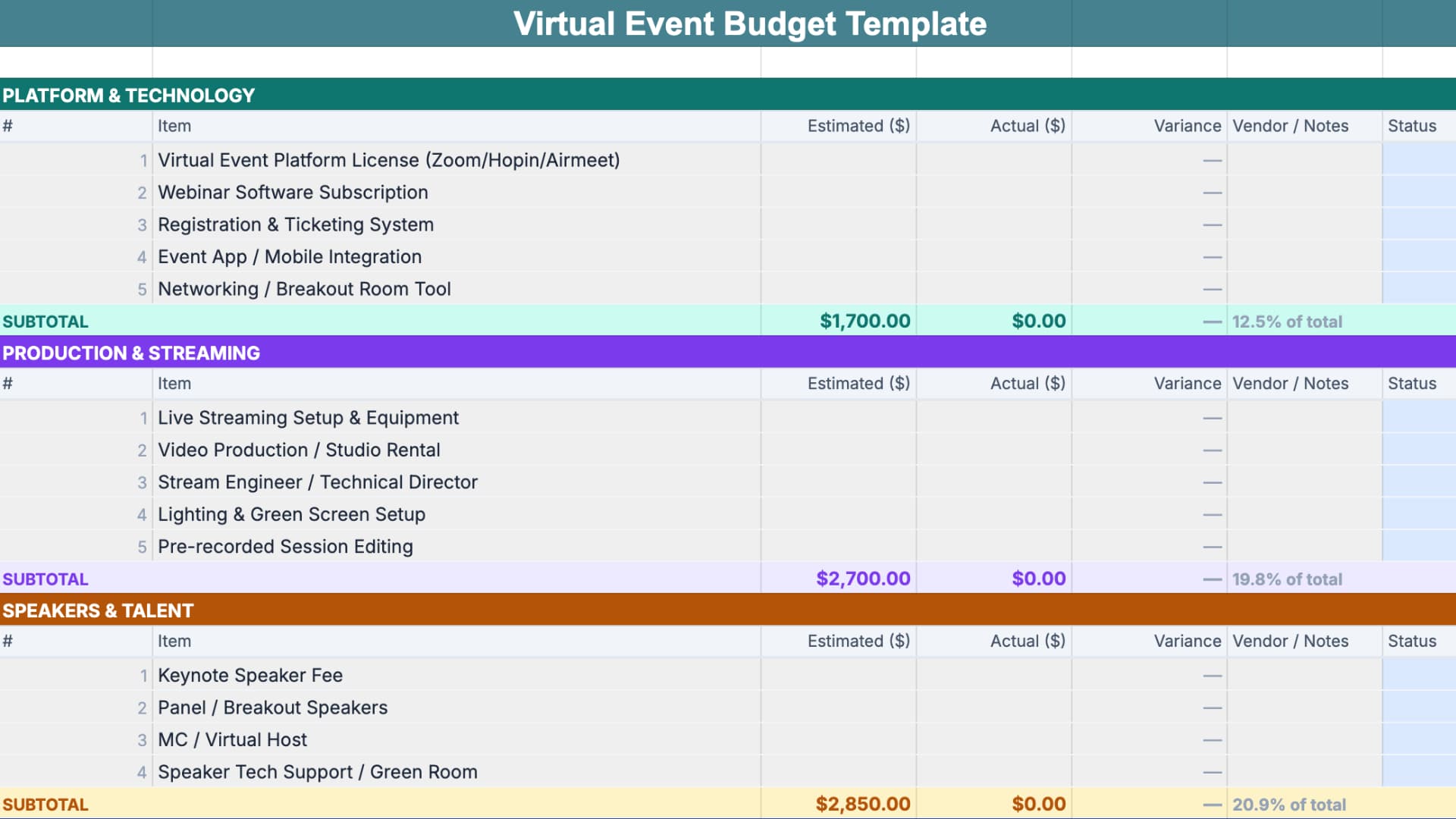
A virtual event budget template is designed for online or hybrid experiences where technology replaces traditional venue costs.
It includes categories such as streaming platform licenses, virtual event software, technical support, production services, speaker fees, digital marketing, registration systems, and content creation.
This template ensures that technical and engagement-related expenses are fully accounted for.
Best for: Webinars, virtual conferences, online workshops, hybrid corporate meetings, remote training sessions, and digital networking events.
5. Charity Event Budget Template
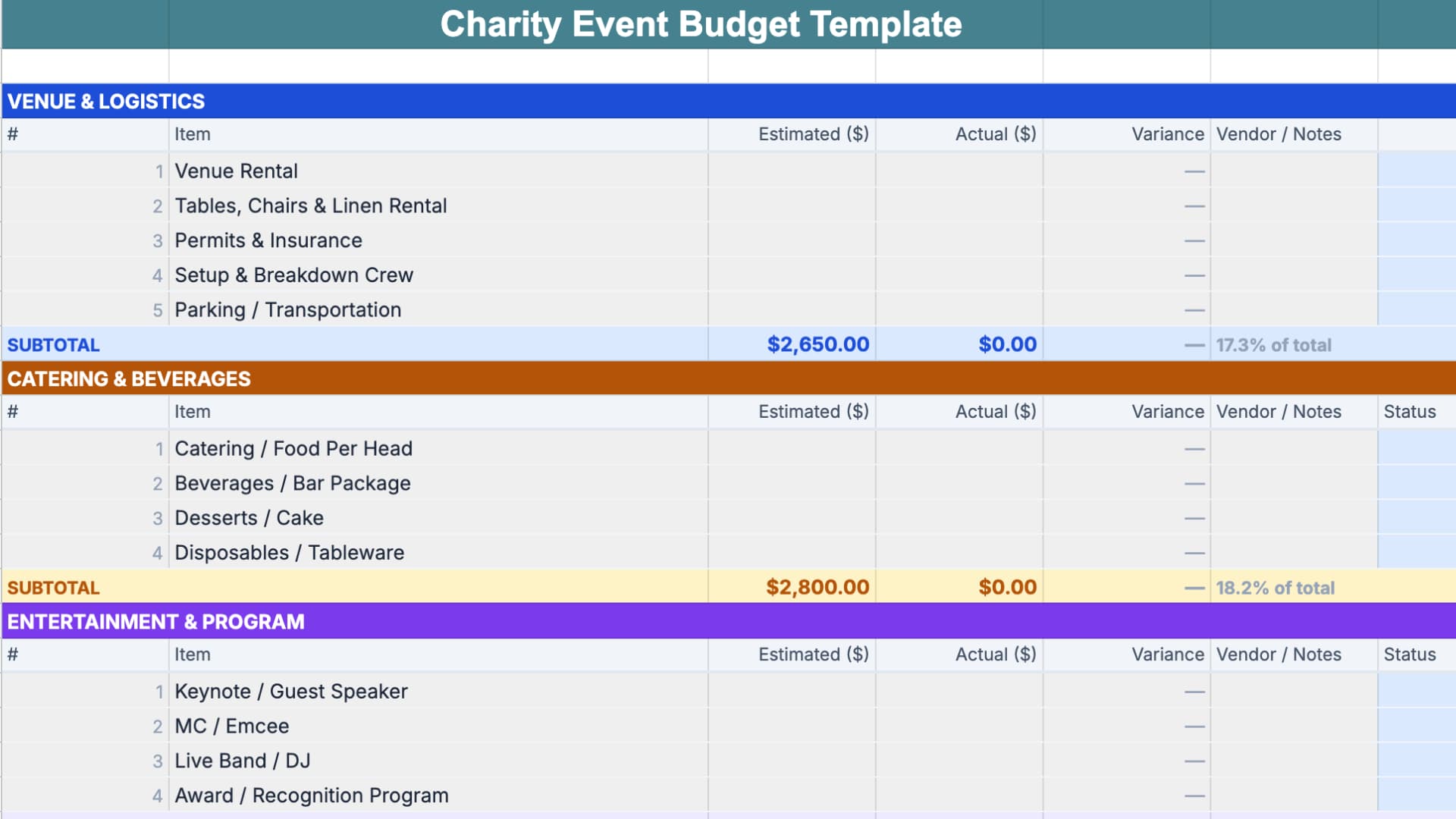
A charity event budget template is structured to balance fundraising revenue with operational costs while prioritizing net proceeds for the cause.
It tracks donations, sponsorships, ticket sales, in-kind contributions, volunteer expenses, marketing, venue, catering, and entertainment.
The focus is on financial transparency and maximizing the final amount directed toward the charitable mission.
Best for: Charity runs, benefit dinners, silent auctions, awareness campaigns, volunteer appreciation events, and community service initiatives.
Free Event Budget Templates and Tools
If you want your event budget to stay organized from day one to the final invoice, you need more than a single spreadsheet. Here Are:
- Google Sheets Template: Free, editable, and shareable spreadsheet for real-time collaboration, projections, and tracking estimated versus actual event budget expenses.
- Microsoft Excel: Downloadable .xlsx template with built-in formulas for totals, variance analysis, payment tracking, and structured category breakdowns.
- Canva: Free drag-and-drop design tool to create visual event budget planners, presentation-ready summaries, and branded budget reports without any design experience.
- Notion: Free all-in-one workspace to build a fully customizable event budget tracker with tables, checklists, vendor notes, and real-time team collaboration in one place.
- Airtable: Free spreadsheet-database hybrid that lets you track event expenses, categorize vendors, manage payment timelines, and visualize your budget in grid, calendar, or kanban view.
Tips for Staying On Budget
Once execution starts, discipline matters more than projections. These practical safeguards protect your event budget from small leaks that become expensive mistakes.
- Single Budget Owner: Assign one person to manage updates, approvals, and changes to prevent confusion, duplicate spending, and conflicting spreadsheet versions.
- Approval Limits: Set spending thresholds that require written approval before commitments, ensuring major expenses never proceed without financial oversight.
- Weekly Tracking: Build your actual spend column from day one and review numbers weekly to catch variances before they escalate.
- Negotiate Terms Early: Secure flexible payment schedules and review attrition clauses early to protect cash flow and reduce financial risk.
- Adjust Scenarios: Revisit conservative and expected projections whenever attendance shifts to avoid overcommitting based on outdated revenue assumptions.
Conclusion
An event without structure is just a series of financial surprises waiting to happen. Use the templates and tools shared here to build smarter from the start.
A clear event budget template turns uncertainty into control by showing you exactly where your money is going and what needs attention next.
When you treat your event budget as a living document, track revenue alongside expenses, and review it consistently, staying on budget becomes practical rather than stressful.
No matter if you are planning a corporate conference, wedding, fundraiser, or virtual event, the right system makes all the difference.
If you have questions, tips, or real-world lessons, drop your comments below and join the conversation.