Smart buildings are not just about fancy thermostats and app-controlled lights anymore. They are becoming living systems that sense, decide, and respond in real time. One reason is pressure on efficiency and resilience: buildings account for around 30% of global energy demand, which makes smarter building operations a practical necessity, not a nice-to-have.At the same time, the smart building economy is accelerating. Several market trackers estimate the global smart building market at well over $100B in 2024 and growing rapidly into the next decade.
In that shift, access control has moved from “doors and badges” to a decision layer for the entire property. As smart buildings evolve into software-driven environments, an access control system is no longer just about managing doors and credentials. Platforms like Coram’s access control system act as an intelligence layer, combining real-time identity verification, risk-based decision-making, and seamless integration with video surveillance and building management tools to enable safer, more adaptive spaces.
Modern platforms increasingly use AI to detect risk, automate policy, and connect identity with everything else inside a facility. The access control market itself is expanding alongside this trend, with estimates putting it around $10B+ in 2024 and growing through 2030.
Below are 7 ways AI access control systems are shaping the future of smart buildings, and what that means for owners, property managers, and security leaders.
1) Risk-based access replaces one-size-fits-all rules
Traditional access control is binary: allowed or denied. AI introduces context. Instead of treating every entry attempt the same, an AI-enabled system can evaluate risk signals such as:
- unusual entry time for that user
- atypical location (wrong building or wrong floor)
- repeated failed attempts
- credential sharing indicators
- anomalies from nearby sensors (forced door, motion after-hours)
This is the “risk scoring” model used widely in cybersecurity, now applied to physical access. In practice, it enables stepped-up verification when needed. For low-risk entries, a phone credential may be enough. For high-risk attempts, the system can require a second factor, alert a guard, or temporarily restrict access until verified.
Why it matters for smart buildings: risk-based decisions reduce friction for normal behavior while tightening security exactly when something looks off.
2) Mobile credentials become the default identity layer
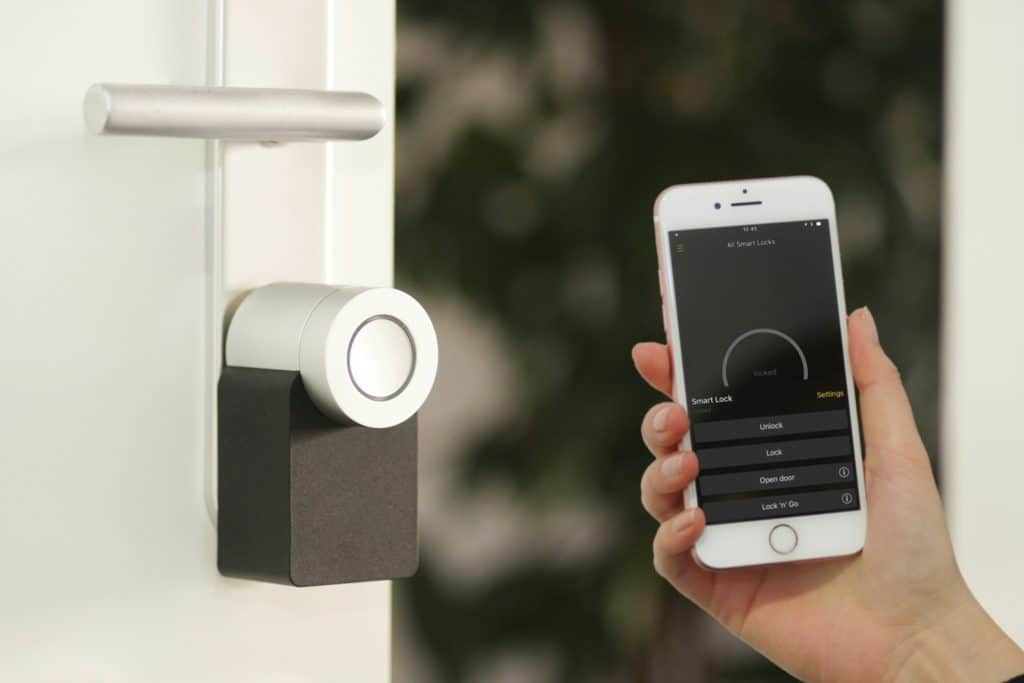
Smart buildings are trending toward “phone-first” access, where a mobile credential replaces or complements cards and fobs. AI makes this more reliable by detecting edge cases that cause everyday failures, like tailgating patterns at peak times, or repeated “door held” events on certain entrances.
Mobile credentials also unlock new workflows:
- time-bound access for vendors and deliveries
- remote granting and revoking of access for contractors
- visitor passes that update dynamically if meetings move rooms
The real shift is not the phone itself. It is the move toward software-defined identity. When identity is software, it is easier to integrate with tenant apps, property management, and building operations.
3) Biometrics evolve from “fingerprint readers” to AI-driven verification
Biometric access is growing as organizations want stronger identity assurance without issuing more hardware tokens. Market trackers project strong growth for biometrics overall through the decade.
AI is the key reason biometrics work better now than earlier generations:
- Liveness detection helps reduce spoofing attempts (photos, masks, replicas).
- Quality scoring improves performance in poor lighting or odd angles.
- Adaptive matching can reduce false rejects without sacrificing security.
For smart buildings, biometrics are often used selectively: data centers, control rooms, executive floors, lab spaces, and other high-risk zones. The best practice is to treat biometrics as an option in a layered approach, not a universal requirement everywhere.
Important note: biometrics also raise privacy and compliance questions. AI does not remove that responsibility, but it can support privacy-preserving approaches like on-device matching and tighter retention policies.
4) Access data becomes occupancy intelligence for energy and operations
One of the biggest missed opportunities in buildings is fragmented data. HVAC runs on schedules. Security runs on door events. Space planning runs on manual surveys. AI access control helps unify signals and convert them into occupancy intelligence.
When a system knows how many people are entering specific zones and when, it can support:
- smarter HVAC and lighting control by zone
- dynamic staffing for reception and security
- real-time crowd management and elevator tuning
- better utilization reporting for tenants
This matters because energy performance is now a business requirement in many portfolios, and buildings are a major global energy consumer. AI does not need to “take over the building” to help. Even basic correlations between access events and occupancy patterns can reduce waste while improving comfort.
5) Converged security: access control becomes the trigger for cameras and analytics
Smart buildings are increasingly run with a “single-pane-of-glass” mentality: access, video, alarms, and sensors working together. AI makes these integrations more effective and less noisy.
Examples of high-impact convergence:
- A door forced open triggers camera bookmarking and an immediate alert.
- A person enters a restricted zone and the nearest camera view is surfaced automatically.
- Tailgating detection is verified using video analytics rather than relying on guard guesses.
- Access is temporarily restricted if a threat is detected in a specific area.
This is how buildings move from passive logging to active prevention. Instead of reviewing incidents later, teams get actionable signals in the moment.
6) Cloud and analytics shift access control from hardware projects to continuous improvement
Legacy access control upgrades often feel like construction projects: panels, wiring, installers, downtime. AI-forward systems lean toward centralized policy management, analytics, and updates that improve performance over time.
That shift enables:
- portfolio-wide policy enforcement across multiple properties
- benchmarking across sites (which entrances are most problematic, which tenants have most exceptions)
- anomaly detection that improves as patterns become clearer
- faster audits for compliance and investigations
This aligns with broader market momentum: access control is growing as organizations integrate advanced technologies and replace older approaches.
The practical outcome: security becomes a measurable program with metrics, not just a set of doors that sometimes fail.
7) Emergency readiness improves with automated lockdowns and “who is where” insight
Smart buildings are judged by how they behave on normal days and on the worst day. AI access control can improve emergency response by enabling:
- rapid lockdown of specific zones, not necessarily the entire building
- automated mustering workflows during evacuations
- faster identification of who entered a floor last and when
- integration with visitor management so guests are not invisible during incidents
When paired with occupancy intelligence, teams can make better decisions quickly, especially in large mixed-use properties where tenant activity changes constantly.
What to prioritize when adopting AI access control in a smart building
If you are evaluating or upgrading, focus on the fundamentals that make AI useful:
- Data quality: door events, schedules, identity attributes, and clear role definitions.
- Integration plan: video, alarms, visitor management, and building management systems.
- Privacy and governance: retention, access to logs, biometric policies, and audit controls.
- Fail-safe operations: graceful degradation if networks fail, plus offline modes where needed.
- Operational ownership: who tunes policies, reviews alerts, and manages exceptions.
AI will not fix messy processes by itself. But with strong inputs and clear rules, it can reduce manual workload and improve security outcomes.
FAQs
1) What makes an access control system “AI-powered”?
An AI-powered system uses machine learning or advanced analytics to detect anomalies, score risk, automate policy decisions, and reduce false alarms. It goes beyond static rules like “user X can enter door Y from 9 to 5.”
2) Are mobile credentials as secure as badges?
They can be, and often more secure when combined with device-level protections, encryption, and optional multi-factor checks. The bigger advantage is fast revocation and reduced credential sharing compared to easily loaned keycards.
3) Do smart buildings need biometrics for modern access control?
Not necessarily. Biometrics are best used for high-security zones or when identity assurance must be strong. Many buildings get major benefits from mobile credentials, risk scoring, and better integration without biometrics.
4) How does AI access control help reduce energy costs?
It can provide occupancy signals that help buildings avoid heating, cooling, or lighting empty zones. Since buildings account for around 30% of global energy demand, even modest efficiency gains can matter at scale.
5) What are the biggest risks to watch out for?
The top risks are privacy missteps, poor integration, noisy alerts, and unclear ownership. You need governance rules for data retention and access, plus a plan for continuous tuning.
6) How long does it take to see value after deployment?
Many teams see early wins quickly through mobile credential rollout, centralized management, and better auditing. The deeper AI benefits, like risk scoring accuracy and anomaly detection, improve over time as the system learns normal patterns.
Conclusion
AI access control is becoming the nervous system of the smart building: it connects identity, movement, and policy to operations, energy efficiency, and incident response. As the smart building market continues to expand rapidly, access control is no longer just a security line item. It is the core infrastructure for how modern properties function.