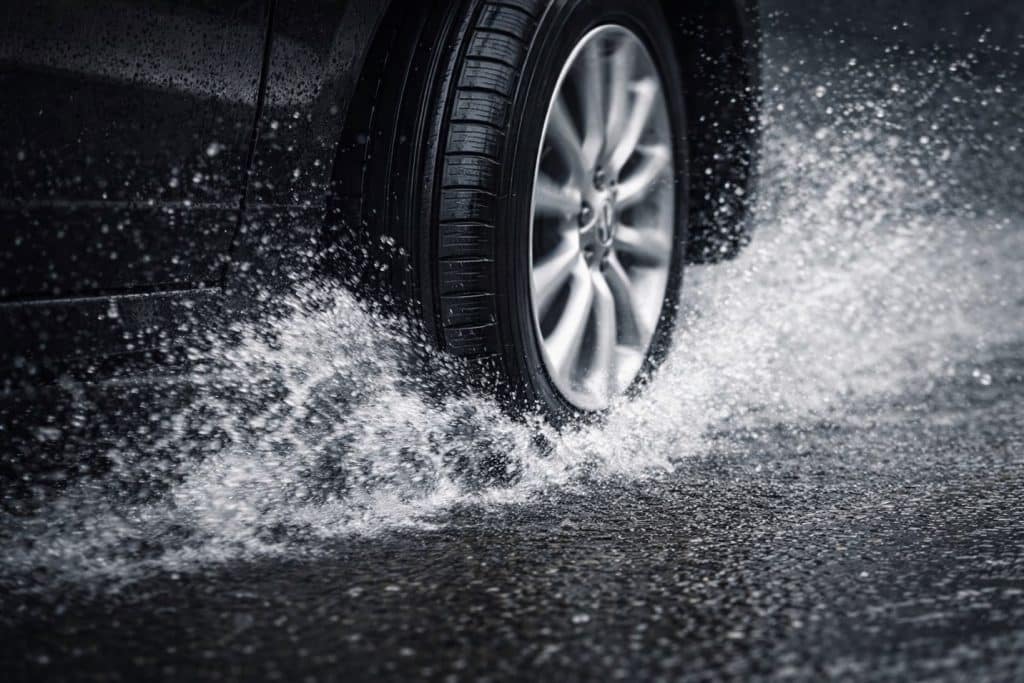
Hydroplaning happens when tires lose contact with the road on wet surfaces. Certain tire wear patterns dramatically increase this risk by reducing water evacuation, grip, and stability—often before drivers realize their tires are unsafe.
What is Hydroplaning?
Hydroplaning occurs when a layer of water builds between the tire and the road surface, preventing the tire from maintaining direct contact with the pavement. When this happens, steering, braking, and acceleration inputs become ineffective.
Hydroplaning risk increases with:
- Standing water or heavy rain
- Higher driving speeds
- Worn or uneven tires
- Improper tire pressure
While weather plays a role, tire condition is the single most controllable factor.
Why Tire Wear Patterns Matter More Than Tread Depth Alone
Many drivers assume hydroplaning risk is only about how much tread is left. In reality, where the tread is worn matters just as much as how much remains.
Uneven wear disrupts:
- Water channeling through tread grooves
- Consistent pressure distribution
- Tire footprint stability
A tire can meet the legal minimum tread depth and still hydroplane easily if wear is concentrated in critical areas.
Tire Wear Patterns That Increase Hydroplaning Risk
1. Center Tread Wear
What it looks like: The middle of the tread is worn down more than the shoulders.
Why it increases hydroplaning risk:
Center tread grooves are designed to channel water away from the tire’s contact patch. When these grooves are shallow, water cannot escape efficiently, causing the tire to ride on top of water at speed.
Common causes:
- Chronic overinflation
- Incorrect pressure assumptions under load
Risk level: High at highway speeds
2. Inner or Outer Shoulder Wear
What it looks like: One edge of the tire is significantly more worn than the rest.
Why it increases hydroplaning risk:
Shoulders play a major role in lateral water evacuation during cornering. When worn smooth, the tire loses its ability to maintain grip while turning on wet roads.
Common causes:
- Camber misalignment
- Worn suspension components
Risk level: High during lane changes and curves
3. Uneven Wear Across the Tread (Patch Wear)
What it looks like: Sections of the tire are noticeably thinner than others.
Why it increases hydroplaning risk:
Water pressure builds unevenly across the tread, lifting thinner sections off the road first and destabilizing the tire.
Common causes:
- Hard braking
- Wheel imbalance
- Suspension issues
Risk level: Medium to high depending on severity
4. Cupping or Scalloping
What it looks like: Alternating high and low spots around the tire circumference.
Why it increases hydroplaning risk:
Cupped tires cannot maintain continuous contact with the road, allowing water to enter under the tire more easily.
Common causes:
- Worn shocks or struts
- Poor damping control
Risk level: High, especially on rough or wet roads
5. Feathering
What it looks like: Tread blocks feel sharp in one direction and smooth in the other.
Why it increases hydroplaning risk:
Feathered edges disrupt water flow and reduce consistent grip, particularly during steering corrections in rain.
Common causes:
- Toe misalignment
- Steering component wear
Risk level: Medium
6. Tires Worn Close to the Legal Limit
What it looks like: Tread depth approaching 2/32 inch (1.6 mm).
Why it increases hydroplaning risk:
At shallow tread depths, even minor uneven wear severely limits water evacuation.
Risk level: Very high in standing water
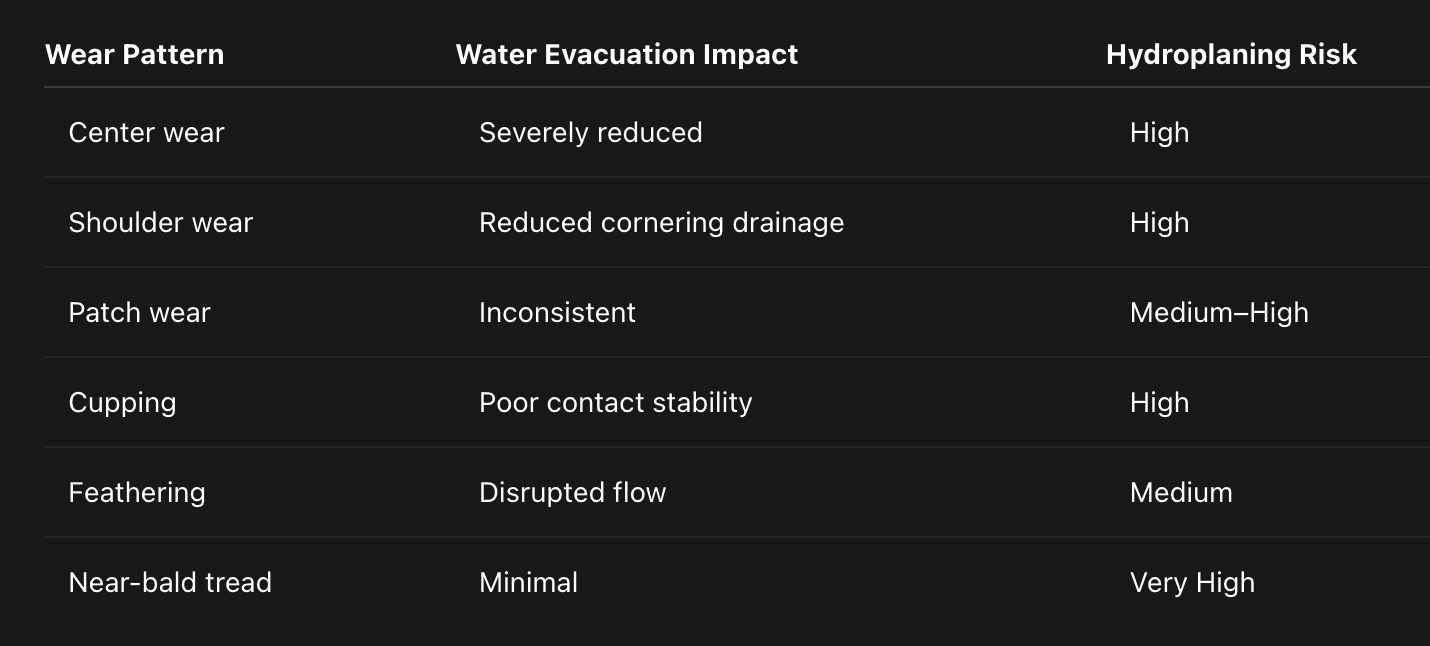
Table: Tire Wear Patterns and Hydroplaning Risk
How Speed and Tire Wear Combine to Cause Hydroplaning
Hydroplaning risk increases exponentially with speed. Even small reductions in tread depth or uneven wear can cause a tire to hydroplane at much lower speeds than expected.
For example:
- New tires may resist hydroplaning above 60 mph
- Moderately worn tires may hydroplane at 45–50 mph
- Unevenly worn tires may hydroplane below 40 mph
This is why drivers often experience hydroplaning “suddenly,” even without extreme weather.
Is Uneven Tire Wear as Dangerous as Driving on a Flat Tire?
While uneven wear does not eliminate air pressure like a flat tire, severe uneven wear can produce similar loss-of-control scenarios in wet conditions.
A flat tire fails structurally. An uneven tire fails functionally—by losing grip when it is needed most.
In rain, the loss of steering and braking response from uneven tires can be just as dangerous.
How to Reduce Hydroplaning Risk From Tire Wear
Immediate Actions
- Reduce speed in wet conditions
- Avoid standing water
- Increase following distance
Tire-Specific Actions
- Replace tires before reaching the legal minimum
- Correct alignment and suspension issues
- Maintain proper tire pressure
- Rotate tires regularly
When to Replace Tires for Wet Safety
Replace tires immediately if:
- One shoulder is nearly smooth
- Cupping causes vibration
- Tread depth is below 4/32 inch in wet climates
- Uneven wear affects handling confidence
Waiting until performance tires are legally bald significantly increases hydroplaning risk.
Preventing Uneven Wear That Leads to Hydroplaning
Practical Prevention Checklist
- Check tire pressure monthly
- Rotate tires every 5,000–8,000 miles
- Align wheels annually
- Replace worn shocks and struts
- Address steering or vibration issues early
FAQ: Tire Wear and Hydroplaning
Which tire wear pattern causes hydroplaning fastest?
Center tread wear and near-bald tread cause the fastest loss of water evacuation.
Can uneven tire wear cause hydroplaning at low speeds?
Yes. Severe uneven wear can cause hydroplaning below highway speeds in standing water.
Is legal tread depth safe in heavy rain?
Legal minimums are not optimized for wet safety. More tread is needed for rain resistance.
Key Takeaways
- Hydroplaning risk depends on wear pattern, not just tread depth
- Uneven wear disrupts water evacuation
- Center and shoulder wear are especially dangerous
- Wet-weather safety declines rapidly as wear increases
Conclusion
Tire wear patterns that increase hydroplaning risk often go unnoticed until traction is lost. Uneven wear reduces water control long before tires appear worn out.
If your tires show uneven wear or shallow grooves, especially on the center or shoulders, replace them before the next heavy rain—wet-road safety depends on it.