
The global infant formula market was valued at $47.2 billion in 2024 and is expected to reach $126.5 billion by 2034. This is due to improved formulations and a growing number of options from a wide range of brands. Plus, nowadays, you can choose between different types of infant formula, from cow’s milk to soy to goat’s milk.
Yet, when it comes to deciding which to feed your newborn, it’s like playing a game of three-dimensional chess. This will be one of the main sources of sustenance for your bundle of joy, and there’s no room for error.
Which do you choose, and why?
In this article, we’ll teach you how to read the labels on infant formula and how to identify the elements that matter the most for your baby’s health and good development.
The Infant Formula Label
The design of the label is different from one country to another, but all brands must follow their ruling authority’s guidelines (FDA in the US, the European Food Safety Authority in the EU, and the Food Standards Agency in the UK).
In most developed countries, formula producers are required to comply with strict rules governing both product formulation and labelling. So, you can trust that what’s written on the label is true.
The only thing that’s left now is to understand it. Let’s take the Kendamil Goat Formula for infants in their first stage of life as an example.
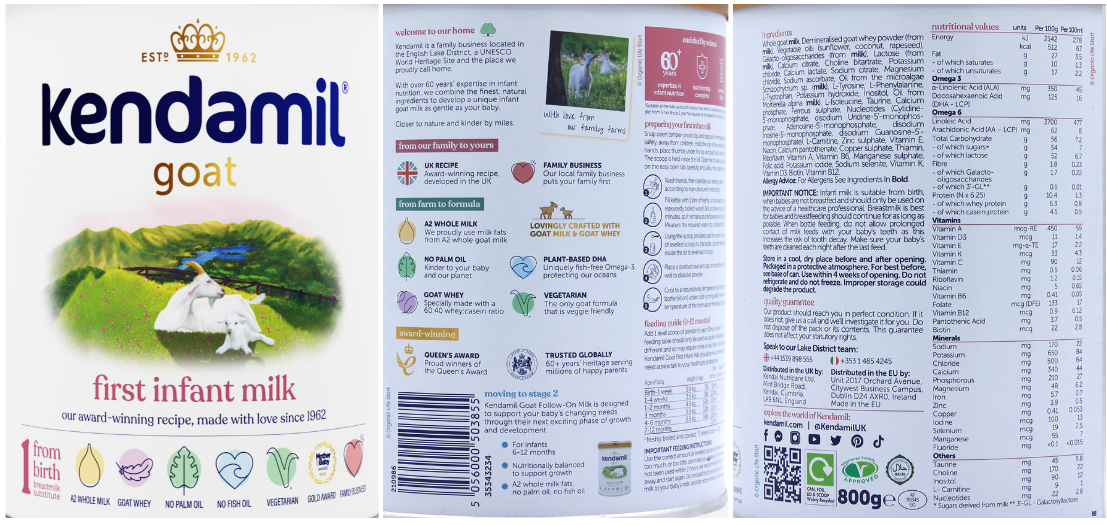
Alt: Screenshot of the Kendamil Goat infant formula
As a general rule, the front of the label is simple and focused on describing the ingredients, benefits, and best use of the product. The back is dedicated to ingredients, nutritional profile, and any additional information.
That’s where you have to pay attention.
Look at the ingredients’ list first. They’re listed from heaviest to lightest. In the EU, the main ingredient is usually a type of milk (goat, in this case) because regulations require the use of ingredients that closely mimic breast milk.
You should also look for:
- Whey protein – It resembles the protein composition of breast milk and is better absorbed by the baby’s system, which makes the formula easier to digest. If you find “Demineralised Whey” or “Whey Protein Concentrate” as the second or third ingredient listed, you are looking at a whey-dominant formula designed for easy digestion.
- DHA and ARA – These are fatty acids that help babies grow healthy and smart, but in the EU and UK, only DHA is mandatory. Since February 2020, all infant formulas in the EU/UK must contain 20–50 mg of DHA per 100 kcal. The authorities are still considering whether to make ARA mandatory as well.
- Additives – Artificial preservatives are banned from baby formulas in both the EU and the UK. Still, producers are allowed to use a small list of antioxidants to prevent the oils from oxidising. These are often listed in the Vitamins or Acidity Regulator sections of the label.
Once you confirm the product has the ingredients your baby needs, check the nutritional profile. Here, you’ll find an extensive list of nutrients, each described in detail (as per law requirements). The information is also presented on a per-100-ml basis for the prepared product, allowing you to see exactly what is in a standard bottle.
In Summary: Infant Formula Labels are Well-Designed
We live in a time when technology is advanced enough to freeze-dry breast milk, so it’s no surprise that the science behind both the formula and its label is accurate and well-designed. Labels are standardised and must present specific information to be trustworthy. As long as you follow these standards, your baby’s diet is in good hands.