Space is the one warehouse problem that never stays solved. You add a new product line and suddenly the same four walls feel smaller than they did last quarter. That’s why so many operators are rethinking storage density instead of hunting for more square footage, and why solutions like a Modula lift keep showing up in more and more conversations.
It isn’t just the technology that’s changed, but the mindset. The best-run warehouses treat space as a resource they can continuously optimize, rather than a fixed constraint they work around until the lease ends. We’ll look at how they do that a little later, but first, let’s look at the “why.”
Space Got Expensive, but Demand Stayed Unpredictable
A space that fits every criteria in the book is unlikely to magically appear. It is tough to find a warehouse that’s just the right size and near your labor pool, your customers, and your carrier network. This contributes to the nationwide industrial vacancy being as high as 7.1%.

Plus, expanding isn’t a simple problem. It can be a nerve-racking exercise that involves permitting, build-outs, racking, safety reviews, all while customers keep expecting tighter delivery windows, and product catalogs keep expanding.
This problem needs to be tackled head-on, because online buying isn’t going anywhere: in the third quarter of 2025, e-commerce accounted for 15.8% of total U.S. retail sales on a not seasonally adjusted basis.
That’s why for the top companies, the space conversation has become less about finding another building, and more about getting a few percent more capacity out of the one they already run.
Smart warehouses design for flexibility. They assume the SKU mix will change and that order sizes will swing, so they build systems that can adapt without requiring a new footprint every time the business gets interesting. Let’s explore how.
1. Using the Cube Footage
Most “full” warehouses aren’t actually full. Sure, the floor is packed with racks and aisles, but the air above is doing absolutely nothing.
Smart facilities attack that mismatch by treating storage as a three-dimensional problem. The goal is densification without turning the building into a maze. Vertical storage systems, well-designed mezzanines, and tighter aisle strategies are all ways to reclaim the cube of the building instead of surrendering to sprawl.
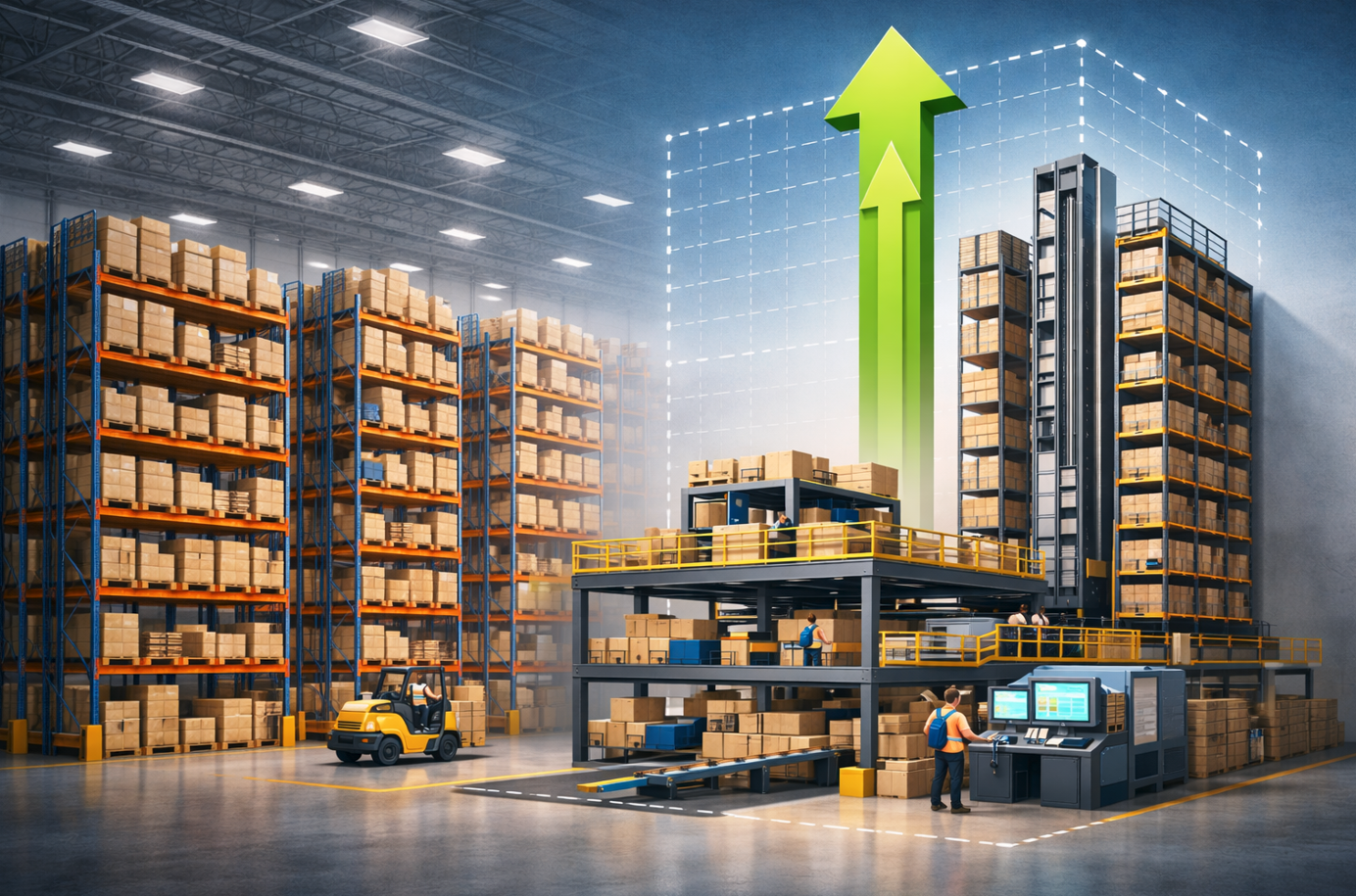
The trick is that density only helps if it stays usable. If you can store more but pick slower, you just traded one constraint for another. That’s why modern densification usually comes with controlled access points and software that keeps inventory locations logical even as they change.
2. Reducing Wasted Motion
Sometimes, space limitations are all about flow.
If your pick paths cut through replenishment traffic, you end up creating buffer zones and staging piles. Also, inbound receiving must have a predictable rhythm; otherwise, you end up over-allocating staging space “just in case.”
Smart warehouses solve these problems by designing for smoother movement. They separate inbound, storage, picking, and outbound so each area can breathe without stealing from the others.
Standardize container sizes where it makes sense, time replenishment to avoid peak picking windows, and use real-time visibility to prevent small problems from turning into physical clutter. Eliminating bottlenecks often creates space you didn’t realize you were wasting every day.
3. Connecting the Building to The Data that Runs It
In a warehouse that’s running like clockwork, all decisions are driven by what’s actually happening on the floor.
That starts with clean inventory data and a Warehouse Management System that people trust. It extends into scanners, sensors, and location logic that reduce ambiguity. It also can include labor planning that reflects real pick rates instead of hopeful targets.
The point is to replace guesswork with feedback loops, so you can keep tightening the operation without breaking it.
It’s the same as smart living: when your thermostat and security system respond to real conditions instead of fixed routines, the whole home feels calmer and more efficient. A warehouse is bigger and messier, but the principle is the same.
4. Automating Selectively
The biggest mistake I see in automation conversations is treating space as an afterthought. Smart warehouses evaluate automation partly on whether it reduces the space cost per order shipped.
Goods-to-person systems can compress storage while keeping throughput high, while automated storage and retrieval can reduce aisle requirements.
Even simpler tools, like dimensioning, smarter cartonization rules, or more accurate cycle counting, can reduce the safety stock and buffer space that eats capacity.
The key thing is being selective about it. Space gains are only worth it when the process upstream and downstream can support them. Otherwise, you create a dense bottleneck, which is just a more expensive version of the same problem.
It’s All About Smarter Decisions
This swelling tide of warehouse intelligence is less about flashy hardware and more about better decision-making. It relies on forecasts, labor planning, and continuous improvement loops.
And, when you think about it, that’s the practical AI future most operators actually want. Nobody is looking for a sci-fi warehouse; we just want one that keeps finding space where it used to waste it, week after week.