Most eBike conversion decisions involve two parallel questions that are easy to conflate: how much power does the build need, and what additional components make that power usable in practice? Getting the wattage right is the first decision, but a high-quality motor in an otherwise underpowered system — paired with a battery too small to sustain it, mounted with inadequate hardware, or operated without the controls and display the rider needs — underperforms relative to what the motor specification implies.
The most effective conversion builds treat the motor as the starting point and work outward from there, selecting accessories and supporting components that are matched to the motor’s output, the rider’s use case, and the specific bicycle being converted. A 1500W build designed for daily commuting on mixed terrain has different supporting component requirements than a 3000W performance build used for off-road riding or cargo hauling at high loads. Understanding both the wattage decision and the accessory ecosystem around it is what produces a conversion that delivers on its potential rather than one that leaves capability on the table.
This article covers the 1500W 48V kit as a well-positioned mid-to-high-power option for serious riders, the accessory and component ecosystem that completes a functional conversion regardless of wattage, and the 3000W kit for applications where standard power levels are genuinely insufficient. The goal is a complete picture of what goes into a conversion that works as intended from the first ride.
The 1500W 48V Build: Where Power and Practicality Meet
The electric bike kit 1500w 48v sits at a particularly useful position in the conversion kit range — powerful enough to handle demanding real-world conditions, compatible with battery and controller configurations that are practical to install and manage, and operating in a wattage class that most bicycle frames can accommodate without requiring structural reinforcement beyond standard torque arm installation.
At 1500W on a 48V system, the motor draws approximately 31 amps at full output — a demand that mid-capacity 48V lithium battery packs handle efficiently at moderate temperatures without significant voltage sag. The 48V platform is the standard voltage tier for serious conversion builds: it provides the voltage headroom for efficient motor operation at high speeds, enables the use of battery packs with practical energy densities for real-world range, and is supported by the widest selection of controllers, chargers, and display systems in the conversion market.
The 1500W direct drive hub motor’s torque output is substantial enough to accelerate a loaded bicycle to cruising speed quickly and to sustain that speed on grades that would require full assist from lower-wattage systems. Riders using this configuration for cargo hauling — panniers, trailer, child seat — report that the power delivery feels consistent under load in ways that 750W and 1000W systems don’t, particularly on climbs where the additional weight makes the motor work harder. The direct drive configuration’s absence of internal gearing means this sustained high-torque output doesn’t create the wear patterns that geared motors experience under similar conditions.
Frame compatibility at 1500W follows the same assessment protocol as higher-wattage builds: steel dropouts handle the torque transmission reliably with a standard torque arm installation; aluminum dropouts require careful evaluation and typically benefit from reinforced torque arm configurations. Riders considering this kit for a front-wheel installation should confirm fork blade material and wall thickness, as aluminum forks with thin blade profiles are generally not appropriate for motors above 1000W regardless of torque arm installation.
Accessories That Make the Conversion Complete
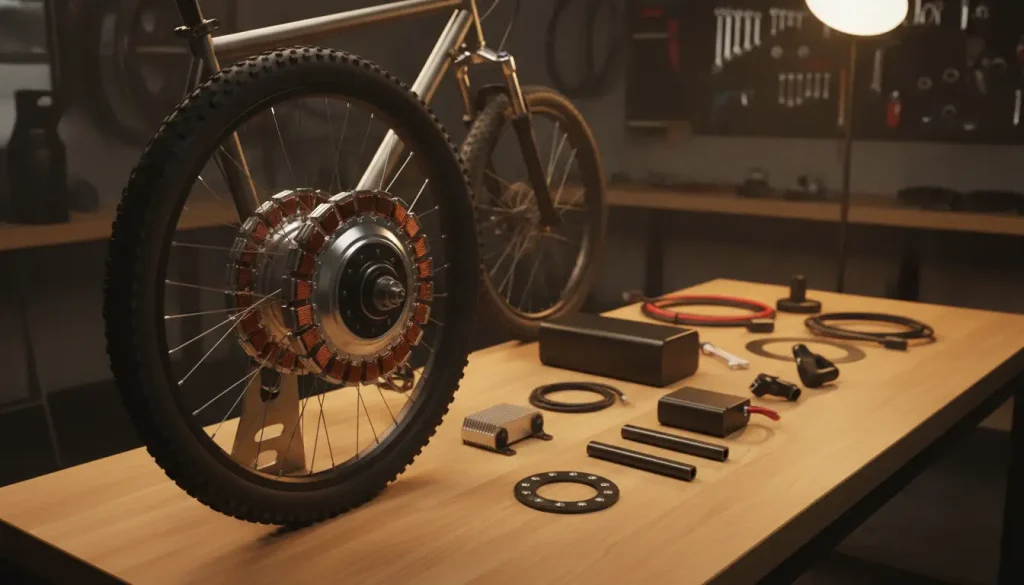
The motor and battery are the headline components of any eBike conversion, but the pedal electric bike accessories that complete the build — the controls, displays, sensors, hardware, and safety components — determine how usable and reliable the finished conversion is in daily operation. A conversion built on a quality motor with inadequate supporting components produces a riding experience that doesn’t reflect the motor’s capability and is more likely to require troubleshooting in the field.
The display unit is the rider’s primary interface with the system during use. A capable display shows real-time battery voltage or state of charge, current speed, assist level, trip distance, and often motor temperature — information that lets the rider manage battery consumption actively and respond to operating conditions rather than relying on intuition. Display quality varies significantly in the conversion market, from basic units that show limited information through small segments to backlit LCD displays with multi-screen layouts that provide comprehensive system feedback. For riders using a conversion for commuting where range management matters, the display investment is directly connected to the consistency of the riding experience.
Pedal assist sensors (PAS) translate pedaling input into motor activation, creating the experience of a natural boost rather than a throttle-driven motor. Cadence sensors detect that the pedals are moving and activate the motor at the selected assist level; torque sensors measure the force the rider is applying and modulate motor output in proportion, producing a more responsive and intuitive assist feel. Torque sensor systems are more expensive and mechanically more complex to install, but they produce a riding feel that most experienced riders prefer for mixed-use cycling where the distinction between assisted and unassisted pedaling matters.
Hydraulic and mechanical disc brake motor cutoff sensors are an important safety accessory for any throttle-capable conversion. These sensors detect brake lever actuation and immediately cut motor power, preventing a situation where the motor continues driving the wheel while the rider is attempting to slow down. Most quality conversion kits include basic brake cutoff levers; riders who prefer to retain their existing brake lever hardware can use inline cutoff sensors that connect between the lever and the brake line without requiring lever replacement.
Maximum Power: What the 3000W Kit Is Built For
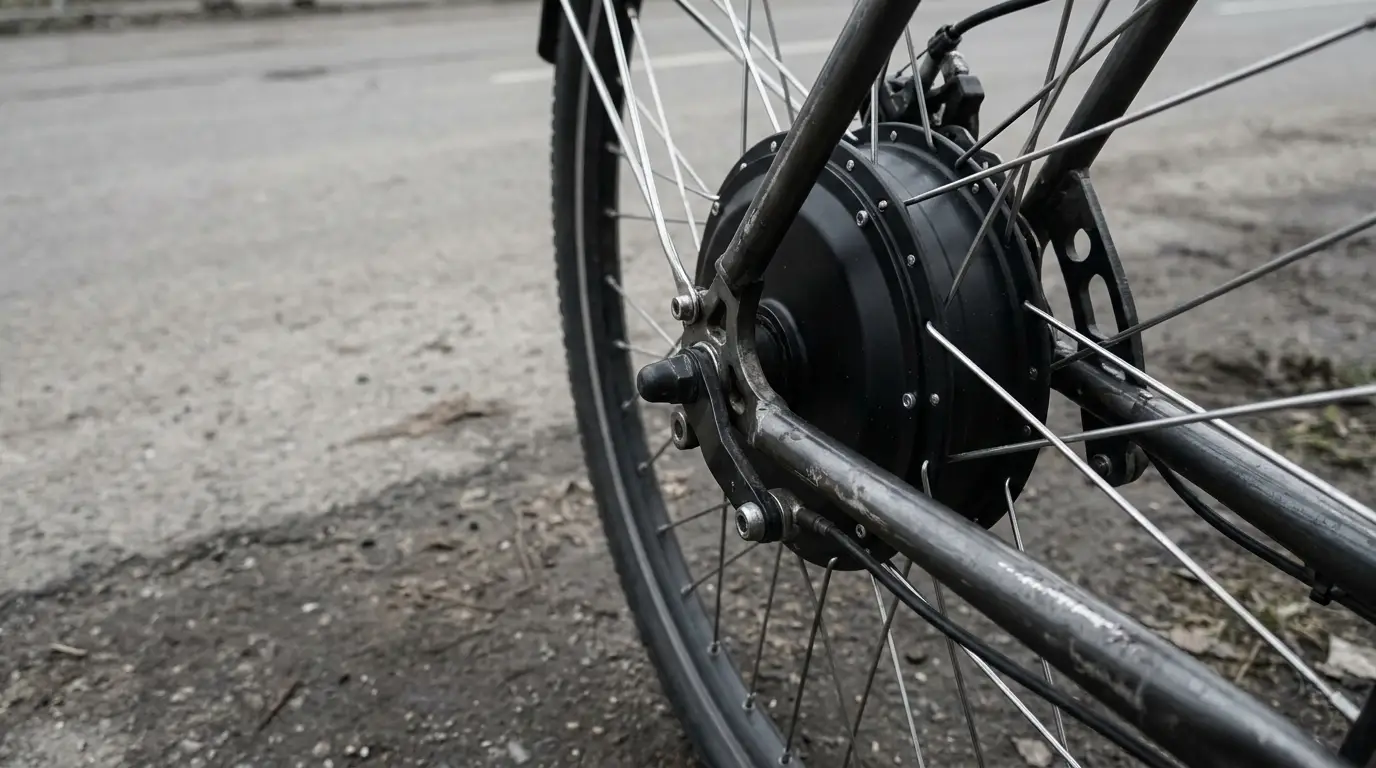
The 3000w electric bike kit is not the appropriate choice for most conversion builds, and that’s by design. It is the right choice for a specific set of applications where standard conversion wattages hit a genuine performance ceiling: heavy-duty cargo builds carrying 150 lbs or more of payload, tandem bicycle conversions where the combined rider weight creates sustained high-load demand on the motor, off-road builds on steep technical terrain where the motor needs to deliver high torque continuously rather than in bursts, and performance builds where high top-end speed is the primary objective.
At 3000W, the direct drive hub motor’s torque output enables acceleration characteristics that place the build in a different performance category from anything below it. A properly configured 3000W build on a 72V battery system can accelerate a standard bicycle from a standstill to 35 mph in a distance and time profile more consistent with a light motorcycle than a conventional bicycle. The motor’s thermal capacity at this wattage is engineered for sustained high-current operation: the hub shell’s thermal mass and the motor’s internal winding design are specified to handle the heat generated by continuous full-output operation without the thermal shutdown that smaller motors experience under equivalent demand.
The structural requirements for a 3000W build are more stringent than for lower-wattage conversions and should be treated as non-negotiable prerequisites rather than optional precautions. Steel-frame bicycles with solid construction and reinforced rear dropouts are the appropriate platform; aluminum-frame road and mountain bikes are generally not adequate for the forces this motor generates under full-throttle acceleration. Torque arm installation is required on both sides of the axle at this power level, not optional on one side as it may be for lower-wattage builds. Braking systems should be upgraded to match the motor’s speed capability — hydraulic disc brakes on both wheels are the appropriate standard for any build capable of sustained speeds above 30 mph.
Battery Sizing for High-Power Builds
The battery specification is the variable most often under-resourced in high-power conversions, and the performance consequences of a mismatched battery are immediate and significant. A 3000W motor drawing full current from a battery pack not rated for that discharge rate will experience voltage sag — the terminal voltage drops under load, the controller sees reduced voltage, and the motor produces less torque than its wattage rating implies. The effective performance of a high-power build is determined by the battery’s continuous discharge rating as much as by the motor’s rated wattage.
For 1500W builds on 48V, a battery with a continuous discharge rating of 30A or higher is the appropriate specification. For 3000W builds, the voltage platform typically steps up to 60V or 72V to manage the current requirements at practical ampere-hour capacities — a 72V 20Ah battery at 3000W continuous output draws approximately 42A, which is within the discharge envelope of quality lithium cells in a properly configured pack. Cell quality, BMS specification, and pack construction determine whether a battery’s rated discharge capacity is consistent across its charge cycle life or degrades rapidly under high-current use.
Conclusion
Selecting the right wattage for an eBike conversion is the starting point of a build decision that extends through battery specification, accessory selection, frame compatibility assessment, and installation quality. The 1500W 48V kit addresses the needs of serious riders whose use case involves varied terrain, meaningful loads, and daily reliability without the structural and legal complexity of higher-power builds. The 3000W kit serves the specific applications where that complexity is justified by genuine performance requirements. In both cases, the accessories and supporting components that complete the build determine whether the motor’s capability is fully realized in practice — and investing appropriately in those components is as important as the motor specification itself.