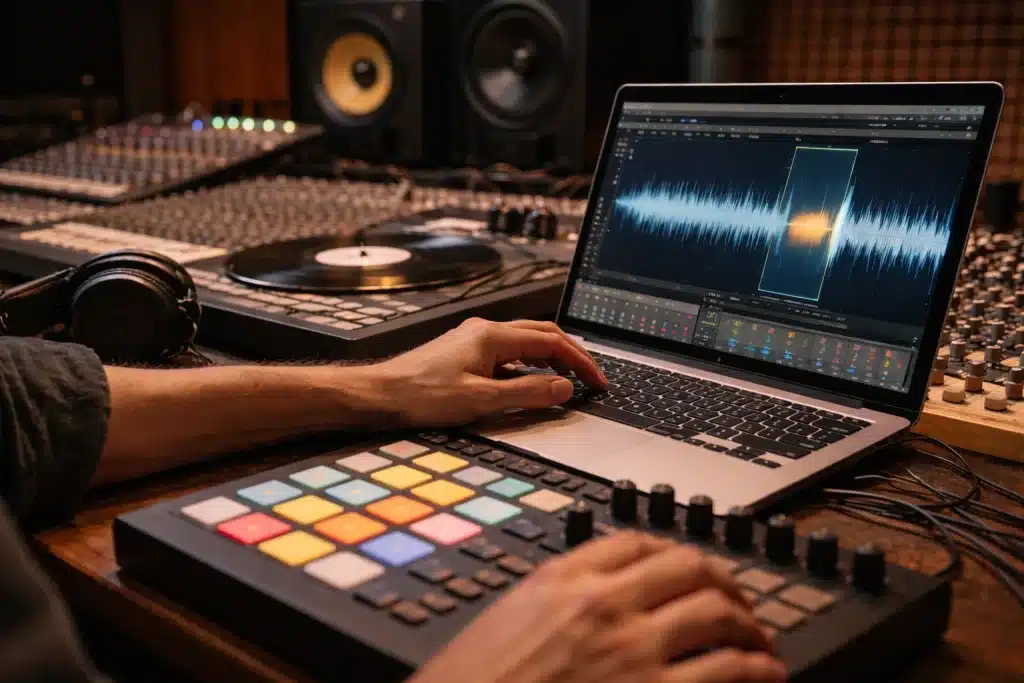
I used to think grabbing a tiny clip from a song was no big deal.
A quick snare hit, a short vocal chop, maybe a bass riff. Most producers I talked to believed the same thing. But here’s the problem.
Can 3 seconds of a song be sampled legally without permission? The answer shocked me, and it will likely shock you, too.
US copyright law does not care how short your sample is. There is no magic number of seconds that keeps you safe.
In this blog, I break down what the law says, real court cases that prove it, and what you can do instead to stay out of trouble.
Disclaimer: This blog is for informational purposes only and does not constitute legal advice. Consult a licensed attorney for guidance on your specific situation.
What Is Music Sampling?
Music sampling is a technique where segments from existing recordings are integrated into new compositions.
This can include rhythmic loops, vocal phrases, or guitar riffs. Since the 1980s, genres like hip-hop, electronic, and pop have used sampling as a core element, fostering creativity and innovation.
Samples can be brief, like a 1-bar loop, or extended, like an entire chorus, providing both rhythmic and melodic structure.
Sampled tracks dominate playlists, radio, and even hours-long live concerts.
Sampling pays tribute to original works while fostering the fusion of diverse musical styles, resulting in unique and fresh creations.
The “3-Second Rule” Is a Complete Myth
The belief that “if it is under 3 seconds, it is fair use” is a misconception that misleads music producers and creators, leading to potential legal issues.
The Copyright Act of 1976 automatically protects all recorded music as soon as it is created, with no time-based loopholes.
Thus, even a brief sampling can be copyright infringement. Additionally, the “30% rule” suggests that altering 30% of a work avoids infringement, which is inaccurate.
Fair use is determined by factors such as the purpose of use, the nature of the original work, the amount used, and the market effect.
Understanding these principles is essential for navigating copyright law.
What US Copyright Law Says About Sampling?
In the US, sampling any copyrighted sound recording, even if heavily altered or brief, is considered infringement and remains illegal without the rights holders’ permission.
If you want to use a sample legally, you need 2 separate permissions:
- Master recording license: Obtained from the label or artist who owns the actual recording.
- Composition license: Obtained from the songwriter or publisher who controls the underlying music and lyrics.
Unlike cover song licenses, neither of these is compulsory. The rights holder can refuse your request entirely or set any price they want.
Court Cases That Set the Standard
Real lawsuits prove that the question of whether 3 seconds of a song can be sampled legally is not just a hypothetical question. These rulings shaped how US courts treat sampling today.
1. Bridgeport Music vs. Dimension Films (2005)
The Sixth Circuit Court of Appeals ruled that a 2-second guitar sample from George Clinton’s “Get Off Your Ass and Jam” constituted copyright infringement.
This sample was incorporated into NWA’s track “100 Miles and Runnin.”
This ruling effectively abolished the de minimis defense that artists previously relied on for digital sound recording sampling.
The court emphasized the importance of obtaining proper licensing for any samples used, stating plainly, “Get a license or do not sample.”
2. Vanilla Ice vs. Queen & David Bowie (1990)
Vanilla Ice famously incorporated a distinctive bass line from Queen and David Bowie’s hit song “Under Pressure” in his 1990 song “Ice Ice Baby.”
This sample, lasting approximately 3 seconds, played a pivotal role in the track’s catchy hook.
However, this creative decision led to legal complications, prompting Queen and Bowie’s representatives to intervene.
Ultimately, the situation was resolved through a settlement, allowing the original artists to collect royalties and ensuring proper recognition for their work.
3. Grand Upright Music vs. Warner Bros. (1991)
In a landmark case, Biz Markie sampled Gilbert O’Sullivan’s “Alone Again (Naturally)” without permission, leading to significant legal repercussions.
A court ordered Warner Bros. to recall Markie’s album until the track was removed.
This ruling emphasized the need for sample clearance and prompted record labels to reassess their approach to copyright and sampling.
The case ultimately highlighted the risks artists face when using existing works, resulting in stricter policies on sampling in hip-hop and the broader music industry.
4. Newton vs. Diamond (2003)
The Beastie Boys famously sampled a short, 6-second, 3-note flute passage created by jazz musician James Newton.
In their case, the Ninth Circuit ruled that this specific sample was de minimis with respect to the composition copyright, meaning its use was too trivial to warrant infringement.
However, it’s important to note that this ruling applied solely to the composition side of copyright law, not the sound recording.
This situation underscores how legal outcomes can differ by circuit and depend on the type of copyright involved.
Penalties for Sampling Without Permission
Getting caught with an uncleared sample can cost you financially. Statutory damages in the US range from $750 to $30,000 per infringement under 17 U.S.C. § 504(c).
If the court finds willful infringement, that number can jump to $150,000.
Beyond fines, a court can order you to stop distributing your music, recall physical copies, and destroy all infringing materials.
And don’t think that you can squeeze that second of the song into your work.
AI-powered audio fingerprinting tools like YouTube’s Content ID now detect samples as short as a second, making it harder than ever to go unnoticed.
Only if you get proper clearance first; otherwise, you may end up in a situation like De La Soul had.
Legal Ways to Use Samples in Your Music
You do have options that keep you on the right side of the law.
- Clear the sample: Contact the publisher via ASCAP, BMI, or SESAC for composition rights and the record label for master rights. Budget: $1,000–$10,000+, depending on the sample and artist.
- Use pre-cleared libraries: Platforms like Tracklib offer catalogs of real recordings with built-in licensing. This removes the back-and-forth with labels and publishers.
- Use royalty-free samples: Many producers distribute sample packs under open licenses. Always read the terms carefully before releasing your track.
- Use public domain music: Recordings with expired copyright are free to sample. In the US, sound recordings published before 1927 are in the public domain. The Library of Congress has a collection of copyright-free audio.
Try Interpolation Instead of Direct Sampling
Interpolation involves re-recording or replaying a musical element to sound like the original, without directly copying the master recording.
A notable example is Grandmaster Flash’s “The Message,” which used a looped bassline from Chic’s “Good Times.”
This approach allows artists to bypass the master recording license, although they still need a composition license from the songwriter or publisher.
Many artists, like Taylor Swift, choose interpolation to reduce costs and navigate the complex controller licensing process.
While venues usually have blanket performance licenses for live playback, distributing the music online presents a separate legal challenge.
What to Do After You Understand Sampling Law?
Now that you know can 3 seconds of a song be sampled legally only with proper licenses, the next step is building a workflow around it.
Start keeping a log of every sample you use in a project. Research rights holders early, before you get attached to a particular sound.
Consider investing in a pre-cleared sample subscription so you can produce freely without legal roadblocks.
Platforms like ASCAP and BMI maintain searchable databases that make it easy to identify who controls a composition.
As AI detection technology improves, uncleared samples will become riskier every year.
Sampled music reaches every audience today, from festival headliners to kids attending their first concert. Building clean habits now protects your catalog in the long term.
Conclusion
I know the answer to can 3 seconds of a song be sampled legally is not what most producers want to hear. But the truth is simple.
No amount of sampling is automatically safe under US law. You need written clearance from both the recording owner and the composition owner, every single time.
The good news is that legal options like pre-cleared libraries, interpolation, royalty-free packs, and public domain recordings make it easier than ever to produce music without putting your career at risk.
Take the time to clear your samples or find safe alternatives. Your future self will thank you for it.
Have you ever used a sample without clearing it or thought it was safe? Drop your experience or questions in the comments below.