The short answer to the question most buyers are really asking: yes, the Steam Deck genuinely delivers a portable PC gaming experience, but with trade-offs that depend entirely on how and what you play.
If you already have a Steam library and want to break free from a desk setup, the Steam Deck does that better than any other handheld at this price point.
Valve built the Steam Deck, a portable gaming system, to run a large portion of the Steam library without a desk or monitor.
It looks like a handheld console, but inside it works more like a compact gaming PC. That distinction matters when setting expectations.
This review covers the design, hardware performance, software experience, real-world gaming results, and how it stacks up against the competition in 2025.
By the end, you will have a clear picture of who the Steam Deck is genuinely built for, and who should look elsewhere.
Steam Deck Review: Quick Overview
The Steam Deck is a handheld gaming device created by Valve. It is designed to run PC games from the Steam platform in a portable form.
It currently starts at $399 for the entry-level LCD model, with the Steam Deck OLED, the version worth buying today, priced at $549 for 512GB storage and $649 for 1TB.
Unlike typical handheld consoles, it works more like a small gaming computer. Players can install games, adjust settings, and even access a desktop environment.
Valve introduced the device in 2021 and released it in early 2022. The goal was simple: make PC gaming portable without forcing players to leave their Steam library behind.
This vision was later improved with the OLED version, which launched in November 2023 with a better display, improved battery life, and a noticeably quieter fan.
The original LCD models have since been phased out in most markets, making the OLED the current standard version of the device.
Steam Deck: Design and Build Quality
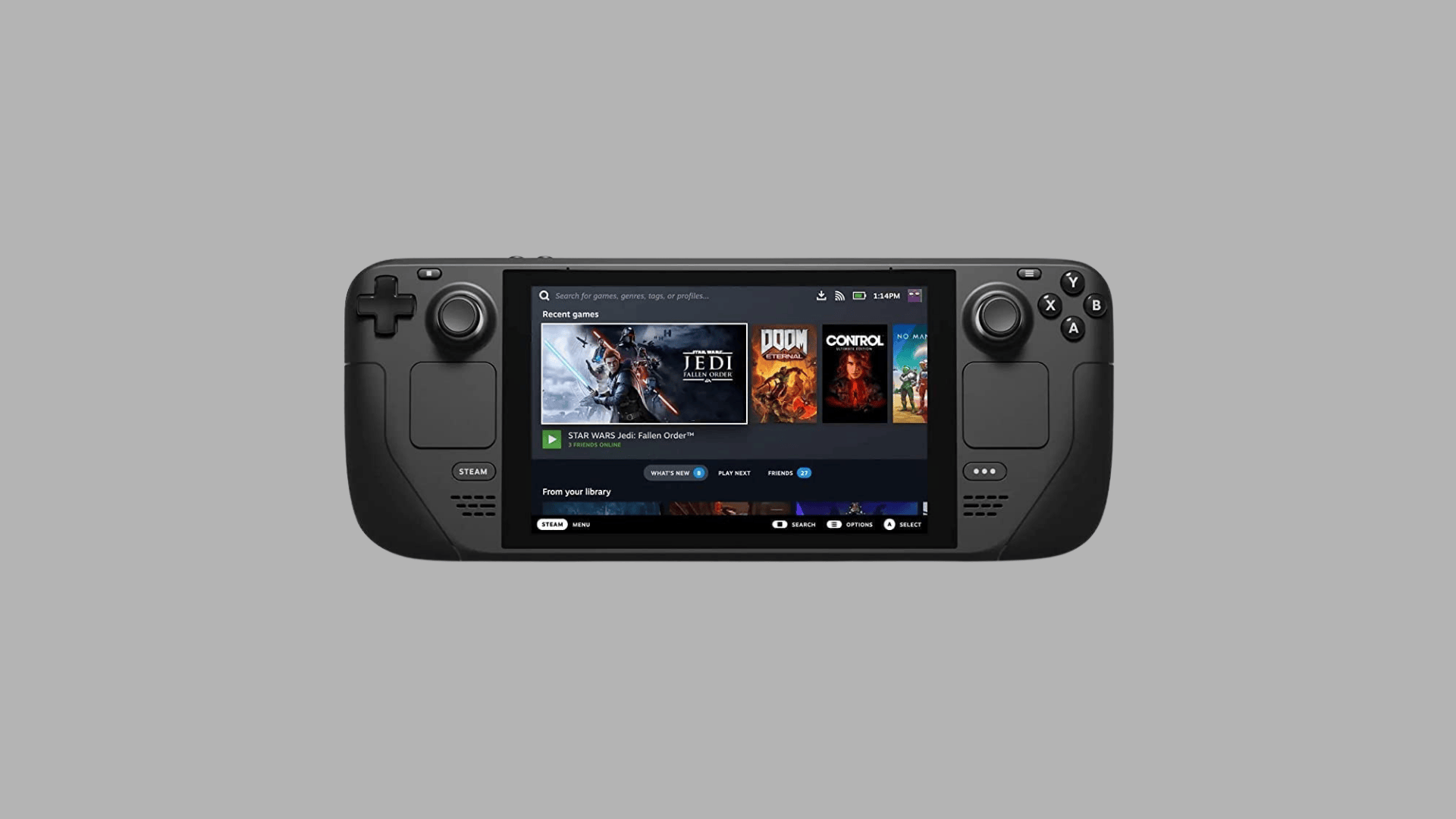
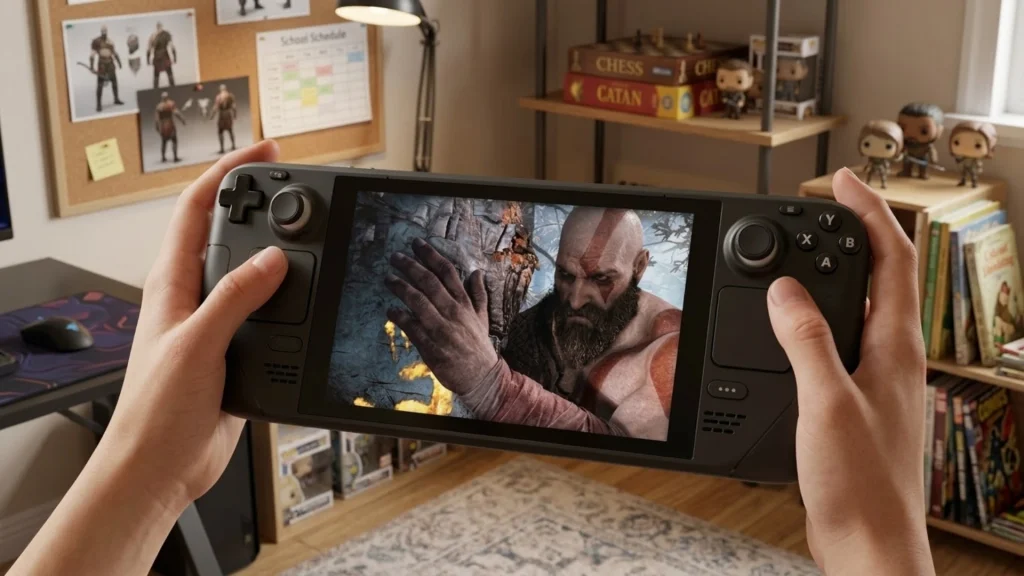
The Steam Deck has a large handheld design compared to most portable consoles.
The LCD model weighs around 640 grams; the OLED trims that to 608 grams, still heavier than the Nintendo Switch at approximately 275 grams in handheld mode, but the curved grips on both sides distribute the weight well across extended sessions.
Completing the setup with a good gaming headset can make those extended sessions even more immersive.
The button layout feels familiar to most players. It includes standard ABXY buttons, a D pad, triggers, and shoulder buttons.
Valve also added two large trackpads below the joysticks. These trackpads help when navigating menus or playing games that normally need a mouse.
A colleague of mine who travels frequently for client work eventually replaced both her Nintendo Switch and her gaming laptop with a single Steam Deck.
The OLED display is a 7.4-inch panel running at 90Hz, with deeper blacks and stronger contrast than the original LCD’s 60Hz screen.
The difference is immediately apparent in dark environments or fast-moving games.
Steam Deck: Performance and Hardware
The Steam Deck runs on a custom AMD APU built with a Zen 2 CPU and RDNA 2 graphics.
The system operates within a 15W TDP (thermal design power) envelope, a deliberate constraint that prioritizes battery efficiency over raw processing output.
In real-world gaming, this translates to a range of experiences depending on the title:
- Elden Ring / God of War: 35-45 FPS at medium settings
- Baldur’s Gate 3: 30 FPS at medium; battery ~2-3 hours
- Cyberpunk 2077: Playable at low settings with FSR upscaling enabled
- Stardew Valley / Hades / Hollow Knight: Locked 60 FPS; battery 8-10 hours
The device includes 16 GB of LPDDR5 RAM, which helps games load smoothly and keeps background tasks stable.
Storage depends on the model, with NVMe SSD options that improve loading speeds and system responsiveness. Many modern games exceed 50–100GB, so a microSD card is a near-essential addition from the start.
Thermals are managed through an internal cooling system. The fan can become noticeable during demanding games, but temperatures usually stay within safe limits during long sessions.
Steam Deck: Software Experience and SteamOS Features
The Steam Deck runs on SteamOS, a Linux-based operating system designed for handheld gaming. The interface is simple and built on the Steam library, making it easy to browse games, install titles, and adjust settings.
Navigation feels similar to using Steam on a PC, but optimized for controller use. Game compatibility is supported through Valve’s Proton layer, which allows many Windows-based games to run on Linux without major issues.
The most significant compatibility barrier is anti-cheat software. Games such as Fortnite, Destiny 2, and Battlefield 1 do not run on SteamOS due to kernel-level anti-cheat systems that are incompatible with Linux.
One notable feature is Desktop Mode, which lets the device act like a regular computer.
Users can open a full desktop environment, install software, browse the web, and even connect a keyboard and mouse
If you plan to hook it up to an external display, knowing the difference between DisplayPort vs HDMI will help you pick the right connection.
The Steam Deck also supports cloud gaming services, including Xbox Cloud Gaming and Nvidia GeForce Now, accessible through the browser in Desktop Mode.
The upgraded Wi-Fi 6E chip in the OLED model makes this significantly more reliable than on the original LCD hardware, a meaningful addition for users who want access to a broader game library beyond Steam.
Steam Deck vs Top Competitive Handheld Devices
The handheld gaming PC market looks very different in 2025 than it did when the Steam Deck launched.
Competitors, including the ASUS ROG Ally X, Lenovo Legion Go S (SteamOS version), and the ROG Xbox Ally X, now offer more raw processing power, but at a higher price and with varying levels of software maturity.
| Device | Price | OS | Key Strength | Key Weakness |
|---|---|---|---|---|
| Steam Deck OLED | $549 | SteamOS (Linux) | Best price-to-experience ratio; mature OS; large community | Older hardware; anti-cheat incompatibilities |
| ASUS ROG Ally X | ~$800 | Windows 11 | More powerful; full Windows compatibility | Windows UX on handheld form is rougher; pricier |
| Lenovo Legion Go S | ~$500 | SteamOS | Newer hardware at a competitive price | Smaller community and ecosystem than Steam Deck |
| ROG Xbox Ally X | $1,000+ | Windows 11 | Most powerful; includes Game Pass | Expensive; Windows power management on a handheld |
Steam Deck Review: What Do Major Tech Sites Say?
A Steam Deck review across major tech and gaming websites shows a balanced picture. Many reviewers praise the device for bringing PC gaming into a portable format.
1. GodisaGeek
GodisaGeek calls the OLED model a significant upgrade over the original version. The changes go beyond just the display.
Internal improvements, better battery life, and small quality-of-life updates all add up to a smoother experience.
The device feels more polished in daily use, and these upgrades make an already strong handheld feel more complete and reliable for long gaming sessions.
2. Rock Paper Shotgun
Rock Paper Shotgun strongly favors the OLED model, calling it an easy choice for anyone considering a Steam Deck.
The review points out that it directly addresses the biggest weaknesses of the original version, especially in battery life and display quality.
Along with that, the design and build feel more refined in hand. Even without next-level performance upgrades, the OLED version feels like a solid and satisfying upgrade for now.
3. GamesRadar+
GamesRadar+ highlights how the OLED model improves the overall experience through multiple refinements. The new display delivers better color and faster response times, enhancing gameplay.
Additionally, several small upgrades across the system improve usability and comfort.
These combined changes make the device feel more refined, helping the OLED version stand out as the best version of the Steam Deck available right now.
Steam Deck Review: What Real Users Are Saying?
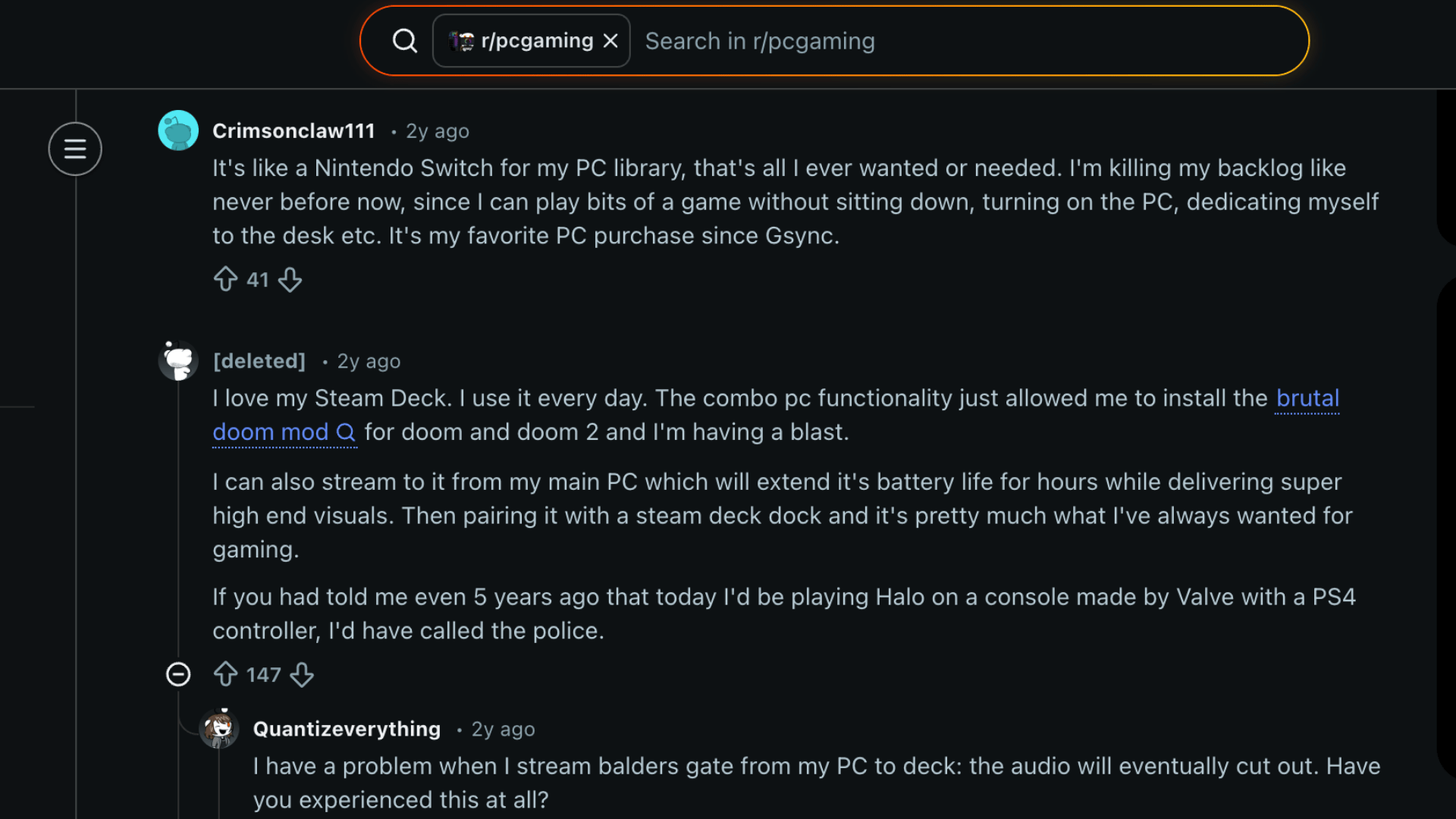
A Steam Deck review from Reddit users shows how the device fits into different gaming habits and lifestyles.
Many players enjoy the flexibility and comfort the handheld offers, though the experience depends on how often they need portable gaming.
Several users say the Steam Deck becomes part of their daily routine. One player mentioned using it every day and enjoying the PC like features that allow installing mods, such as the Brutal Doom mod for Doom and Doom 2.
Others appreciate the hardware but admit they do not use it as much if they already spend most of their time at a desktop setup.
Comfort is another common highlight in many Steam Deck review discussions. Some players prefer using it on the couch or in bed instead of a laptop.
Another user said the sleep feature makes it easy to pause games instantly, which helps when gaming around family or with a busy schedule.
Steam Deck Review: IGN Insights & Performance Breakdown
This Steam Deck review, based on IGN’s beow video, highlights both the strengths and the trade-offs of the device in real use.
The handheld delivers strong performance when everything works as expected. Games like God of War, Elden Ring, and GTA 5 run well, and the device feels powerful for its size.
The controls, screen, and overall build make it enjoyable for long sessions, and the experience is always very smooth.
Many popular games still face a few compatibility issues with SteamOS, and installing Windows brings its own limitations. Battery life can drop quickly in demanding games, sometimes under two hours.
The fan noise and longer loading times also stand out. While the device shows great potential, it still feels like a work in progress in some areas.
Steam Deck Review: Key Strengths and Limitations Explained
This Steam Deck review section highlights the main advantages and drawbacks, helping readers understand where the device performs well and where it struggles in real use.
| Strengths of the Steam Deck | Limitations of the Steam Deck |
|---|---|
| A portable PC gaming experience that allows full Steam access anywhere | The battery drains quickly in high-performance or AAA games |
| Access to a large Steam library, including indie and older titles | Heavier than most handheld consoles, which may affect long sessions |
| Strong customization options with mod support and settings control | Some popular games still face compatibility or anti-cheat issues |
| Functions like a mini PC with desktop mode and software flexibility | Storage fills up fast, especially with large modern games |
| Good value compared to other handheld gaming PCs in the same category | Fan noise and heat can become noticeable during extended gameplay |
Who Should Buy the Steam Deck?
This section explains the type of users who will benefit the most from the Steam Deck based on usage habits, gaming preferences, and portability needs.
- PC gamers: Those who already own a Steam library and want to play their games away from a desk without losing progress or features
- Indie game fans: Players who enjoy smaller titles that run smoothly and offer better battery performance on the device
- Frequent travelers: People who need a portable gaming option for long trips, flights, or daily commutes
- Casual couch players: Users who prefer playing in bed or on a sofa instead of sitting at a full gaming setup
- Portable Steam access seekers: Anyone who wants quick and flexible access to their Steam games without relying on a traditional PC setup
Who Should Look Elsewhere
- Multiplayer-first gamers: If Fortnite, Destiny 2, or other live-service titles with kernel-level anti-cheat are your primary games, the Steam Deck will not run them on SteamOS.
- Current-gen performance chasers: If playing the latest AAA releases at acceptable settings is the priority, the Steam Deck’s 2022 hardware will disappoint. A ROG Ally X or Legion Go 2 is better suited here.
- Game Pass subscribers: Microsoft’s Game Pass is not natively supported on SteamOS. Access via Xbox Cloud Gaming is possible in the browser, but it requires a workaround and isn’t seamless.
- Console-simplicity seekers: Unlike a PlayStation or Nintendo Switch, the Steam Deck occasionally requires light troubleshooting.
Conclusion
The Steam Deck stands out as a unique handheld that brings PC gaming into a portable space without losing too much of its core experience.
After time with both the LCD and OLED models, the recommendation is clear: the OLED version addresses the original’s most meaningful weaknesses, battery life, display quality, and fan noise, without raising the price significantly.
It performs well in many games, offers strong flexibility, and gives access to a large library, but it is not without trade-offs.
In this Steam Deck review, it is clear that the device works best for players who already have a Steam library and want to play beyond a desk setup.
It fits well for casual sessions, indie games, and relaxed gaming at home or while traveling, but may not suit those expecting a smooth console-like experience.
Do you think portable PC gaming is worth these compromises? Share your thoughts and experience in the comments below.