
Growth should strengthen systems, not overwhelm them. As organizations expand, workflow complexity, data volume, and system integrations increase rapidly.
Enterprise mobile app development meets demands with secure, scalable, API-driven applications designed for high concurrency and connectivity with ERP and CRM platforms.
Development follows structured processes including requirement analysis, microservices architecture, containerized deployment, and continuous integration and delivery pipelines.
Security frameworks like RBAC, OAuth 2.0, and end-to-end encryption safeguard enterprise data, while cloud infrastructure and distributed systems ensure availability and performance.
Advancements in AI automation, low-code platforms, and edge computing are further shaping enterprise mobility.
Enterprise mobile applications now serve as core operational systems, supporting productivity, system interoperability, and data-driven decision-making across large organizations.
Understanding Enterprise App Development
Enterprise application development focuses on creating software that supports the daily operations, workflows, and data needs of large businesses.
When you look at how these applications work, you can see that they manage important tasks across different teams, so they must be secure, stable, and capable of handling heavy use.
These apps also connect with systems you may already use, such as CRMs, ERPs, and databases. This helps keep everything organized in one place, which makes daily work easier to manage.
This type of development also ties directly into enterprise mobile app development.
With mobile access, your team can use tools and view data on their phones, helping them work faster, stay up to date, and move through tasks without being tied to a desk.
Key Steps in Enterprise Application Development
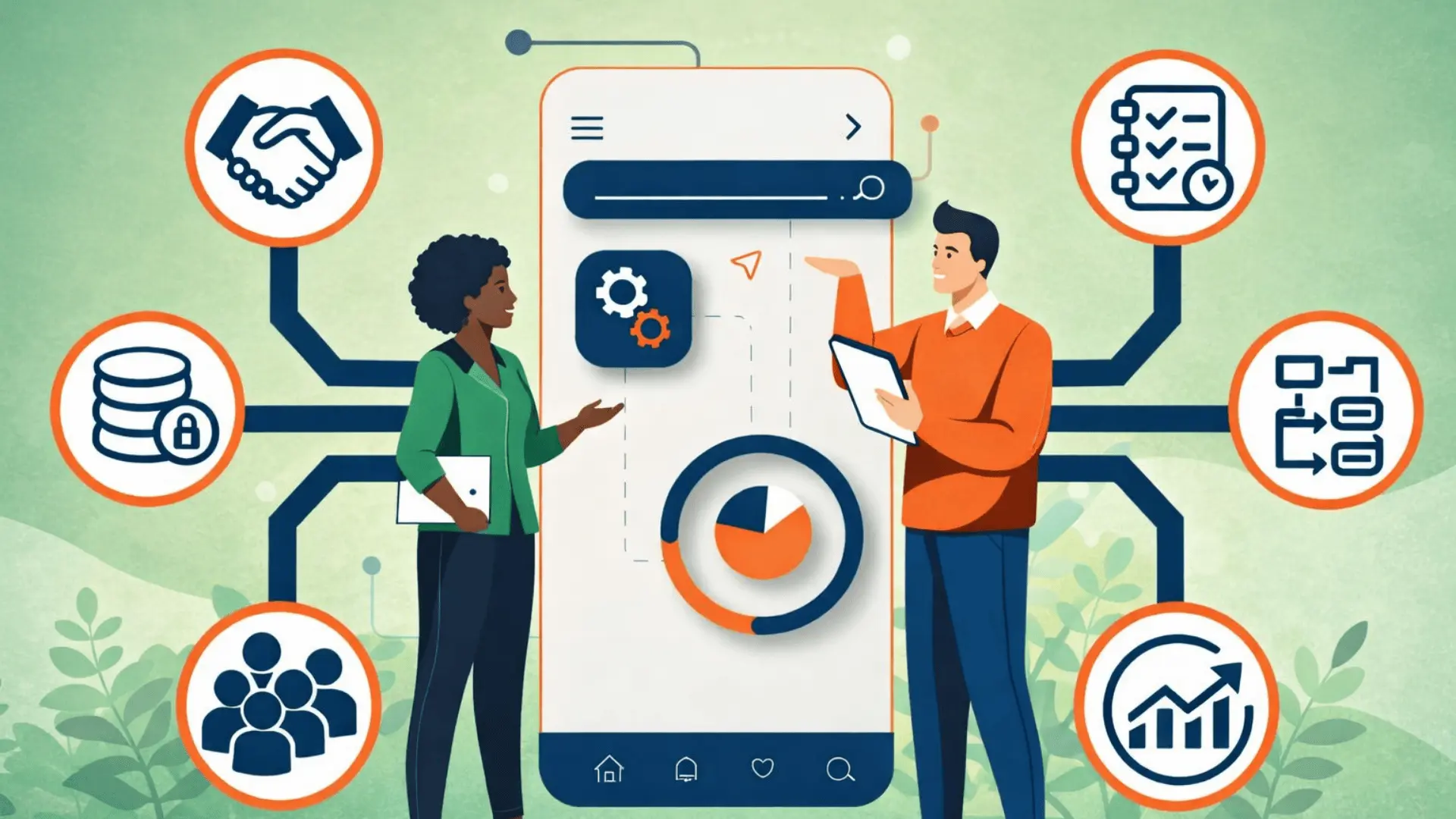
Enterprise mobile app development follows a structured Software Development Life Cycle (SDLC). Each phase directly impacts performance, maintainability, and long-term operational efficiency.
1. Business Requirement Analysis (BRA)
This phase defines functional requirements (FRs) and non-functional requirements (NFRs) through stakeholder interviews, workflow mapping, and gap analysis.
Teams document user stories, system constraints, SLA expectations, compliance mandates (GDPR, HIPAA), and performance benchmarks.
Deliverables include a Requirement Specification Document (RSD) and a feasibility assessment to reduce scope creep and architectural rework.
2. System Architecture & Technical Design
Architects define the application architecture model (monolithic or microservices), the database structure (SQL vs. NoSQL), and the API design strategy (REST vs. GraphQL).
This stage includes planning for Role-Based Access Control (RBAC), OAuth 2.0 authentication, load balancing, horizontal scaling, caching layers (Redis), and container orchestration (Docker, Kubernetes).
The outcome is a High-Level Design (HLD) and Low-Level Design (LLD) blueprint.
3. UI/UX & Access Layer Engineering
Design focuses on role-driven dashboards, workflow-automation logic, and data-visualization modules.
Enterprise systems implement multi-role access layers, adaptive layouts, and mechanisms for offline data synchronization.
Wireframes evolve into interactive prototypes, which are validated through usability testing before development begins.
4. Backend Development & System Integration
Engineers develop microservices, API endpoints, business logic layers, and middleware connectors.
Integration includes ERP platforms (SAP), CRM systems (Salesforce), payment gateways, and legacy databases via secure API gateways.
Infrastructure incorporates message brokers (Kafka), distributed caching, and asynchronous processing pipelines to support high concurrency and real-time data exchange.
5. Quality Assurance & Security Validation
Quality Assurance includes unit, integration, regression, load (JMeter), and stress testing to validate performance under high concurrency.
Security validation covers penetration testing, vulnerability scanning (OWASP), SAST/DAST analysis, and API security testing.
In emerging contexts, enterprises are evaluating post-quantum cryptography (PQC) using NIST-recommended quantum-resistant algorithms to prepare for future quantum computing threats and strengthen long-term cryptographic resilience.
6. CI/CD Deployment & Release Management
Deployment uses CI/CD pipelines (Jenkins, GitHub Actions) for automated build, test, and release cycles.
Applications are containerized with Docker and deployed to Kubernetes clusters using Blue-Green or Canary deployment strategies to minimize downtime.
Infrastructure may run on AWS EC2, Azure Kubernetes Service, or hybrid cloud environments.
7. Monitoring, Maintenance & Optimization
Post-deployment support includes Application Performance Monitoring (APM), log aggregation, real-time alerting, and incident response protocols.
Ongoing tasks involve version upgrades, security patch management, performance tuning, and infrastructure scaling adjustments.
Continuous monitoring ensures system stability, SLA compliance, and long-term operational resilience.
Common Enterprise Development Methods
Enterprise software projects rely on structured development methodologies to maintain project control, ensure consistent quality, and deliver applications efficiently within defined timelines.
- Agile: An iterative sprint-based method enabling adaptive planning, regular feedback, and continuous feature releases for changing business requirements.
- DevOps: Integrates development and operations using CI/CD pipelines, automation, and monitoring to improve deployment speed and system reliability.
- Waterfall: Sequential model with clearly defined phases, strong documentation, and fixed requirements suitable for structured enterprise projects.
- Lean Development: Focuses on reducing waste, improving efficiency, and delivering business value through optimized development processes.
- Scrum: Agile framework using short sprints, defined roles, and regular reviews to improve collaboration and accelerate delivery.
Technologies Behind Enterprise Mobile App Development

Enterprise apps rely on strong technologies that handle data, support security, and connect with systems across the company. These tools help developers build reliable applications that work well at scale.
1. Backend Technologies
Backend technologies power the core functions of an enterprise app. Languages like Java, .NET, Python, andNode.js process data, manage workflows, and support integrations with other systems.
These tools help the app run smoothly behind the scenes and safely handle large amounts of information.
A strong backend ensures stability, security, and scalability, which are key needs for enterprise mobile app development. It also supports future updates without breaking existing features.
2. Mobile Technologies
Mobile technologies bring enterprise apps to smartphones and tablets so employees can work from anywhere.
Developers choose between native tools such as Swift and Kotlin and cross-platform options such as FlutterandReact Native. These technologies help create fast, responsive apps that match company needs.
Mobile tools also allow teams to build features that work offline or sync automatically. Choosing the right mobile approach improves user experience and helps teams stay productive on the go.
3. Cloud Services
Cloud services give enterprise apps the storage, speed, and flexibility needed to support large-scale operations.
Platforms such as AWS, Azure, and Google Cloud help companies manage data securely while keeping the app accessible from different locations.
Cloud tools also support backups, real-time updates, and easy scaling when user demand grows.
This makes cloud services a strong fit for enterprise mobile app development, especially when businesses need reliability without managing physical servers.
4. Security Tools
Security tools protect sensitive business data and keep the app safe from threats. Developers use encryption, identity management systems, and mobile device management tools to secure access.
These protections help control who can view or edit information inside the app. Security tools also monitor unusual activity and ensure the app meets industry standards.
Strong security is essential in enterprise environments because it protects company data while enabling teams to work confidently.
Cost of Enterprise Mobile App Development

Enterprise mobile app development typically costs between $50,000 and $200,000+ USD, depending on complexity, integrations, security standards, and deployment model.
Applications built on microservices architecture, API gateways, real-time data processing, and high-availability clusters require higher investment than monolithic systems.
Integration with ERP platforms like SAP, CRM systems such as Salesforce, and legacy databases increases engineering and testing effort.
Security layers, including AES-256 encryption, OAuth 2.0, RBAC, and GDPR or HIPAA compliance, further raise costs.
Geographic location also impacts pricing, with development in regions like India generally costing less than in the US or Western Europe.
Team composition, including architects, developers, DevOps, and QA engineers, plus cloud infrastructure expenses, significantly influences the overall budget.
Challenges in Enterprise Application Development
Enterprise mobile app development presents technical and operational challenges that directly impact performance, security posture, and system interoperability.
- Legacy System Integration: Connecting older ERP systems, databases, and infrastructure is difficult due to missing APIs, incompatible data formats, and security limitations.
- Data Privacy and Compliance: Enterprise apps must meet regulations like GDPR and HIPAA through encryption, access control, and continuous security monitoring.
- Scalability Issues: Applications must handle growing users, high concurrency, and heavy data loads without causing latency or system downtime.
- App Distribution and BYOD Policies: Managing deployment across private stores and employee devices creates security risks and device compatibility challenges.
Trends Shaping Enterprise Mobile App Development
Modern enterprise systems are evolving through automation, faster deployment models, and distributed computing frameworks.
- AI and Machine Learning Integration: AI-powered analytics, predictive modeling, and intelligent automation improve decision-making and streamline enterprise workflows.
- Low-Code and No-Code Platforms: Visual development environments and reusable components accelerate deployment cycles and reduce engineering effort.
- Edge Computing: Distributed edge nodes process data closer to the source, reducing latency and improving real-time performance.
- Enhanced Cybersecurity Focus: Zero-trust architecture, identity and access management, and multi-factor authentication strengthen data protection in enterprise mobile app development.
Pros and Cons: Enterprise App Development
The following technologies form the technical foundation of enterprise mobile app development, each offering distinct advantages and trade-offs for scalability, performance, and cost.
| Category | Technology | Pros | Cons |
|---|---|---|---|
| Backend | Java / .NET | Scalable, stable, secure | Higher cost, complex setup |
| Backend | Node.js | Fast, real-time support | Needs tuning at scale |
| Mobile | Swift / Kotlin (Native) | High performance | Separate codebases |
| Mobile | Flutter / React Native | Shared codebase, faster dev | Limited deep customization |
| Cloud | AWS / Azure / GCP | Scalable, reliable | Ongoing infrastructure cost |
Best Practices for Successful Enterprise Apps
Enterprise apps perform best when built with clear planning, strong security, scalable architecture, continuous testing, and reliable post launch maintenance.
- Clear Requirements: Define business goals, user roles, and workflows early to ensure the application supports operational needs and prevents confusion during development.
- Strong Security Measures: Implement encryption, access control, authentication systems, and regular security testing to protect sensitive enterprise data.
- Scalable Architecture: Design systems that support increasing users, growing data volumes, and future integrations without performance issues.
- Continuous Testing: Perform regular testing during development to identify bugs early and maintain stable system performance.
- Ongoing Maintenance: Provide updates, monitoring, and technical support after deployment to keep the application stable and aligned with business needs.
Conclusion
Enterprise mobile app development requires a structured approach built on scalable architecture, secure infrastructure, and strong system integration.
Successful projects depend on clear requirement analysis, reliable development frameworks, secure APIs, and efficient CI/CD deployment pipelines.
Organizations must also account for ERP and CRM integration, regulatory compliance, infrastructure planning, and long-term maintenance.
Technologies such as AI automation, low-code platforms, edge computing, and advanced security frameworks are further improving scalability, performance, and operational efficiency.
When implemented with proper planning and technical governance, enterprise mobile applications provide stable platforms that support enterprise operations and data-driven decision-making.
What challenges have you faced while building enterprise mobile apps? Share your thoughts in the comments below.