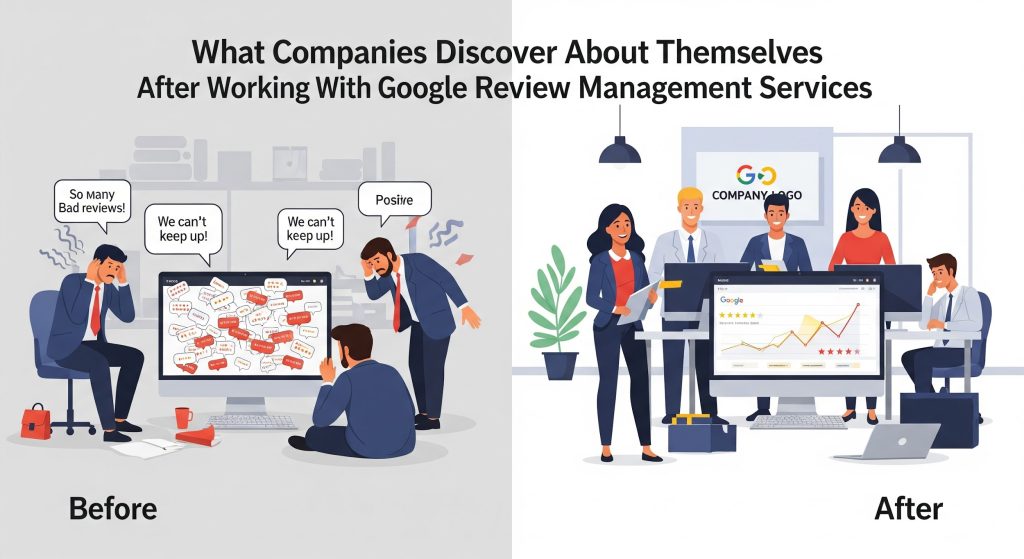
Most companies think they understand how customers experience them. They have surveys, internal reports, and confident assumptions built over years of operating the business.
Then they take Google review management seriously.
Not casually reading reviews. Not responding when something blows up. But actually working with Google review management services that audit patterns, timing, sentiment, and visibility over time.
That’s when the surprises start.
The First Realization: You Don’t Hear From Most Customers at All
One of the earliest discoveries companies make is that their feedback is really incomplete.
Before structured Google review management services are in place, most feedback comes from extremes. The happiest customers. The angriest ones. Everyone else disappears quietly.
When reviews are systematically audited, a pattern emerges: large groups of customers rarely leave feedback, especially after mediocre or slightly disappointing experiences. These “silent customers” don’t complain. They just don’t come back.
Companies often assume silence equals satisfaction. Review data quickly disproves that.
Once feedback collection improves—through better follow-ups, review prompts, and timing—businesses realize how much experience data they were missing, and how many issues had gone unnoticed simply because no one had said anything out loud.
The Second Realization: A Good Average Rating Can Hide Real Problems
Many companies enter Google review management believing their star rating tells the whole story.
Then, sentiment analysis tells a different one.
A 4.2 rating might look healthy, but when reviews are analyzed at scale, recurring complaints surface: response delays, inconsistency between staff, pricing confusion, and rushed service during peak hours.
What surprises leadership isn’t the criticism itself. It’s how consistent the criticism is.
Working with Google review management services reveals that customers aren’t randomly unhappy. They’re reacting to the same friction points over and over. Those points just never showed up clearly when reviews were skimmed individually.
This is often where companies realize reputation isn’t just a marketing issue. It’s an operational one.
The Third Realization: Customers Experience Different Versions of the Same Business
One of the most uncomfortable discoveries comes when companies see how uneven their experience actually is.
Reviews don’t describe “the business” as a single entity. They describe moments. Shifts. Employees. Locations. Timeframes.
Some customers describe professionalism and care. Others describe confusion and indifference. Both are accurate.
Google review management services make this contrast impossible to ignore by mapping feedback to timing, locations, and behaviors. Patterns emerge that leadership never sees from the inside.
This is where many organizations stop asking, “How do we get better reviews?” and start asking, “Why are we showing up so differently depending on when and how someone interacts with us?”
That question changes everything.
The Fourth Realization: Internal Assumptions Don’t Match External Reality
Another insight companies frequently uncover is how far internal narratives drift from customer reality.
Internally, teams believe they communicate clearly. Reviews say otherwise.
Internally, leaders believe policies are fair. Reviews reveal confusion and resentment.
Internally, staff believe they’re responsive. Reviews show long gaps and missed follow-ups.
This disconnect isn’t malicious. It’s structural.
When companies work with experienced providers like NetReputation, the value isn’t just responding to Google reviews. It’s translating review patterns into operational insight—connecting what customers say publicly with what’s happening privately inside the business.
That translation is where real change begins.
The Fifth Realization: Competitors Are Beating You in Ways You Didn’t Notice
Google review management services don’t just analyze your reviews. They analyze your market.
Companies often discover they overestimated their competitive position. A rival with fewer locations may dominate visibility because its reviews are more recent, more consistent, and more engaged with.
It’s not that competitors are perfect. It’s that they feel predictable.
Seeing side-by-side review data forces an uncomfortable but productive comparison. Businesses learn that trust is built less on perfection and more on reliability—and Google rewards the latter.
The Sixth Realization: Reviews Reveal Growth Opportunities, Not Just Problems
Not all discoveries are negative.
Once companies start analyzing positive reviews with the same rigor as negative ones, opportunities emerge. Customers repeatedly praise things the business never thought to promote, package, or expand.
Certain employees become unofficial brand ambassadors. Specific services generate disproportionate loyalty. Small operational details drive outsized satisfaction.
Google review management services turn this praise into a strategy. What customers love becomes something the business can intentionally scale rather than accidentally deliver.
This is often where review management shifts from defensive to strategic.
The Final Realization: Reputation Is a Leadership Responsibility
The most profound change happens at the leadership level.
When executives see unfiltered review dashboards, sentiment trends, and the impact on visibility laid out clearly, reputation stops being “something marketing handles.” It becomes a core business metric.
Leaders start tracking response time, consistency, and customer trust alongside revenue. Review responses get executive oversight. Operational changes are prioritized based on customer impact, not internal convenience.
In many companies, this marks a cultural shift. Reputation is no longer about optics. It’s about alignment.
What Companies Ultimately Learn
Working with Google review management services doesn’t just improve online ratings; it also helps businesses build trust and credibility. It forces companies to see themselves the way customers already do.
It reveals where silence hides dissatisfaction.
Where averages hide inconsistency.
Where internal confidence hides external confusion.
And for companies willing to listen, those discoveries don’t just protect reputation. They reshape how the business operates, competes, and grows.